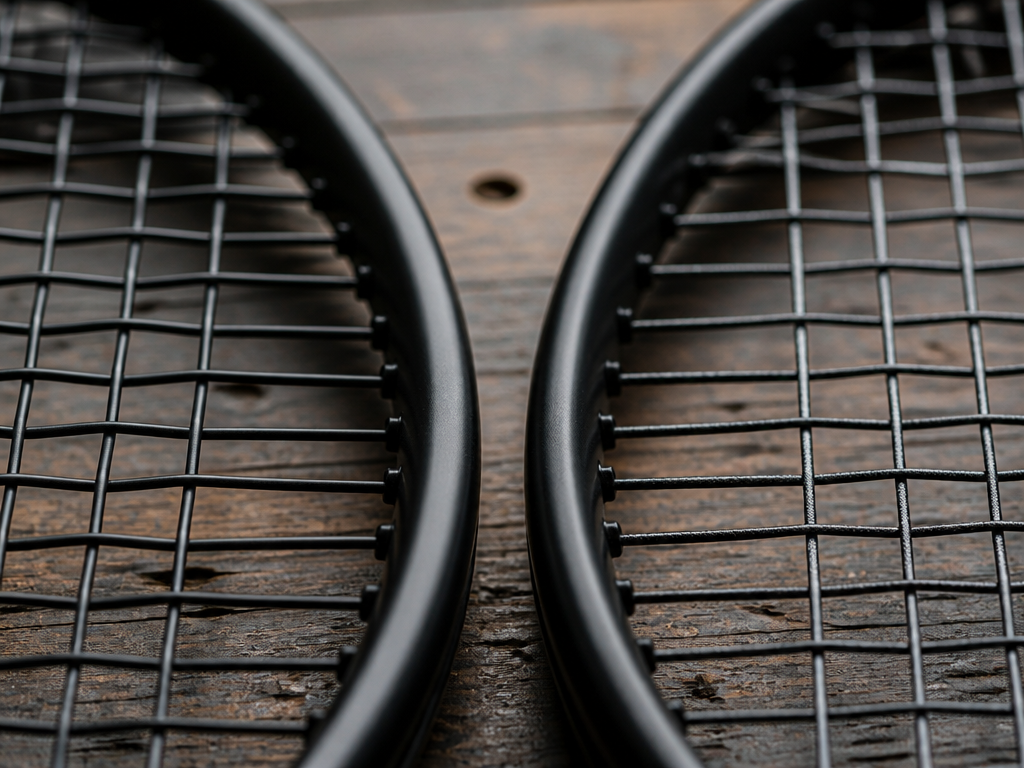
Two Tecnifibre co-polyesters sit at nearly the same price, in the same drawer at the same shop, wearing nearly the same promise. Black Code has five sides. Razor Code has four. Both are sold to players who want to hit heavy, and if you are shopping tennis strings on spin claims alone, the two product pages will do almost nothing to separate them. So we read the published specs, the manufacturer's own language, the independent research on how a string bed actually generates spin, and the accumulated consensus of tester and owner reviews. The honest answer is not the one the packaging implies.
The verdict, in one sentence: Razor Code is the firmer, lower-launching, more control-biased of the two and suits a player who already swings fast and long, while Black Code is the more forgiving one with the better reputation for holding tension — and the spin gap between them is far smaller than the pentagon-versus-square framing suggests.
How we evaluated
We did not string these up and hit with them. This is a synthesis, and you deserve to know its ingredients before deciding how much weight to give the conclusion.
Four source classes, weighted in roughly this order:
- Published specs and Tecnifibre's own product pages (tecnifibre.com), for cross-section profile, gauge availability, and the technology names the company attaches to each string. Manufacturer material is reliable for geometry and gauge and close to worthless as evidence of performance.
- Independent string research, chiefly the string-movement and spin experiments associated with Tennis Warehouse University and the work of Crawford Lindsey and Rod Cross, which reframed how the sport understands spin generation. We weight this most heavily, especially where it contradicts marketing.
- Named tester reviews from retail and enthusiast playtest programmes. These are directional and usually candid about feel and durability, but they are rarely instrumented, essentially never blinded, and almost always run at a tension and in a frame that isn't yours.
- Aggregate owner reviews, which are noisy one at a time but useful in bulk for one thing specifically: failure modes. When several hundred people independently describe the same tension drop or the same notching pattern, that is signal.
Where those four disagree, we say so. Where a number exists only in marketing copy, we label it as marketing copy. And where we could not verify a figure at the gauge you would actually buy — which is more often than we would like — we tell you to look it up rather than repeat something we cannot stand behind.
The two strings on paper
| Black Code | Razor Code | |
|---|---|---|
| Profile | Pentagonal, five-sided | Square, four-sided |
| Marketed technology | A thermal-core treatment Tecnifibre calls Thermocore | High-modulus co-polyester construction |
| Typical gauges | Roughly 1.18 / 1.24 / 1.28 mm, market-dependent | Roughly 1.20 / 1.25 / 1.30 mm, market-dependent |
| Company positioning | Spin with a rounder, more forgiving response | Spin with a firmer, more precise response |
| Consensus in reviews | Comparatively good tension maintenance; the more comfortable of the two | Crisper and more controlled; the harsher of the two on the arm |
| Sibling in the family | Black Code 4S — a square version of the same string | Razor Soft — a softer version of the same string |
One caution on that gauge row. Tecnifibre rotates gauge and colourway availability by market and by model year, and the thinnest options in particular come and go. Check the current product page for your region before you order, and treat any gauge chart you find on a third-party blog — including the one above — as approximate.
Notice the last row, because it quietly undermines the whole premise of the comparison. Black Code has a square sibling. Razor Code has a soft sibling. If shape alone determined performance, Tecnifibre would not need to sell a square Black Code, and if construction alone determined it, Razor Soft would not exist. The company's own catalogue is telling you that shape and stiffness are two separate dials.
What most people do
Most players shopping this decision run a three-step heuristic, and all three steps are shakier than they look.
Step one: more edges means more spin. The reasoning is intuitive — a sharp corner bites the ball, a round string slips. It is the single most common thing said about shaped polyester, it is repeated in nearly every retail description, and it is at best a small part of the story. Under this logic, square Razor Code should out-spin pentagonal Black Code by a clear margin, and the choice would be trivial.
Step two: buy the thickest version, because polyester breaks. Players who have snapped a set mid-match reach for 1.30 mm and stop thinking about it. This is rational for the wallet and quietly expensive for the shot, and it usually cancels out whatever spin advantage the shape was supposed to deliver.

Step three: copy a tension from someone else's spec sheet. A tour player's published tension, a forum post, a number the shop used last time. Two co-polys strung at the same number in different frames are not comparable, and the same string at 48 lb and 54 lb behaves more differently than two rival strings at the same tension.
There is a fourth habit worth naming: playing a poly set until it breaks. Polyester is the one string category where breakage is a poor signal to restring, and we will come back to why in a moment.
None of this makes people foolish. It makes them reasonable in the absence of good comparative data, which the manufacturers have not given them. But it does mean the Black Code versus Razor Code question, as usually asked, is being decided on the least informative variable available.
What the evidence suggests
Spin comes from snapback, not sharpness
The most useful finding in modern string research is also the least intuitive. In the string-movement experiments carried out by Lindsey and Cross under the Tennis Warehouse University programme, the main strings slide sideways under an angled impact and then snap back toward their original position while the ball is still on the string bed. That return is what adds spin. The dominant variable is not how sharp the string's edges are — it is how freely the mains slide against the crosses, which is to say the friction between the strings themselves.
The consequence is awkward for shaped-string marketing. In that body of work, slick round strings frequently measured as much spin potential as textured or shaped ones, and sometimes more, because low inter-string friction let them snap back more completely. A sharp profile does bite the ball, and it also digs into the crosses, which is the opposite of what you want for snapback.
So the pentagonal-versus-square distinction is real, but it is not a spin dial with a clean direction. Square edges plausibly give slightly more initial bite and slightly worse long-run string movement. Pentagonal edges split the difference. Neither geometry overrides the far larger factors of swing speed, racquet head speed at contact, and how fresh the bed is.
High modulus describes something; Thermocore mostly names something
"High modulus" is a real material property. Modulus is stiffness — resistance to elongation under load — and a higher-modulus polyester stretches less at a given tension. That has predictable downstream effects: less dwell time, a lower launch angle, more perceived control for a player who swings hard enough to still generate depth, and more shock transmitted to the hand. Every tester and owner description of Razor Code we read is consistent with a stiffer string, and that consistency is worth something.
"Thermocore" is different. It is Tecnifibre's proprietary term for a treatment of the string's core, and we could not find an independent characterisation of what the process changes at the polymer level or what it measurably does to stiffness or tension retention. That is not an accusation — most string technology names are in the same position, from every brand. It is a caution: treat it as a brand name for a manufacturing choice, not as a spec. When a tester writes that Black Code feels softer, that observation may be entirely accurate and still have nothing to do with the word Thermocore.
The practical translation: Razor Code is understood as the stiffer, more control-biased string, and Black Code as the more forgiving one. That difference is better attested than the spin difference, because stiffness has a real physical definition and reviewers converge on it.
Tension loss is the great equalizer
Every co-polyester loses tension fast, and most of the loss happens in the first day, much of it in the first hour. This is the least disputed fact in string testing and the most ignored one in string shopping. It means the string in your frame on Thursday is not the string the tester reviewed on the day they strung it.
Black Code carries the better reputation for tension maintenance among the two, and that reputation appears consistently across owner reviews rather than in one place. We would still call it a reputation rather than a measurement, because the tests behind it are not standardised across sources and the difference between two co-polys in the same family is generally smaller than the difference stringing two pounds apart makes.
The more important consequence is about when to restring. A polyester bed goes dead well before it snaps. As the mains notch into the crosses, friction rises, snapback degrades, and the spin you bought the shaped string for quietly leaves — while the string is still perfectly intact. Playing poly until it breaks means spending most of its life on a string bed that has already stopped doing the one job you chose it for.
Gauge moves the needle more than the model does
If you drop from 1.30 mm to 1.25 mm, you change dwell, bite, string movement, comfort and durability all at once, and by more than switching between two co-polys in the same family at the same gauge will change any of them. Thinner strings move and snap back more freely and generally register higher spin potential; they also break sooner and lose tension no more kindly.

This is the finding that reorganises the whole comparison. The question is not really Black Code or Razor Code. It is: how thin can you go before you are restringing more often than you are willing to pay for?
What I actually do
A note from one editor, in the first person, because the rest of this piece is the desk's collective reading and this part is a personal decision procedure. To be explicit: what follows is how I make the call from the evidence above, not a report of anything I measured on court.
I stop treating the model as the primary decision. I pick the stiffness bias first — do I want more control and less launch, or more forgiveness and a softer impact? That answer selects Razor Code or Black Code in about ten seconds, and it is the only part of the choice the evidence supports making confidently.
Then I pick the thinnest gauge I can afford to break. Not the thinnest available; the thinnest that fits my restringing budget. If that means 1.25 rather than 1.20, so be it — a thin string I ration is worse than a slightly thicker one I replace on schedule.
I buy a single set, never a reel, until I've lived with it. A reel is a bet on a string you have used for one afternoon, and it is the most common way players end up committed to something they never actually liked.
I write the stringing date on the frame in marker and restring on a rough hour count rather than on breakage — for a hard swinger, that is often somewhere in the region of ten to fifteen hours, adjusted by how quickly your own bed starts feeling boardy. This is the change that does more for spin than any shape argument in this article.
And I change one variable at a time. New string and new tension in the same restring tells you nothing about which one you liked.
Who each string is for, and who should skip both
Razor Code fits the player with a long, fast swing who is losing balls long rather than into the net, wants a lower launch angle, and has no history of elbow or shoulder trouble. If you already generate your own pace and want the string bed to stop adding to it, the stiffer, more control-biased option is the right tool.
Black Code fits the intermediate-to-advanced player stepping into full polyester for the first time, or moving down from a stiffer poly, who wants the spin-friendly shaped profile without the harshest version of the co-poly bargain — and who values a string bed that holds its character for a few sessions longer.
Black Code 4S is worth a look if you have read this far and still want the square profile with the family's more forgiving reputation. It is the obvious hedge, and it is oddly absent from most versus-comparisons.
Skip both if your elbow or shoulder hurts. No full polyester bed is arm-friendly, and choosing between two co-polys on comfort is choosing between degrees of the same problem. A multifilament, or a gut-and-poly hybrid with the gut in the mains, is a genuinely different answer rather than a softer version of the same one. Skip both, too, if you break a set inside three hours — at that rate you are subsidising a string that will be dead before it snaps, and a durability-first poly in a thicker gauge is the economical choice even at a small cost in feel.
The verdict, and how confident we are
If you want one line to screenshot: choose Razor Code for control and a lower launch, Black Code for comfort and staying power, and expect the spin difference between them to be small enough that restringing on schedule will out-perform whichever one you pick.
We owe you grades rather than confidence for its own sake.
- Central claim — that the square profile delivers meaningfully more spin than the pentagonal one: Weak. The independent snapback research undercuts the mechanism the claim rests on, and we found no standardised head-to-head measurement at matched gauge and tension.
- Supporting claim — that Razor Code is the stiffer, more control-biased string and Black Code the more comfortable one: Moderate. Manufacturer positioning, the physical meaning of modulus, and independent tester consensus all point the same direction, but the evidence is descriptive rather than instrumented.
- Claim that Black Code holds tension better: Unclear. Widely repeated in owner reviews, not something we can attribute to a controlled comparison.
The uncomfortable finding is that a reader agonising between these two is optimising a variable the evidence barely supports, while the variables that do matter — gauge, tension, and the age of the bed — sit unexamined.
So, tonight's rule of thumb: if your current set is notched and grooved but not broken, your spin problem is a dead-string problem rather than a model problem — restring what you already have before you buy either of these.