- That is the number doing most of the work on the spec sheet of nearly every tennis backpack sold between roughly $80 and $200, and it is the number this product review is actually about. 600D polyester. It sits in the materials line like a grade, next to the racquet count and the colorway options, and it reads like a durability rating.
It is not one. Denier is a unit of yarn thickness. On its own it predicts close to nothing about whether a bag survives two winters of Tuesday-and-Saturday sessions, a car boot, and a wet towel that didn't get taken out until Wednesday.
Our verdict: denier is the least informative number printed on a tennis backpack, and the specs that actually predict survival — zipper size and brand, coating, stitching at the strap anchors, and the warranty standing behind all three — are the ones most brands leave off the page. If you are choosing between a bag that says 900D and one that says 600D, you have learned almost nothing. If one says YKK #8 and the other says nothing, you have learned something.
How we evaluated
We are a review desk, not a lab and not a test court. What follows is a synthesis, and it's worth saying exactly what went into it.
We read the published spec sheets and product pages of the major tennis bag brands and several smaller direct-to-consumer makers, looking specifically at which numbers get printed and which get omitted. We took the definition of denier and the relevant fabric test methods from textile standards, which are public and unambiguous. We read independent tester write-ups and a large volume of owner reviews at retailers, and we weighted those the way you should weight crowd data: unreliable about how often something fails, genuinely useful about where it fails, because the same four or five complaints recur across brands and price points.
One weighting rule shaped everything below. A defined unit is trustworthy about the thing it defines and nothing else. A manufacturer claim with no stated test method behind it — "thermal," "water-resistant," "heavy-duty" — gets discounted, not dismissed. We have taken no bag apart and measured nothing ourselves.
What 600D actually measures
Denier is linear mass density: the weight in grams of 9,000 metres of a yarn. A 600D yarn is one where 9,000 metres would weigh 600 grams. The unit descends from silk, where 9,000 metres of a single filament weighed about a gram — hence 1D. Higher denier means a coarser, heavier yarn.
That is the entire content of the number. It describes the thread, not the fabric, and certainly not the bag.
Which means two panels both honestly labelled 600D can differ in every respect that determines whether they last:
- Polymer. Nylon 6,6 and polyester are both spun to 600D and behave differently. The standard textile trade-off is that nylon carries higher abrasion and tear resistance per denier, while polyester holds up better under UV and absorbs less water. A 600D nylon panel and a 600D polyester panel are not comparable products, but the spec line invites you to treat the number as settling it.
- Weave. Threads per inch, and whether it's a plain weave, a dobby, or a ripstop grid. A loosely woven 600D can be beaten by a densely woven 420D.
- Coating. Most pack fabric gets a polyurethane backing, and that layer — not the denier — is where water resistance lives. Coating weight is almost never published.
- Finish. A durable water repellent treatment is a surface finish that wears off with abrasion and washing. It is not a membrane and was never meant to be.
Durability does have real measurements. Abrasion is tested by Wyzenbeek (ASTM D4157, reported in double rubs) or Martindale (ISO 12947, reported in cycles). Tear strength has the Elmendorf method, ASTM D1424. Water penetration has hydrostatic head. Outdoor and luggage brands occasionally cite these figures. We have not found a tennis bag maker that publishes any of them, and that absence is itself the finding: the industry prints the number that is easy to state and silent about the ones that would be comparable.
What the number doesn't measure
Here is the practical case against denier as a buying criterion: tennis backpacks do not usually die by wearing through a panel. Reading across owner feedback, the complaints cluster in four places, and denier governs none of them.
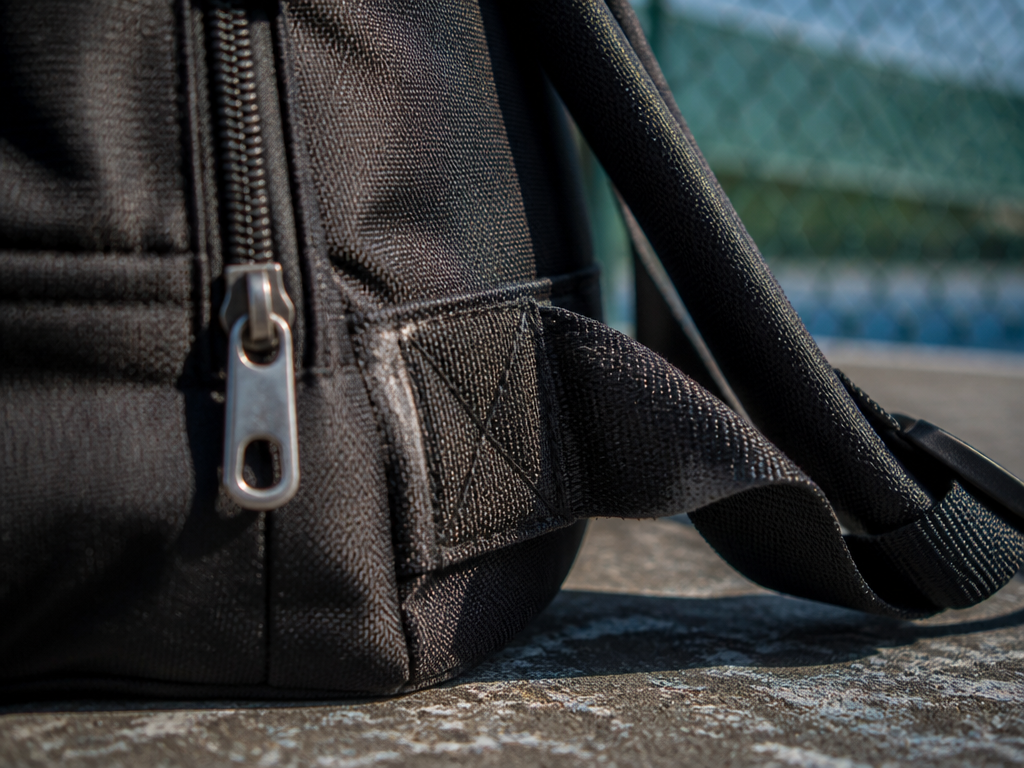
The main zipper. The single most common failure report is a slider separating on the stuffed racquet compartment. Zipper size is a published spec when a brand chooses to publish it — YKK sizes are numbered by chain width, so #5, #8, #10. A #5 coil under the load of two strung frames plus shoes is under-specified. A #8 or #10, or a chain rather than a coil, is a real upgrade, and the brands that fit good hardware tend to say so, because it costs them money.
The shoulder strap anchor. Where the strap webbing meets the body is the highest-stress seam in the bag. Bartack stitching is visible in most product photography if you zoom. A single row of straight stitch there is a countdown.
The bottom panel. This is the one place abrasion genuinely applies, and it is also where a coated or reinforced base — a different material from the body — does more than any denier bump to the main fabric.
The liner. Delamination of foil-faced insulation is a recurring complaint on bags advertising temperature control, and it is a construction issue, not a fabric-weight one.
| Spec on the page | What it actually measures | What it predicts about survival | How to verify it |
|---|---|---|---|
| 600D polyester | Yarn mass per length (g/9,000 m) | Very little on its own | Nothing to verify — ask instead about coating and weave |
| DWR / water-resistant | A surface finish is present | Short-term beading; wears off | Check whether the brand claims a coated backing too |
| Thermal compartment | Nothing standardised | Unknown; no published method | Ask for the test conditions; expect no answer |
| Holds 3 racquets | Bare frames, packed by the maker | Optimistic by roughly one frame in practice | Owner photos of a loaded bag |
| YKK #8 zipper | Chain width and manufacturer | Strong signal on the main failure point | Stated on the page, or visible on the slider |
| 2-year warranty | What the maker will pay to replace | The most honest durability claim available | Read what it excludes |
The thermal claim, specifically
Several brands sell insulated racquet compartments under proprietary names. Physically these are usually a thin metallised film over closed-cell foam. What we have not seen from any of them is an R-value, a test protocol, an ambient temperature, or a duration — the four things that would make the claim checkable.
What is uncontroversial, and agreed on by stringers and string manufacturers alike, is that co-polyester strings lose tension over time and that heat accelerates the loss. What is unverified is whether two or three millimetres of foil-faced foam meaningfully slows the temperature rise inside a car in July over an hour. That figure is manufacturer-implied, not independently measured, and we would treat the feature as a tiebreaker between two otherwise equal bags rather than a reason to pay more.
The capacity claim, specifically
A stated three-racquet capacity is measured with bare frames, no head covers, no dampeners, packed by someone who is not in a hurry in a car park. The recurring note in owner reviews is that the count assumes the main compartment holds racquets and nothing else. For a player carrying two frames, a change of clothes, and a full bottle, plan on the stated number minus one and you will not be disappointed.
Who this is for, and who it isn't
This buying frame fits you if you play once or twice a week, drive or ride to a court, and want a bag that carries two frames, shoes kept away from clean clothes, two bottles, and a wet towel that won't contaminate the rest. Prioritise, in this order: zipper size and brand, bartacked strap anchors, a genuinely separate ventilated shoe or wet pocket, a reinforced base, and a warranty of two years or more. Fabric denier is a distant sixth.
It doesn't fit you if you carry six frames to tournaments — the geometry that makes a backpack comfortable is the geometry that caps it at three, and you want a duffel or a roller. It also doesn't fit if you want a laptop bag that occasionally holds a racquet: a compartment sized for a 27-inch frame makes for a deep, awkward commuter. And if price is the only filter, this whole frame is moot, because every spec that matters here costs the manufacturer money.
The line worth screenshotting: buy the zipper and the warranty. The fabric number is marketing.
Evidence grade — Strong for the definitional claim that denier measures yarn mass and cannot by itself predict durability; that is settled textile fact, not opinion. Moderate for the failure-location claim, which rests on the consistency of owner reports across brands rather than on any published failure-rate data. Nobody has published that data, ourselves included.
So: 600. It is a real number, honestly stated, and it tells you the truth about one thread. It was never asked to tell you about a slider under load, a seam holding forty pounds of gear at a bus stop, or a company's willingness to replace the bag in month fourteen. Read it as what it is — a thread specification that migrated onto a marketing page — and the spec sheet gets quieter, shorter, and considerably more useful.