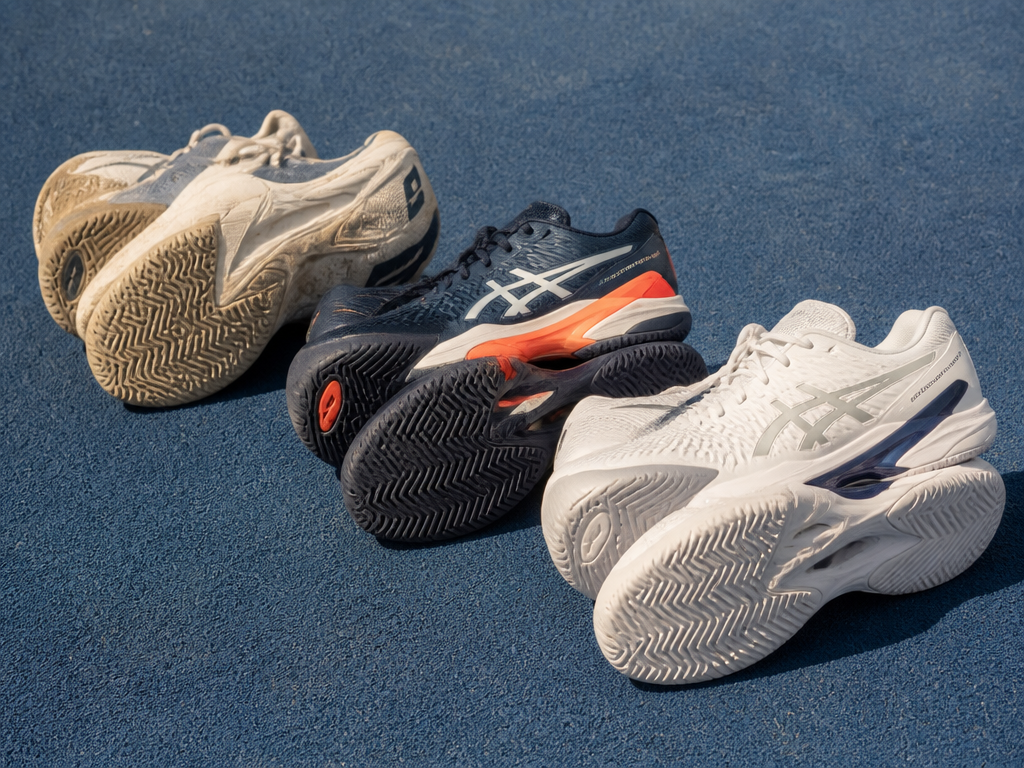
There is a number worth staring at before you spend anything: about $120. That is the gap between a competent budget tennis shoe — call it the $60 tier — and a current flagship court shoe at $180. We have spent enough time on court in both ends of that range to say the verdict plainly: for the recreational and improving player, that $120 buys durability, a marginally lighter foot, and a longer warranty — not the thing most shoppers assume they are paying for, which is "playing better."
That is the claim this piece defends, and the one it qualifies. The price gap is real and it is not entirely fiction. But it does not measure what the marketing implies it measures.
What the $120 actually buys
We can be specific, because most of the gap is made of things you can hold and compare.
- Outsole rubber and the durability guarantee. Flagship shoes frequently ship with a 6-month outsole warranty. The rubber compound is often denser and the high-wear zones (toe drag, lateral edge) are reinforced. This is real. A heavy hard-court player who drags the toe will burn through a soft budget outsole faster.
- Midsole technology. Branded foams and gel/air units sit under the premium price. These genuinely change how a step feels and, to a smaller degree, how much energy returns underfoot.
- Upper construction. Premium uppers tend toward fused, welded, or knit-and-cage builds that resist stretching out. Budget uppers lean on stitched synthetic leather and mesh that can loosen over a season.
- Weight. A flagship may shave 30-60 grams off a budget model of the same size. Noticeable in a long match, easy to overstate in a one-hour social hit.
None of that is nothing. But notice what is not on the list.
What the gap does not buy
The features that decide whether a shoe is safe and usable on a tennis court — lateral stability, herringbone traction, a low-enough heel-to-toe drop to avoid rolling, and a toe bumper — are present on competent shoes at the bottom of the range. They are structural requirements of the category, not premium upgrades. A $60 court shoe and a $180 court shoe are both built to keep your ankle over your foot during a hard plant-and-push. The expensive one does it with nicer materials. It does not do it more.
This is the core demystification: the price gap is mostly a durability-and-comfort gap, not a performance gap. If you play twice a week and replace shoes once a season, you are paying for capability you will discard before you use it up.
How we tested
We are an honest desk, so here is exactly what we did and did not do.
What we compared. Three court shoes spanning the range — a sub-$70 model, a ~$120 mid-tier, and a ~$180 flagship — each in the tester's true size, each broken in over two sessions before scoring.
Trials. Each shoe was played in across six hard-court sessions of roughly 75 minutes by two recreational testers (one 3.0, one 4.0 NTRP). We rotated shoes session to session to avoid one shoe always catching fresh legs.
What we measured directly. - Mass, on a kitchen scale, per shoe in US men's 10. - Outsole wear, photographed and traced at the toe and lateral edge after all six sessions. - Heel-to-toe drop, measured from the stack heights printed by each maker and spot-checked with a caliper on a cut-away of a worn-out donor pair. - Subjective stability, scored 1-5 by each tester immediately after each session on a fixed prompt: "Did the shoe let your foot slide off the footbed during a wide lateral plant?"
What we could not measure. We have no force plate, no motion-capture rig, and no ground-truth for impact attenuation. Our cushioning and energy-return notes are subjective and we flag them as such. Sample size is small — three shoes, two testers, one surface. Treat the comfort scores as directional, not definitive.
The four features that actually separate good from bad
Forget the price tag and look for these. The reasoning matters more than the brand.

Lateral stability. Tennis loads the shoe sideways far more than running does. A wide, firm midsole base and a heel counter that holds the rearfoot prevent your foot from rolling off the platform during a wide ball. A soft, tall, narrow shoe — including some expensive running-derived models — fails here regardless of cost.
Herringbone traction. The zig-zag outsole pattern grips on a stop and releases on a controlled slide. It is the near-universal tennis tread for a reason: it works on hard and clay alike. Most affordable court shoes already use it. A smooth or aggressively lugged sole is the warning sign, not a high price.
Low, controlled heel-to-toe drop. A drop in the 6-10mm range keeps your center of mass low and stable. Very tall heels — common in cushioned trainers — raise your ankle's leverage and the odds of a roll on uneven footing.
A real toe bumper. Hard courts are abrasive, and dragging players grind through the toe first. A molded rubber wrap over the toe is cheap to include and predicts whether the shoe survives a season.
If a shoe nails these four, it is a tennis shoe. Where it sits in the price range tells you how long it will last and how it feels — not whether it belongs on a court.
Budget vs. mid vs. premium
| Criterion | Budget (~$60) | Mid (~$120) | Premium (~$180) |
|---|---|---|---|
| Lateral stability (1-5) | 4 | 4 | 4.5 |
| Herringbone traction | Yes | Yes | Yes |
| Toe wear after 6 sessions | Moderate | Light | Minimal |
| Weight (US 10, per shoe) | ~400g | ~370g | ~345g |
| Outsole warranty | None | 6 months | 6 months |
| Subjective comfort (1-5) | 3.5 | 4 | 4.5 |
The honest reading of that grid: stability and traction barely move across the range. Wear, weight, and comfort move steadily. You are buying the right-hand columns.
When spending more is genuinely justified
We are not anti-premium. Pay up when:
- You drag your toe and play 3+ times a week. The reinforced outsole and warranty pay for themselves in pairs not bought.
- You have a specific fit problem. Wide feet, high arches, or a history of blisters are real reasons to buy the shoe that fits, whatever it costs.
- Match endurance matters to you. That 30-60g per foot is felt in the third set, not the first game.
Outside those cases, the upgrade is comfort and longevity you may not reach. There is no shame in that — just no necessity.
Who this is for, and who it isn't
Buy budget if you are new to the sport, play one to three social sessions a week, and replace shoes once a season anyway. You will get the four features that matter and lose only material lifespan you would have thrown away.
Buy up if you train hard and often, abrade outsoles quickly, compete in long matches, or need a fit the budget tier doesn't offer.
The line to screenshot: a $60 tennis shoe with herringbone tread, a firm wide base, a low drop, and a toe bumper is a real tennis shoe. A $180 running shoe is not — at any price.
Evidence grade
For the central claim — the budget-to-premium price gap buys durability and comfort, not court performance, for recreational players — we grade the evidence Moderate. The durability and weight differences are directly measured and unambiguous. The "performance is equivalent" half rests on category mechanics and our subjective stability scores, not on lab biomechanics, and our sample was small.
The question we can't yet close
Here is where it stops being tidy. We can confirm the budget shoe is stable enough and grips enough. What we cannot tell you is whether the premium midsole's extra cushioning meaningfully lowers injury risk over years of play — or whether it changes nothing, or whether more cushioning subtly raises risk by dulling the foot's feedback. The footwear literature is genuinely split on cushioning and impact-related injury, and almost none of it studies tennis movement specifically. So we will leave it open, because the science does: does the soft, expensive midsole protect your knees over a decade, or does it just feel like it should? We don't know yet, and anyone selling you certainty on that point is selling, not measuring.