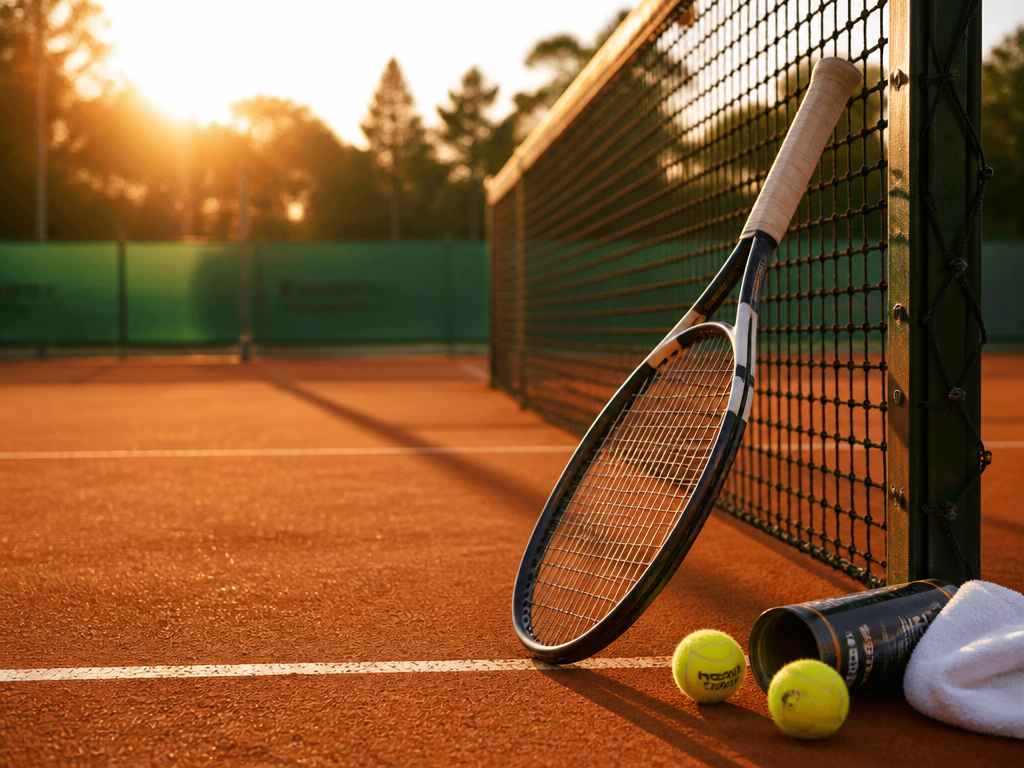
Last winter we did something slightly invasive. A longtime club member let us photograph and inventory his tennis gear closet — everything he'd been given or bought over four years — and we sorted it into two piles: used regularly, and untouched. The untouched pile included a vibration dampener shaped like a tennis ball, a branded arm sleeve still in its plastic, a "smart" sensor that clips to the racquet butt, and two t-shirts in the wrong size. The used pile was smaller and duller: overgrips, a tube of balls, a microfiber towel gone gray, and a thermos.
That closet is the whole problem with tennis gifts in one snapshot. The things that get used are boring, cheap, and consumed constantly. The things that gather dust are clever, expensive, and bought by people guessing. If you don't play and you're shopping for someone who does, the good news is that the boring pile is exactly the pile you can buy from safely — and we'll explain why, item by item, with the reasoning a player would give you if they weren't too polite to.
What is a good gift for a tennis player?
The safest genuinely useful gift for a tennis player is something they go through and have to replace: overgrips, tennis balls, strings (with a restringing job attached), or a good towel and bottle. These are the items players spend their own money on monthly without thinking, which is exactly why receiving them feels like a small relief rather than a redundancy. The risk with a non-consumable gift — a racquet, shoes, a gadget — is that it has to match a very specific personal preference you can't know from the outside, and a near-miss becomes the untouched pile.
That's the headline. The rest of this piece is about why that's true, and how to spend a little more thoughtfully if you want to.
Why the boring stuff wins: a racquet wears out from the outside in
It helps to understand what a tennis player is actually consuming as they play, because that's where the reliable gifts live. The wear happens in a predictable order, from the parts you touch to the parts you don't.
First, the grip. The outermost layer is an overgrip — a thin wrap, usually around 0.5 to 0.6 mm thick, that goes over the racquet's factory grip. Sweat and friction kill it. A player who practices three or four times a week will often change overgrips every week or two, sometimes more in summer. A pack of three costs a few dollars; a box of thirty or sixty is a real, useful gift that nobody ever has too much of. The two names you'll see everywhere are Tourna Grip (the dry, pale blue one favored by heavy sweaters) and Wilson Pro Overgrip (tackier, the most-sold overgrip in the world). Buying either is close to foolproof, though we'll flag below how to choose between them.
Second, the strings. Underneath nothing, but at the center of everything — the strings are the only part of the racquet that touches the ball. They lose tension from the moment they're installed and they eventually break. A common coaching rule of thumb is to restring as many times per year as you play per week: play three times a week, restring roughly three times a year. At a typical shop rate of $20 to $40 in labor plus $5 to $20 for the string itself, this is a recurring cost players quietly resent. A prepaid restringing voucher from their local shop is one of the most thoughtful tennis gifts available, and almost nobody thinks to give it.
Third, the balls. Pressurized tennis balls go flat. Not from wear — from physics. The rubber core is pressurized above atmospheric pressure, and the gas slowly diffuses out through the rubber wall even sitting in the can once it's opened. A serious player notices a can has gone "dead" within a week or two of opening. They buy balls constantly. A case of balls is unglamorous and completely welcome.
Fourth, everything that manages sweat. Towels, wristbands, a water bottle or insulated flask. These wear, stain, and get lost. They're safe because there's no precise spec to match — a player's hand doesn't care which microfiber towel dries it.
Notice the pattern. Every item in that list is consumed, replaced, or lost, which means you cannot buy a redundant one. You can only ever buy a useful one. That is the core insight a non-player should hold onto.
The bundle move: pair things that finish each other

The single best trick for turning a small, boring gift into a thoughtful one is bundling — pairing two items so the second completes the first. A bundle says you thought about how the thing gets used, not just what it is.
A few that work, with the logic behind each:
- A set of strings plus a restringing voucher. Strings alone leave the recipient with the chore of paying to install them. Adding the labor turns a $15 reel into a finished, ready-to-play gift.
- A tube of balls plus a ball hopper or a cheap pickup tube. Anyone who practices serves alone is bending over to collect sixty balls by hand. The hopper removes the part of practice everyone hates.
- A towel plus a water-resistant bag. A wet towel and dry kit in the same bag is a misery. A small dry bag or wet/dry pouch solves a problem the player has stopped noticing they have.
The principle generalizes: if a gift creates a small downstream chore, the better gift is the one that also handles the chore.
The categories where guessing goes wrong
Three categories tempt non-players because they look like "the real thing," and all three are traps unless you have inside information.
Racquets
A racquet is an intensely personal piece of equipment, fitted to a player the way a chef's knife is fitted to a hand. The variables that matter — head size, weight, balance, stiffness, string pattern, grip size — interact, and a player who has settled on theirs will not switch for a gift. Grip size alone is measured in eighths of an inch (commonly 4‑1/4 to 4‑3/8 for adults) and the wrong one is genuinely uncomfortable. A new racquet also typically runs $200 to $280. It is the single most expensive way to land in the untouched pile. Unless the player has explicitly said "I want this exact model," skip it.
Shoes
Tennis shoes are real, distinct equipment — different from running shoes, built with lateral support and tougher outsoles for the sliding and stopping the sport demands, which is why playing tennis in running shoes wears them out fast and rolls ankles. That makes them sound like a great, practical gift. But fit is everything, brands run differently, and a half-size off is unwearable. Buy shoes only if you know the brand, model, and size the player already wears, in which case you're really just paying for a repeat purchase they'd have made anyway. That's fine. Guessing is not.
Strings, bought blind
We just praised strings, so this needs a caveat. Strings come in wildly different materials — natural gut, multifilament, polyester ("poly"), synthetic gut — and they feel completely different. A player using a soft multifilament for arm comfort will hate a stiff poly, and vice versa. The safe move is to buy the exact string they already use (check the side of their racquet or just ask their stringer), or to give the restringing voucher and let them choose. Buying a random "premium" string because it costs more is how you end up gifting a reel that sits in a drawer.
There's a quieter reason to be careful here, too. Stiff polyester strings strung at high tension have been associated in player surveys and clinical discussion with elbow load, though the evidence is more mechanism and consensus than settled trial data.1 The point isn't to scare anyone — it's that string choice is personal and sometimes medical, and not a place for a surprise.
A spending guide that won't backfire
Here is the practical version, sorted by budget and by how much you need to know to buy safely.
| Budget | Safe with zero inside info | Safe if you can ask one question | Avoid unless you know the exact spec |
|---|---|---|---|
| Under $25 | Overgrips (multipack), a tube of balls, wristbands, dampeners | A specific overgrip type (dry vs. tacky) | — |
| $25–$75 | Microfiber towel + dry pouch, an insulated bottle, a ball hopper | Restringing voucher at their shop, their exact string | A specific string for their racquet |
| $75–$200 | A quality racquet bag, a recovery tool (see below) | A bag sized to their racquet count | Shoes, if you don't know brand/model/size |
| $200+ | A lesson package or club credit | A clinic series with their coach | A racquet |
The one question worth texting a mutual friend, or the player's coach, or the player themselves under some pretext: "Where do you get your racquet restrung, and what string do you use?" That single answer unlocks the entire middle column.
Recovery tools: what's worth it, honestly

The recovery aisle is where gift guides go to oversell, so we'll be plain about what the evidence actually supports.
Foam rollers and massage sticks. These are cheap, durable, and players genuinely use them. What they do is less dramatic than the marketing claims. The best-supported effect of foam rolling is a short-term increase in range of motion without a loss of strength — a 2015 systematic review by Cheatham and colleagues in the International Journal of Sports Physical Therapy found consistent acute flexibility gains across the studies it pooled, but the studies were small and varied. The evidence that rolling meaningfully speeds muscle recovery or reduces next-day soreness is thinner and more mixed. So: a foam roller is a good, low-risk gift that a player will use before play to loosen up. Promising it will erase soreness oversells it. Verdict: plausible and genuinely useful for mobility; the recovery claims are thinner than they sound.
Massage guns (percussive devices). Popular, pricey, and the data is early. A 2020 study by Konrad and colleagues found a percussion treatment increased ankle range of motion without reducing performance, but again with small samples and short follow-up. They feel good and people use them; whether they do more than a foam roller for less money is not established. Verdict: fine as a gift if the budget's there, but you're buying a nice experience more than a proven outcome.
Compression sleeves and "recovery" wearables. Here the gap between confidence and evidence is widest. The mechanism stories are appealing and the trial data is sparse and underwhelming. We'd put most of these in the folk-wisdom column. If your player has specifically asked for one, that's different — desire is its own reason. As a surprise, it's a coin flip on the untouched pile.
A note from one of our reviewers, who tests this gear:
I keep a massage stick in my bag and use it on my forearms after long hitting sessions. It helps me feel looser the same day. Does it change how I feel two mornings later? Honestly, I can't tell, and I've stopped pretending I can. I'd give one as a gift for the same-day comfort, not the recovery promise.
On gift cards, and the dignity problem
There's a quiet snobbery about gift cards — that they signal you didn't try. For tennis specifically, we'd push back. A gift card to the player's local tennis shop or stringing service is arguably more thoughtful than a guessed-at product, because it routes money toward exactly the consumables and labor they were going to buy anyway, while letting them pick the string, the grip, the brand. It respects that they know their setup better than you do. Pair it with one small physical thing — a multipack of overgrips, a can of balls — so there's something to unwrap, and you've solved both the dignity problem and the redundancy problem at once.
Lessons are the higher-end version of the same logic. A block of lessons or a clinic series at the player's club is spent on the one thing every player wants more of and the one thing no amount of gear buys: getting better. It can't end up in the closet.
Back to the closet
We went back to that club member's closet with the inventory in hand and asked him to rank, fairly, what he'd have actually wanted. The thing he kept coming back to wasn't on either of our lists at the start. It was the prepaid restringing he'd gotten one year — a folded card from a relative who'd called his coach to ask where he played. He used it within two weeks, walked out with a fresh string job he'd been putting off, and remembered who gave it to him every time he picked up the racquet. The clever sensor, by contrast, he couldn't remember opening.
The lesson isn't that thoughtful gifts have to be expensive or clever. It's the opposite. The gifts that land are the ones aimed at what the player is already spending money on and already slightly tired of buying. You don't need to understand tennis to spot those. You just need to ask one question and buy the boring thing well.
If you do one thing tonight, text the player's coach or stringer and ask where they get restrung and what string they use — then buy the answer.
-
The link between stiff polyester strings, high stringbed tension, and elbow load is widely discussed among stringers and sports-medicine clinicians and grounded in plausible mechanics, but high-quality controlled trials isolating string type as a cause of injury are scarce. Treat it as informed consensus, not proven fact. ↩