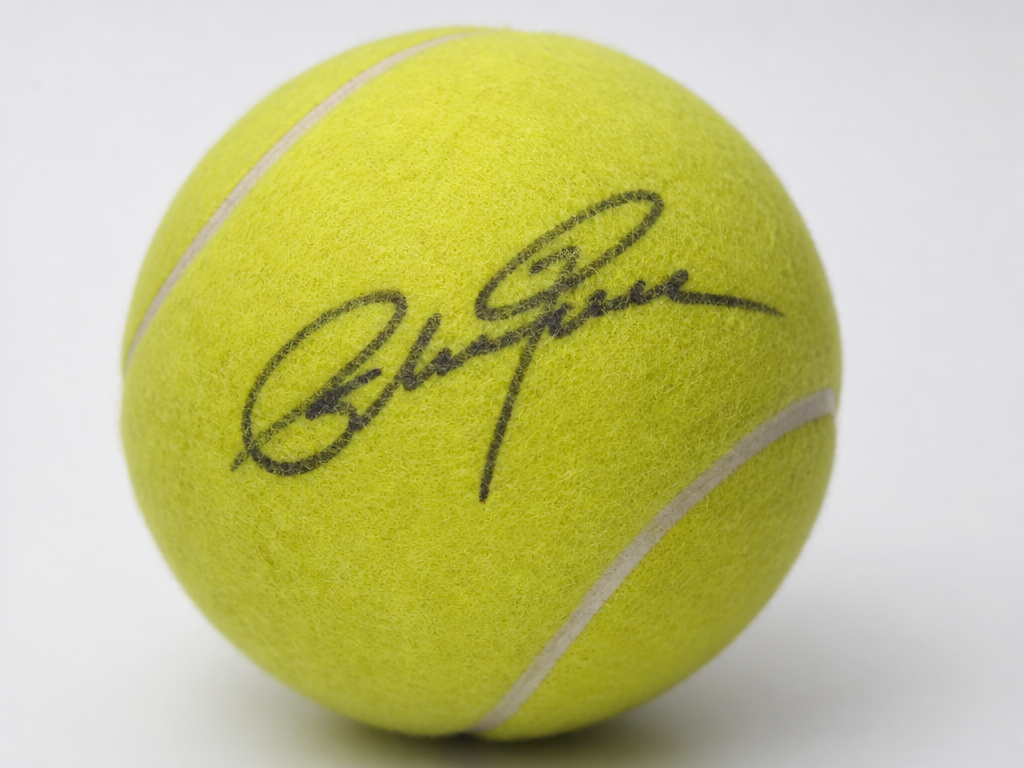
There is a small, persistent belief in tennis fan culture: that the surest way to hold onto a championship moment is to get it signed onto a giant tennis ball. Bring the oversized felt orb to the practice courts, wait by the rope, and walk away with a keepsake that outlasts the program, the ticket stub, and the selfie buried in a phone. We've watched this play out at qualifiers and show courts for years. The belief is real. The question we set out to answer is whether the object lives up to it — and whether the brand and size you buy will still look like a trophy in five years or like a sad, faded melon in two.
The short version of our verdict: a felt-covered jumbo ball with a stitched seam holds a Sharpie signature and survives display better than any plastic-membrane novelty ball, and the best of the three we tested was the standard 9-inch felt model — not the biggest one, not the cheapest one. Below is how we got there.
Where the belief came from, and why it's thinner than it looks
It is worth being honest about the origin of this whole ritual, because the field treats it as settled lore and it mostly isn't.
The oversized tennis ball as a fan object is younger than people assume. The regulation ball has a fixed history — the felt-over-rubber construction, the 6.54–6.86 cm diameter, all written into the rulebook decades ago. The jumbo version has no such pedigree. It arrived as tournament merchandise and toy-aisle novelty, and somewhere along the way it picked up a second job: autograph canvas. Nobody designed it for that. There is no manufacturer who set out to build the perfect signature surface and landed on a giant ball. The use found the product, not the other way around.
The "championship moment" framing is even softer. Press coverage of autograph culture — including a widely quoted 2014 Wall Street Journal piece on young collectors working the rope line at the US Open — describes kids chasing players for signatures on anything they can hold up. The big ball shows up in that world not because it's optimal but because it's large enough to be seen over a crowd and large enough to sign without crouching. Those are real, practical advantages. But they got promoted, over time, into a kind of received wisdom: that the jumbo ball is the keepsake, the thing every fan should bring.
That belief has a source. The source is convenience and visibility at a crowded rope line, plus a decade of merchandise tables selling the things near the gate. It is not a durability claim, and it is not a quality claim. When you separate the genuinely useful part of the lore (it's big, it's easy to sign, the player can spot it) from the part that just got repeated (it lasts forever, it's the best display piece), you find the foundation is narrower than the monument built on top of it.
So we tested the monument.
What we tested and how
We bought three oversized balls representing the range a fan actually encounters: a tournament-booth-style felt ball, a mid-tier felt ball sold online, and a cheap plastic-membrane novelty ball of the kind that turns up in pet aisles and discount toy bins. We are not naming the budget novelty unit because the failures we saw are typical of the whole plastic-shell category, not one bad batch — calling out a single brand would imply the others are fine, and they aren't.
Sample size, stated plainly: one unit per type, plus a second felt unit for the display-fade test. This is a small sample. We can speak confidently about construction differences we could see and measure, and more cautiously about long-run fade, where we had a partial reference rather than a full multi-year ground truth.
Here is the protocol.
Construction inspection
We measured diameter with calipers, weighed each ball, and cut a retired unit of each type in half to inspect the interior — felt thickness, whether there was a true rubber core or an air-filled shell, and how the seam was joined (stitched, glued, or molded).
Ink retention (the signature test)
We applied four marker types to a marked patch on each ball: a fine-tip permanent marker, a chisel-tip permanent marker (the kind players actually use at the rope), a paint pen, and a standard ballpoint. We photographed each immediately, then again after 30 minutes, to record bleed and feathering into the surface.
Display fade
We placed signed felt samples in a south-facing window for six weeks and compared ink density against a shaded control using the same photo setup and lighting each week. Six weeks is not five years. We treat this as an accelerated indicator, not proof of decade-long behavior, and we say so again in the grade at the end.
Abuse (the dog-and-kid test)
We ran each ball through what a household actually does to it: repeated floor bounces on tile, a tug session with a 40-pound dog, and a week of being carried, dropped, and kicked around by an eight-year-old. We logged the first visible failure for each.
Results
| Criterion | 9" felt (booth-style) | Mid-tier felt (online) | Plastic-membrane novelty |
|---|---|---|---|
| Diameter | 9.0 in | 8.3 in | 9.4 in |
| Surface for signing | Dense felt, stitched seam | Thinner felt, glued seam | Smooth plastic shell |
| Best ink result | Chisel permanent marker, crisp | Chisel marker, slight feather | Paint pen only; markers bead and smear |
| Fade after 6 wks (S-facing window) | Minor lightening | Noticeable lightening at edges | Ink lifted/flaked at touch points |
| First abuse failure | None in test window | Seam lift after dog tug | Shell split on day 2 of dog tug |
| Display verdict | Looks like a trophy | Acceptable, watch the seam | Looks worn fast |
The pattern is consistent across every criterion that matters for a keepsake: felt construction and a stitched seam outperform both thinner felt and the plastic shell, and the largest ball was the worst performer because its size came from a hollow plastic membrane rather than from more material.
The signature is a surface problem, not a size problem
This is the finding that reframes the whole category. Fans buy big because they think big equals impressive. But the thing that determines whether your signed ball reads as a treasure or a smudge is the surface, not the diameter.
Felt holds permanent marker the way a regulation ball would, only with more room. The chisel-tip permanent marker — the exact tool most players carry — laid down a crisp, dense line on both felt balls. The ink sits in the nap and stays put. On the plastic-membrane ball, that same marker beaded up. The ink had nowhere to soak in, so it pooled on the slick surface, smeared under a thumb, and dried unevenly. The only pen that behaved on plastic was a paint pen, which a player at a rope line will not be carrying and which you cannot reasonably ask them to use while a hundred people press behind you.
That is the quiet trap in the lore. You bring the giant novelty ball because it's the iconic fan object, the player reaches for their standard marker, and the signature you waited two hours for slides around on a plastic shell. The felt ball doesn't have this problem. If you want a signature that lasts, you are buying a signing surface, and felt is the signing surface.
On fade, both felt balls lost some ink density in the window test, with edge-lightening more visible on the thinner-felt online unit. The plastic ball was the worst: its ink didn't fade so much as lift, flaking at the points we handled most. We'll be honest about the ceiling on this claim — six weeks of harsh window light is a stress test, not a calendar. What it tells us reliably is the ranking, not the exact number of years. Keep any signed ball out of direct sun and the felt versions will hold for a long time. We just can't put a precise figure on "long."
The dog and the kid will tell you the truth
If a ball is going to live in a house with a dog or a young child — and a lot of these end up exactly there, signed or not — durability stops being abstract.
The plastic-membrane ball split on the second day of tug. This is not a defect; it is the category. A thin plastic shell over air is built to be light and cheap, and a dog's molars find the weak seam in minutes. We want to be fair here: that ball is genuinely fun for a kid to kick around a yard, and it's bright and light and harmless. As a dog toy it is short-lived, and as a keepsake it is a poor choice. Those are two different failures and worth separating.
The felt balls held up far better to abuse, with one caveat: the mid-tier online unit's glued seam started to lift after the dog tug session, peeling at one pole like a label coming off a jar. The booth-style ball with a stitched seam showed no failure in our window. Stitching costs more and it shows in exactly the place the ball gets stressed.
So if you've got a dog who will absolutely claim this thing, buy felt, buy stitched, and accept that even then it's a chew object on borrowed time. Nothing in this category is indestructible, and any review that tells you otherwise is selling.
Price: the booth markup is real, but so is the gap in what you get
Here is where fans get genuinely frustrated, and the frustration is justified — partly.
A tournament merchandise table will routinely charge two to three times the online price for an oversized ball. Some of that is captive-audience markup, plain and simple. You're inside the gate, the kid wants it now, there's a player you might catch in twenty minutes, and the booth knows it.
But not all of the gap is gouging. The booth ball in our test was the stitched-seam felt unit — the one that won. The cheapest online options that undercut the booth on price were, in our sample, the plastic-membrane balls that failed. So the honest framing is this: you can beat the tournament price online, but only if you buy the same construction the booth is selling. Matching the price by dropping to a plastic shell isn't a saving. It's buying a different, worse object that happens to be round and yellow.
Our practical read:
- Buying for a signature you intend to keep: order a stitched-seam felt ball online in advance, bring it to the event. You get the winning construction and skip the booth markup.
- Buying on impulse at the gate because a kid is melting down: the booth ball is usually the good felt one, so the markup buys you quality you'd want anyway. Annoying, but not a rip-off.
- Buying purely as a toy: the cheap novelty ball is fine, as long as you know it won't survive the dog and won't take a signature.
Who this is for, and who it isn't
This is for you if: - You're heading to a tournament hoping to catch a signature and want it to still look like a trophy when your kid is in high school. Buy felt, stitched, bring your own marker, ask for a chisel tip. - You play in a local league and want a fun, oversized memento for a team or a milestone. Felt photographs well and holds a group of signatures. - You want one object that's both a display piece and an occasional family toy — felt handles both, within reason.
This isn't for you if: - You primarily want a dog toy. Buy something built to be destroyed; don't pay felt prices for a chew that'll get chewed. - You want a guaranteed multi-decade archival keepsake. No felt ball is acid-free archival paper. It will slowly lighten. Frame the moment realistically. - You're chasing the biggest ball for impact. In our test, the biggest was the hollow plastic one, and size bought you nothing a signature could live on.
The verdict, stated plainly
The championship-moment lore around the jumbo ball is half true. The useful half — that a big ball is easy to spot, easy to sign, and easy to hand up over a crowd — is real and worth respecting. The repeated-until-believed half — that the giant ball is automatically a lasting keepsake — depends entirely on a construction detail most fans never check. Felt with a stitched seam holds the moment. A plastic shell loses it.
If you buy one thing from this, buy the felt one, and bring a real marker.
Evidence grade
Central claim: A stitched-seam felt jumbo ball holds a signature and survives display and household abuse better than a plastic-membrane novelty ball.
Grade: Moderate. The construction, ink-retention, and abuse differences were clear, repeatable, and consistent with how felt and plastic behave as surfaces — we're confident in the ranking. The grade isn't Strong because our sample was small (one to two units per type) and our fade test was a six-week accelerated proxy, not a multi-year display record. We can tell you which ball is better and why. We can't yet hand you a precise lifespan in years.
The lore had a source. The source was a rope line, not a lab. Now you know which part to trust.