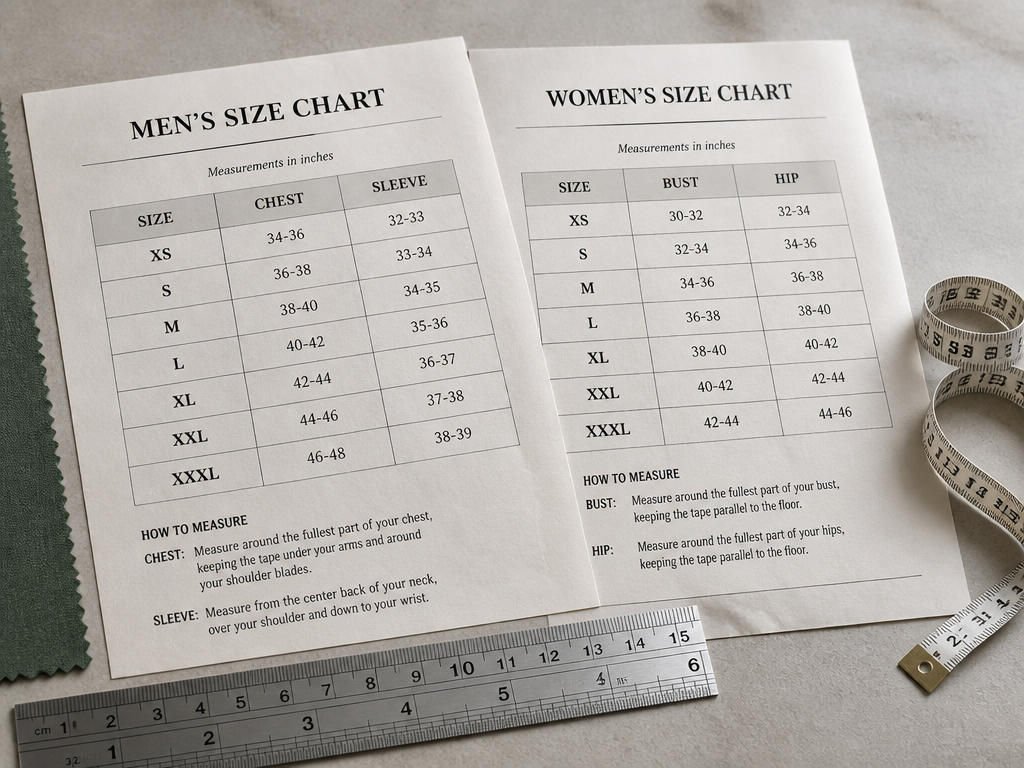
Reviewer's note. I opened the men's and the women's size chart for the same seasonal line, put them side by side, and read them column by column. The men's chart listed chest, natural waist, sleeve length, and inseam. The women's listed bust, waist, and hip. The men's chart had no hip column at all. Same brand, same season, same garment family — and the two halves were not being measured against the same set of numbers.
That asymmetry is the whole subject in miniature. Fall tennis apparel collections arrive split down the middle, men's on one page and women's on another, and the split usually gets read as a merchandising convention. Some of it is exactly that. But a meaningful part of it happens upstream of anything a merchandiser touches, inside the pattern block, and the parts that are load-bearing are worth separating from the parts that are habit.
Why men's and women's collections differ
Three causes stack, and only the first is engineering. First, the two lines are drafted from different base patterns derived from different body-measurement data. Second, silhouette conventions inherited from the tour and from tournament dress codes — dress and skirt on one side, polo and short on the other — get applied before anyone thinks about function. Third, retail sorts by department, so the two halves are budgeted, tiered, and colorway-planned as separate assortments even when the fabric is identical. Confusing the three is what produces both the "it's all marketing" take and the "women's gear is engineered differently" take. Neither survives contact with the process.
The order it actually happens
A piece starts as a fit block: a base pattern with fixed relationships between shoulder, chest, waist, and hip. The block is chosen, not calculated per garment. Next comes grading, the rules for scaling that block across sizes — and grading is driven by a controlling measurement, chest on one side, bust-to-hip on the other, which is why the size charts diverge in the first place.
Only then does silhouette get decided: dress, skirt, tank, polo, crew. After that comes seam and panel engineering — where the side vent sits, whether there's a bra shelf, whether the pocket is in the skirt or in the compression short underneath. Fabric comes fifth, and it is usually the same yarn at a different knit gauge rather than a different material. Colorway is last, and it is the only step most buyers ever see.
What the body data supports, and what it doesn't
The commonly cited anthropometric reference here is ANSUR II, the 2012 U.S. Army survey of 4,082 men and 1,986 women — a large, public dataset built for equipment sizing rather than sportswear, but the closest thing the industry has to a shared baseline. Its shoulder and hip breadth distributions overlap substantially and still differ in the mean by a few centimeters in opposite directions. That difference is enough to change armhole depth, sleeve pitch, and whether a raglan or a set-in shoulder hangs correctly. Separate blocks are not a styling choice. Grade one block to the other and the shoulder seam lands in the wrong place on a serve.
The thermoregulation argument is weaker than it sounds. The consensus reading of the sweating literature — Gagnon and Kenny's work in the early 2010s is the usual citation — is that apparent sex differences in whole-body sweat rate shrink considerably once you match participants for body surface area and metabolic heat production. Sample sizes in that line of work are small, typically a dozen or two per group. So the claim that women's pieces are cut in lighter fabric because women need lighter fabric is doing more work than the evidence behind it can carry.
Where the split earns itself
Ball storage is the clearest case. Two deep side pockets on a men's short hold two balls without changing how the short moves. A skirt has no equivalent volume, so the solution migrated to the compression short underneath — and a skirt shipped without those pockets is a functional downgrade at an identical price tier. It is the single most useful thing to check before buying.
Bra shelf integration is the second. A built-in shelf changes the front panel, the side seam, and the fabric weight all at once, and it is a genuine construction difference rather than a scaled-down version of anything.
The third is documented in a rulebook. The All England Club changed its all-white dress code ahead of the 2023 Championships to permit women to wear dark-colored undershorts, a change announced in late 2022 after sustained pressure from players. That is a rare, dated, public admission that a garment convention carried a real cost for one group of players and none for the other.
Where it doesn't
Tier depth is where the two halves of a seasonal assortment come apart, and not for any reason found in a pattern block. Read across a collection and the men's side tends to run layering-heavy — half-zips, hoodies, track jackets, the shoulder-season pieces — while the women's side runs silhouette-heavy, with more dress and skirt variants and a thinner bench above the top layer. We are describing catalog structure as we read it, not a count we can publish; nobody releases SKU tables by tier and gender.
The fabric question is similar. Jacquard construction knits the pattern into the structure of the fabric, with floats on the reverse and more yarn per unit area, which is why it holds shape and resists abrasion better than a flat-knit jersey with the same pattern printed on. Flat knit is lighter, drapes more, and takes an applied graphic. Which construction lands on which side of a collection is easy to assert and hard to check, because tennis brands almost never publish fabric weight in grams per square meter. Without GSM, any claim about who gets the heavier cloth is an inference, including ours.
A tier-by-use-case read
| Tier | Typical construction | Best use | Check before buying |
|---|---|---|---|
| Match / tour | Jacquard or engineered knit, laser-cut or bonded hem | League and tournament play, heat | Pocket count and depth |
| Core performance | Flat-knit jersey, applied print | Practice, weekly hitting | Shoulder seam type |
| Layering | Brushed back, bonded zip | Cold starts, warmups | Whether it fits over the match top |
| Off-court | Cotton or cotton blend | Travel, coaching | Nothing structural |
Rule of thumb: buy the tier that matches the coldest, longest session actually on the calendar, not the warmest. Layering is where the two halves of a collection differ most in depth, and it is the layer that gets skipped and then missed in October.
The verdict, stated plainly
Well-established: separate fit blocks are required by real variation in shoulder-to-hip proportion, and grading one block into the other produces a garment that fits badly at the serve.
Plausible but thin: that fabric weight should differ by gender for thermoregulatory reasons. The matched-subject data undercuts it.
Folk wisdom: that a women's piece is the same garment, smaller. It usually isn't — and where it is, that's a shortcut, not a design.
Reviewer's note, closing. I went back to those two size charts afterward and still couldn't answer the question I actually wanted answered: whether the layering gap is real in numbers, or whether it's a pattern I noticed because I expected to. That needs SKU counts by tier and gender across several seasons, and no retailer publishes them. Fabric weight has the same problem. Both are answerable, just not from a product page — the places to look are the brands' own size and spec documentation, the ITF and AELTC published dress regulations, and a retailer willing to read a supplier spec sheet out loud over the phone.
The split between men's and women's lines is real engineering wrapped in a much thicker layer of convention, and almost nobody selling it bothers to tell you which is which.