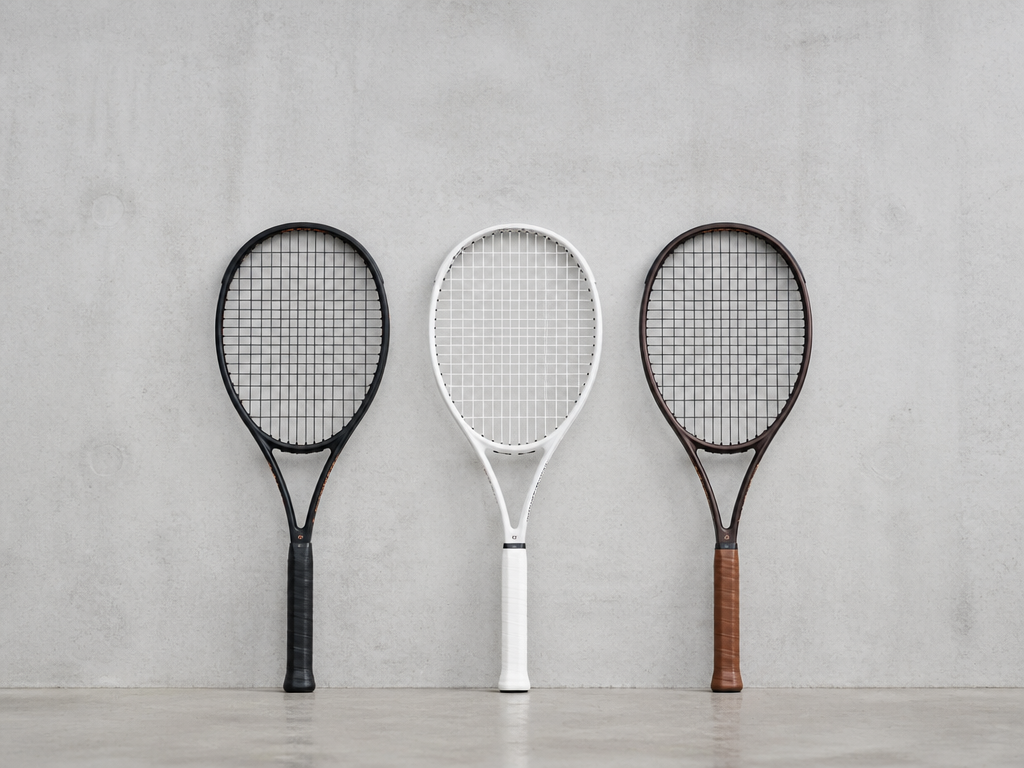
The Yonex EZONE 100 is the frame that gets recommended by default, which is exactly why a tennis racquet review of it should start somewhere other than its reputation. Ask around a club and you will hear the same four claims: powerful, comfortable, spin-friendly, forgiving. Those four rarely coexist honestly in a single 300-gram frame, because the design choices that buy one usually cost another. We have not hit a ball with this racquet. What we have done is read the published specifications closely, set them beside the two frames the EZONE most often wins or loses a sale against, and worked out whether the numbers support the story the marketing tells.
That is a narrower kind of authority than a playtest, and we would rather say so at the top than pretend otherwise.
What Yonex publishes, and what it doesn't
The EZONE 100 has run through several generations with remarkably stable core numbers. Yonex's own product listing gives the following for the 300-gram version:
| Specification | Yonex's published figure | Typical retailer figure, strung |
|---|---|---|
| Head size | 100 sq in (isometric) | unchanged |
| Weight | 300 g / 10.6 oz unstrung | roughly 318 g / 11.2 oz |
| Balance | 320 mm unstrung | near 32.5 cm, three to four points head-light |
| String pattern | 16 x 19 | unchanged |
| Frame stiffness (RA) | not published | commonly measured in the mid-60s |
Two things in that table deserve more attention than they usually get.
The first is the gap between the unstrung and strung columns. Yonex, like every manufacturer, publishes unstrung specifications, because that is the state in which the frame leaves the factory and the only state the brand controls. A full string bed adds something in the region of 16 to 18 grams, most of it distributed through the head, which shifts the balance point up the frame and raises the swingweight meaningfully. The 300 grams on the box is not the racquet you will swing. Any comparison that puts one frame's unstrung weight against another's strung weight is comparing nothing at all.
The second is the empty cell. Yonex does not publish a stiffness rating for the EZONE line. Babolat does not publish one either. The RA figures that circulate — mid-60s for the EZONE 100 across recent generations — come from retailers and reviewers running frames through a Babolat RDC machine, not from Yonex. They are real measurements taken by third parties, and they are also unstrung measurements of a single unit, which is a different thing from a manufacturer's specification. We will come back to why that distinction matters.
The rest of the sheet is straightforward. Standard 27-inch length. A tapered beam listed between roughly 22.5 mm at its thinnest and 26.5 mm at its widest, which puts it in the moderate-to-thick category rather than either the box-beam control camp or the true power-beam camp. The isometric head shape — Yonex's squared-off hoop, in the line since long before the EZONE existed — is the one genuinely distinctive geometric feature, and its stated purpose is a larger effective sweet spot from a given head size. Recent generations have also carried Yonex's vibration-damping mesh in the handle and graphite variants marketed under the 2G-Namd name. Those technologies are real, but their per-generation contribution is not something an outside reader can isolate from the spec sheet, and we are not going to pretend we can.
How we evaluated
This is a synthesis, and the weighting matters, so here is how it was built.
Manufacturer specifications were treated as reliable for the things a manufacturer can control and has no incentive to misstate: head size, unstrung weight, unstrung balance, string pattern, length, beam width. These are the load-bearing figures in this piece.
Third-party measured specifications — strung weight, strung balance, strung swingweight, RA stiffness — were treated as directionally reliable but unit-specific. Retailers who publish these numbers are measuring the racquets they have in stock. They are not publishing a tolerance band, and production variance within a model is real enough that frame-matching is a paid service the same retailers offer. When we cite a swingweight, read it as "a measured unit landed near here," not "every unit is here."
Independent tester and owner consensus was used only for direction, never for magnitude. Where a large number of reviewers and owners independently report the same qualitative behaviour — that this frame gives up ground against heavy hitters, for instance — that convergence is worth something. Where a single reviewer reports a number we cannot trace to a measurement, we left it out.
Published research was used for the one claim in this category that has an actual literature behind it: the relationship between frame properties and load on the arm. We cite it below with its limits attached.
What we did not do: hit with the frame, measure anything ourselves, or compare it against opponents of any particular pace. Where the honest answer is that a question can only be settled on court, we say so instead of manufacturing an answer.
Three frames, five criteria
The useful comparison is not EZONE-versus-everything. It is EZONE against the two frames that occupy the same shelf and the same 100-square-inch, 16x19, sub-11-ounce brief while making opposite engineering bets.
| Frame | Unstrung weight / balance | Stiffness (third-party RA) | Strung swingweight (measured units) |
|---|---|---|---|
| Yonex EZONE 100 | 300 g / 320 mm | mid-60s | around 320 |
| Babolat Pure Drive | 300 g / 320 mm | around 70 | low 320s |
| Wilson Clash 100 | 295 g / 310 mm | mid-50s | mid-310s |

On paper the EZONE and the Pure Drive are twins: identical published weight, identical published balance, identical pattern, similar measured swingweight. Everything that separates them is in the stiffness column and the beam geometry. The Clash is the outlier in every column — lighter, more head-light, and dramatically more flexible than either.
Criterion one: stiffness and free power
This is where the three frames actually diverge, and it is the criterion most reliably misdescribed in marketing copy.
A stiffer frame deforms less at impact and returns more of the ball's energy, which shows up as depth the player did not have to generate. The published beam figures and the third-party RA measurements put the Pure Drive clearly ahead of the EZONE here, and the EZONE clearly ahead of the Clash. That ordering is consistent across every source we looked at, and it is the one performance claim in this piece that follows directly from measured specifications rather than from tester impressions.
What the ordering does not tell you is how much. The gap between an RA of 70 and an RA of 65 is five points on an unstrung scale, and stringing changes effective stiffness in ways the unstrung number does not capture — a full bed of stiff polyester at high tension will do more to the frame's behaviour than the five-point difference between these two hoops. Reviewers who describe the EZONE as "almost as powerful as a Pure Drive with better manners" are describing something plausible, but they are describing an impression, not a measurement, and the string setup is doing unquantified work inside that sentence.
The fair statement: the EZONE sits between the two on free power, closer to the Pure Drive than to the Clash, and its position there is a design decision rather than a compromise. It is worth noting that a mid-60s RA is not a low-power frame in absolute terms. It is only moderate relative to the stiffest 100s on the market.
Criterion two: mass and swingweight
Here is the finding that most reader questions about this frame actually turn on, and it is not about the racquet's engineering at all.
The EZONE 100 weighs 300 grams unstrung with a measured strung swingweight around 320. Those are moderate numbers. A frame at that mass will be pushed backwards by a genuinely heavy ball, and no amount of torsional stiffness in the hoop changes that, because what resists a heavy incoming ball is momentum, not rigidity. Torsional stability governs how much the head twists on off-centre contact. Mass governs whether the frame holds its line against pace. These are different properties, and marketing language routinely blurs them into a single word — "stable" — that means whichever one is convenient.
This is the point at which tester and owner consensus converges most strongly and most usefully. Across independent reviews, the recurring qualification is the same: the frame does what it promises against equal or moderate pace, and gives ground against players hitting genuinely heavy. That is not a manufacturing flaw. It is what 300 grams does, and the Pure Drive at the same published weight faces exactly the same physics.
The practical consequence is that a player who finds the EZONE 100 insufficient against big hitters is usually not looking for a different brand. They are looking for more mass — either the 305-gram variant in the same line, or lead tape, or a heavier frame entirely. Switching to a stiffer 300-gram racquet will add depth without adding hold.
The Clash's lower swingweight and more head-light balance make it the most manoeuvrable of the three and the least able to hold its line, in that order and for the same reason.
Criterion three: spin access
All three frames run a 16x19 pattern in a 100-square-inch head, which means the main strings are spaced widely enough to bite the ball and move laterally before snapping back. This is well-understood string-bed behaviour and it is common to all three. There is no meaningful spec-sheet difference in spin potential between them.
What differs is how easy each frame makes it to swing the fast, steep, upward path that generates spin in the first place — and that is a function of swingweight and balance, not pattern. The Clash, lightest and most head-light of the three, is the easiest to accelerate. The EZONE and Pure Drive sit together a step behind.
We would treat any claim that one of these three generates materially more spin than the others, at matched string setup and matched swing, as unsupported. String choice moves spin production more than the difference between these frames does.
Criterion four: comfort and the arm
The EZONE is marketed on comfort, and the comfort claim is the one most worth interrogating, because it is also the claim players make purchase decisions on when something already hurts.
The honest position starts with the research. Hennig's 2007 review in Exercise and Sport Sciences Reviews surveyed the racquet-properties literature and identified frame stiffness, string tension, string material and grip size as factors influencing the load transmitted to the forearm. That is a genuine finding and it points the right direction. What it does not establish — and what we have not found established anywhere since — is a clean dose-response relationship between a specific RA figure and a specific injury outcome in a specific player. The variables that matter most in tennis elbow are technique, volume, and string bed, and the frame is one input among several.
So: is the EZONE 100 comfortable? Relative to the stiffest frames in its class, the measured stiffness says it should transmit less shock, and the near-unanimous tester and owner consensus agrees that it feels softer than a Pure Drive. Relative to the Clash, both the measurement and the consensus run the other way, and not narrowly — a mid-50s RA is a category apart, and the Clash line exists specifically to serve players for whom that gap matters.

A player choosing the EZONE for comfort reasons should understand what they are buying: a moderate frame that is kinder than the stiff end of the market, not the kindest option available. If comfort is the binding constraint rather than a preference, the flexible frame is the flexible frame.
Criterion five: directional precision
This criterion resists spec-sheet analysis more than the others, and we will not pretend it doesn't.
What the numbers permit us to say is structural: the same properties that produce forgiveness on off-centre hits — a large effective sweet spot, an open pattern, a moderately stiff hoop — also reduce the feedback a player gets about where on the string bed contact occurred. Forgiveness and precision are traded against each other in every frame ever built, and a 100-square-inch head with a 16x19 pattern has already chosen forgiveness. The isometric shape pushes further in that direction by design.
Tester consensus describes the EZONE as predictable rather than pinpoint, and players who prefer to drive through the ball on a flatter path more often name a tighter-patterned or smaller-headed frame as their preference. That is a coherent pattern across sources, but it is a pattern in impressions, and we grade it accordingly.
Where the evidence is thin
Three gaps are worth naming.
Generation-to-generation change is largely unverifiable from outside. Yonex revises the EZONE on a roughly three-year cycle and renames the internal technologies each time. The core specifications — 100 square inches, 300 grams, 320 mm, 16x19 — have barely moved. Whether a given generation genuinely plays differently from its predecessor, or plays differently because the paint job resets everyone's expectations, is not a question a spec sheet can answer, and reviewer accounts of these transitions are not blinded.
Stiffness figures come from third parties measuring single units. Different sources publish different RA values for what is nominally the same frame. Neither Yonex nor Babolat publishes an official figure to arbitrate between them.
Grip sizing runs its own scale. Retailers and stringers consistently report that Yonex grips measure smaller than the equivalent nominal size from other brands. This is widely enough repeated to be worth acting on, and we have not found a published measurement establishing the size of the discrepancy. Treat it as a reason to handle the frame before ordering, not as a number.
The verdict
Run the five criteria and the result is consistent: the EZONE 100 does not win any single criterion outright, and it is the only one of the three that finishes in the top two on every criterion that matters to a baseline player. The Pure Drive beats it on free power and loses to it on comfort. The Clash beats it on comfort and manoeuvrability and loses to it on power and on holding a line. The EZONE is the frame with no disqualifying weakness, which is a genuinely valuable thing to be and is not the same thing as being the best at anything.
If you want a line to screenshot: it wins on the absence of a fatal flaw, not on the presence of a decisive strength.
Who this is for, and who it isn't
It fits the intermediate-to-club baseliner who generates their own pace, plays against opponents in roughly their own range, wants topspin available without fighting the frame for it, and has no acute arm complaint. It also fits the player replacing a frame they liked but found harsh — the specifications support a genuine reduction in transmitted shock relative to the stiff end of the 100 category.
It does not fit three readers. The player who regularly faces genuinely heavy hitters and finds themselves defending: buy mass, not a different 300-gram frame. The player with an active arm problem: the measured stiffness gap between this and the flexible options is large enough to act on, and the moderate choice is a compromise you may not be in a position to make. The player who flattens the ball out and wants to know precisely where it is going: the forgiveness this frame is built around is working against you, and a tighter pattern or smaller head is the honest answer.
Evidence grade
For the central claim — that the EZONE 100 occupies a genuine middle position on power and comfort between the stiff and flexible ends of the 100-square-inch category — the evidence is Moderate. The published specifications and third-party stiffness measurements are consistent and point the same way, and independent tester consensus agrees. It is not Strong because the stiffness figures are third-party single-unit measurements with no manufacturer baseline, and because the comfort literature supports the direction of the claim without supporting any specific magnitude.
For the secondary claim — that the frame's limitation against heavy pace is a function of mass rather than of frame design — the evidence is Strong. That one follows from published weight specifications and basic mechanics, and it holds equally against the comparison frames.
A reviewer note
In the first person, because this is a personal habit rather than a recommendation: the spreadsheet I keep for frames like this has a column that is not weight, balance or swingweight. It is headed who measured this. The EZONE 100 row holds stiffness values from three separate sources, not one of them Yonex, and the spread between the highest and lowest is wider than the difference the marketing copy asks me to care about between this frame and its nearest rival. I used to treat that column as bookkeeping. I have come to treat it as the finding.