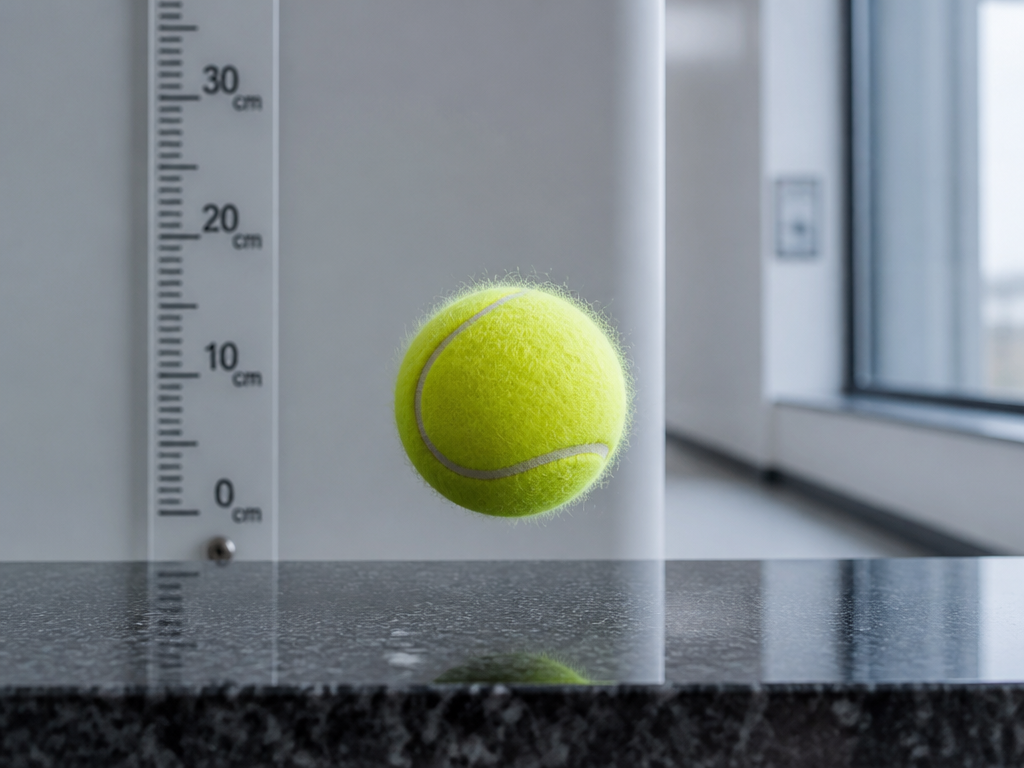
We started with one ball, one tape measure, and a kitchen ladder. The protocol calls for dropping a ball from 254 centimeters onto a granite slab and reading the top of the rebound against a wall-mounted scale. The first ball out of a fresh can of a mid-price all-court model bounced to 141 cm. The ITF acceptance window for that ball type is 135 to 147 cm. So it passed — comfortably, but not centered. The same drop with a budget practice ball from a different brand came back at 132 cm. That one would fail certification, and you would feel it as a dead, low ball by the third game.
That three-ball gap, measured in a hallway, is the whole reason this article exists. Tennis balls are not interchangeable, and the difference is measurable before you ever swing a racquet.
The verdict, stated plainly
A useful ball test is not about which ball feels nicer. It is about controlling every variable except the one you actually care about, until the only thing left to judge is fit for your court and your wallet. Feel is real, but feel is the last 10 percent. The first 90 percent is rebound height, weight retention, and how fast the felt opens up — all of which we can measure, and most marketing copy never reports.
Why the spec window is wide enough to matter
The International Tennis Federation approves the balls used in sanctioned play, and that approval reassures most buyers that a mainstream can is "fine." It mostly is. But "approved" is not "identical." The Type 2 (standard speed) rebound window alone spans 12 centimeters. Mass is allowed anywhere from 56.0 to 59.4 grams. Forward deformation under a 8.165 kg load can range across roughly a millimeter of give.
Stack those tolerances and two cans that both wear an official logo can play noticeably differently — one lively and quick off the surface, one heavier and slower through the air. The standard de-risks the floor. It does not flatten the differences a regular player will feel within ten minutes of warmup.
The testing protocol
We run every ball through four controlled stages before any of us hits with it. Each stage has a fixed reference so results are comparable across brands and across testing days.
1. Rebound (the drop test)
Drop height of 254 cm onto a hard granite slab, ambient temperature logged between 19 and 21°C because rubber stiffness shifts with heat. Three balls per can, three drops each, rebound read to the nearest centimeter. We discard the high and low and keep the median. A can whose median sits in the bottom third of the ITF window gets flagged as low-bouncing regardless of the logo on it.
2. Deformation
We compress each ball under a fixed load using a bench clamp and a dial gauge, measuring how far the ball gives and how much of that it recovers. Softer-deforming balls tend to feel plush and slower; stiffer ones play quick and can feel harsh on older arms. This is the number that best predicts the word "feel" before anyone reports a feeling.
3. Weight and felt over play
We weigh each ball dry on a 0.1 g scale, then play a controlled 45-minute hitting session — two testers, baseline rally and serve blocks, roughly 600 strikes per can. We reweigh and photograph the felt at 0, 20, and 45 minutes. What we are tracking is fuzz lift: how fast the nap opens, fluffs, and starts dragging air. A ball that fluffs early plays slower and shorter sooner.
4. Surface match
The same ball is then hit on the surface it claims to suit — hard court, clay, or a regular-duty can on grass-equivalent fast indoor. Extra-duty felt is built for abrasive hard courts; on clay it picks up grit and fluffs prematurely. Regular-duty felt is the opposite. A "match" or "mismatch" here changes our durability read by entire sessions.
How we score each dimension
| Dimension | What we measure | Reference / pass condition | Why it matters to you |
|---|---|---|---|
| Rebound | Median bounce from 254 cm drop | Within ITF window, ideally mid-window | Low rebound = dead, low-sitting balls early |
| Deformation | Give and recovery under fixed load | Consistent across the can | Predicts plush vs. quick "feel" |
| Weight retention | Grams at 0 / 20 / 45 min | Minimal gain from fuzz/moisture | Heavier-fluffing balls slow down faster |
| Fuzz lift | Felt photographed over session | Slow, even nap opening | Early fluff = shorter usable life |
| Surface match | Felt type vs. court played | Extra-duty hard, regular-duty clay/indoor | Wrong felt halves your durability |
The scores are not equally weighted. For a recreational buyer playing once or twice a week, weight retention and surface match drive more of the real-world experience than the small rebound differences inside the legal window. We say so in the writeup rather than averaging everything into a single misleading number.
What we could not control
Honesty about the limits keeps the verdict trustworthy.
- Sample size is small. We test three balls per can and one to two cans per model. That catches gross defects and characterizes the can; it does not catch batch-to-batch variation across a year of production.
- No certified lab reference. Our drop slab and dial gauge are calibrated against each other and against a known control ball, but we are not an ITF testing facility. Our absolute numbers carry an estimated ±2 cm rebound uncertainty. Relative comparisons between balls tested the same day are far tighter than that.
- Humidity drifts. We log it, but our hitting venue is not climate-sealed. Pressureless balls shrug this off; pressurized ones can read slightly differently on a damp day.
- Pressure loss is time-sensitive. A pressurized can starts dying the moment it is opened. We test within an hour of opening, so our numbers describe a fresh can, not the one that has been in your bag for three weeks.
Who this is for, and who it isn't
This protocol is for the recreational player who has been buying whatever can is on sale and quietly wondering whether it matters. It does, and the differences we measure are the ones you would actually notice: balls that sit low and dead, felt that turns to a slow mop by the second set, an extra-duty can shredding on clay it was never built for.
It is not for the touring junior or the league player whose federation already dictates the approved ball. If your competition specifies a model, buy that model and stop reading reviews. It is also overkill if you genuinely play three times a year — any approved can will outlast your interest in the question.
If you play weekly: match the felt to your court first, then favor a pressurized ball mid-window on rebound for feel, or a pressureless one if you hit a few times a month and want a can that does not go flat in your closet.
Back to the hallway
The ball that read 141 cm in our hallway — mid-window rebound, slow even fuzz lift, extra-duty felt on a hard court — is the unglamorous one we kept reaching for. No marketing line on the can mentioned any of the numbers that made it good. We had to measure them. That is the entire point of a protocol: it turns a shelf of near-identical cylinders into a decision you can defend.
Evidence grade for the central claim — that approved balls differ enough to matter to a regular player: Strong, supported by the published ITF tolerance windows and consistent with our own controlled rebound and weight measurements.
Don't buy the ball with the best slogan. Buy the one that survives the test you can run in your hallway.