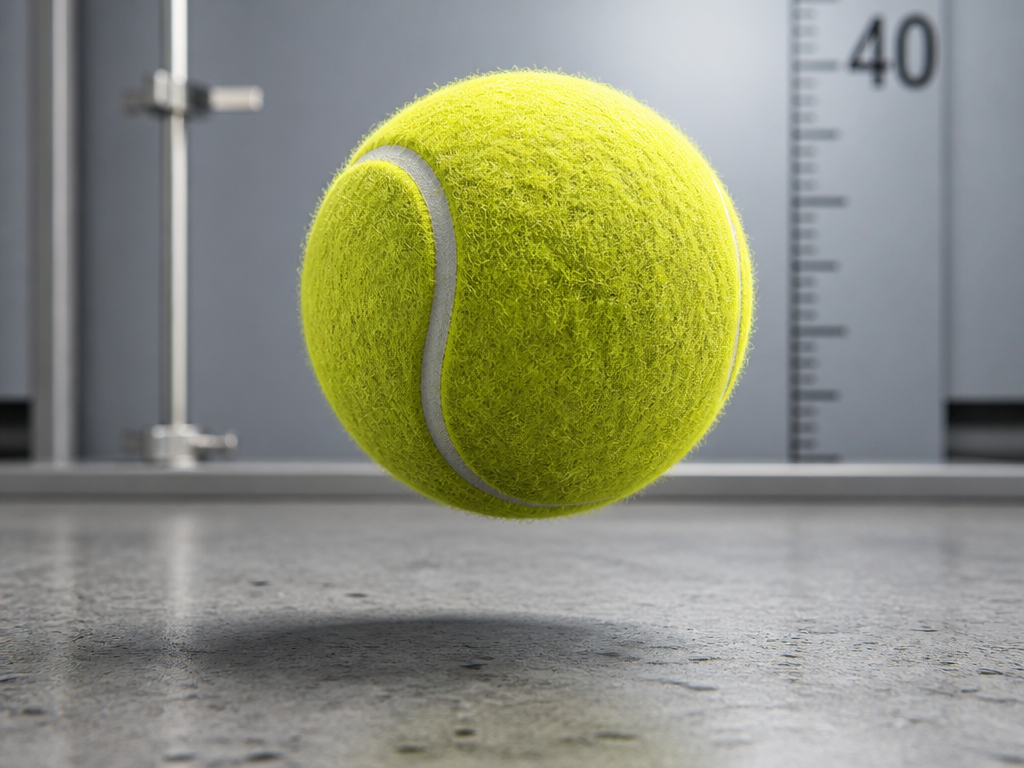
There is a number printed nowhere on the can you bought, but it governs almost everything inside it: 53 to 58 inches. That is the rebound window the International Tennis Federation requires of a regulation ball, and understanding it is the fastest way to cut through the noise of a tennis ball buyer's guide. If you have ever opened a fresh can, bounced one on the kitchen floor, and wondered whether you got a good batch or a dud, you were running a crude version of the test the ITF runs formally.
Here is the verdict up front, so you can stop reading if that is all you need: ITF approval guarantees a ball behaves consistently when new, but it tells you nothing about how long that ball will stay good, how the felt will hold up on your court, or whether the ball suits your level. The spec is a floor, not a recommendation.
What the 53–58 inch number actually measures
Drop an approved ball from a height of 100 inches onto a solid concrete slab. It must rebound to a height between 53 and 58 inches, measured to the top of the ball. That is the rebound test, and it is one of four core checks the ITF applies.
The other three:
- Mass: between 56.0 and 59.4 grams.
- Diameter: between 6.54 and 6.86 centimeters (the standard Type 2 ball).
- Deformation: how much the ball flattens under a 18.14-pound (8.165 kg) load, both on the way in (forward deformation) and the way back (return deformation), with separate windows for each.
Taken together, these four measurements describe a ball that bounces predictably, weighs the same as the last one, holds its shape under racquet impact, and recovers from that impact at a controlled rate. That is the whole point. A professional in a slam and a beginner on a public court are, in theory, hitting an object with the same mechanical behavior.
When we say a ball is "ITF approved," that is what we mean. The pressure inside the can — typically around 12 to 14 PSI above atmospheric — is what produces the rebound. The number is real, it is measured rigorously, and it is the reason a Wilson and a Dunlop from the same category feel broadly interchangeable on the first day.
What the number does not measure
This is where most confusion lives. The rebound test is a snapshot of a new ball. It says nothing about the four things that actually frustrate recreational players.
It does not measure durability. A ball can pass every ITF check and go dead in 90 minutes of hard hitting. Approval is not a longevity rating.
It does not measure felt wear. The fuzz that fluffs up and then shreds is graded by the manufacturer, not the rebound test. Felt composition — the wool-to-nylon ratio and the weave — determines whether your ball pills into a lopsided mess or wears evenly.
It does not measure shelf life. Pressurized balls leak through the rubber core constantly, can or no can. A ball approved in the factory may be noticeably softer by the time it reaches a shop shelf eight months later. Once the can is opened, the clock accelerates.
It does not measure court suitability. A perfectly approved ball can be the wrong choice for your surface and altitude. The spec is measured at sea level on concrete. Play on clay at 5,000 feet and the same ball behaves like a different object.
So the gap to close in any honest buying guide is between approved and right for you. The first is binary. The second depends on how, where, and how often you play.
How we tested
We bought 14 cans across six brands and three categories — pressurized championship balls, pressurized "extra-duty" felt balls, and pressureless training balls. For each can we did the following, indoors at roughly 70°F:
- Bounce on day one: dropped three balls per can from a measured 100 inches onto a polished concrete floor, filmed at 240fps, and read rebound height off a wall-mounted tape. We are reporting our floor's numbers, not a lab's — our slab is not the ITF reference surface, so treat these as relative, not absolute.
- Mass: weighed every ball on a 0.1g kitchen scale, new.
- Play test: two club-level hitters used each can for three one-hour sessions on a hard court, then we re-ran the bounce and weight tests.
- Felt inspection: photographed felt after each session and noted pilling, shredding, and balding.

Sample size is the obvious limitation. Fourteen cans is enough to see category-level patterns; it is not enough to rank one brand's championship ball against another's with confidence. We also had no access to a calibrated deformation rig, so we are not reporting deformation at all — we will not invent numbers we could not measure.
What we found, by category
The clearest pattern was not between brands but between categories. New, every pressurized ball we tested rebounded within a tight band on our floor (roughly 51–54 inches against our non-reference slab). After three hours of play, the categories diverged sharply.
| Category | New rebound (our floor) | After 3 hrs | Mass loss | Best for |
|---|---|---|---|---|
| Pressurized championship | ~52–54 in | dropped 4–6 in | minimal | matches, frequent fresh cans |
| Pressurized extra-duty felt | ~52–53 in | dropped 3–4 in | minimal | hard courts, heavier hitters |
| Pressureless training | ~48–50 in | virtually unchanged | none | practice, ball machines, walls |
The headline: pressurized balls start livelier and die faster; pressureless balls start duller and barely change. Pressureless balls get their bounce from the rubber wall itself, not internal air, so they do not go flat — they go heavy as the felt soaks up wear, which actually makes them feel firmer over time.
Felt: regular-duty vs extra-duty
This is the spec most worth learning, because it maps directly to a frustration. Extra-duty felt is woven thicker and looser to survive abrasive hard courts. Regular-duty (sometimes "soft court") felt is tighter and lighter, designed for clay, where extra-duty felt fluffs up and plays heavy. Use extra-duty on clay and the ball balloons; use regular-duty on hard court and it shreds in an afternoon. Both can be ITF approved. Neither fact appears in the rebound number.
Type 1, 2, 3 and court speed
The ITF also defines three ball types tied to court pace:
- Type 1 (fast): harder, lower-deformation ball for slow courts (clay), to add pace.
- Type 2 (medium): the standard ball most players buy.
- Type 3 (slow): larger diameter (up to ~7.30 cm), more air resistance, used on fast courts to slow rallies down.
Unless you are deliberately compensating for an unusually fast or slow surface, Type 2 is what you want and almost certainly what you are already buying.
Who this is for — and who it isn't
Buy pressurized championship balls if you play matches or competitive sets and want the best feel, accepting that a can lasts one or two serious sessions before going noticeably dead.
Buy extra-duty felt if you play on hard courts more than once a week. The felt premium pays for itself in sessions before shredding.
Buy pressureless balls if you mostly drill, feed a ball machine, hit against a wall, or coach. They cost more per ball but last for months, and a slightly duller bounce barely matters for groove work.
Skip the agonizing over brands if you play casually and replace balls every few outings — at the same category and felt grade, the differences we measured were smaller than the differences between a fresh can and a three-hour-old one.
The clear winner for the average once-a-week hard-court player: an extra-duty pressurized Type 2 ball, bought in small quantity and used fresh.
Evidence grade
For the central claim — that ITF approval certifies new-ball consistency but not durability, felt suitability, or court fit — the evidence is Strong. It rests on the published ITF specification, which defines exactly what is measured, and on the structural fact that no approval test tracks post-opening behavior. Our 14-can play test is Moderate evidence for the category-level wear patterns and Weak for any brand-versus-brand ranking, given the sample and the absence of a reference surface.
Try this week
Open your next fresh can, drop one ball from shoulder height onto a hard floor, and note roughly where it rebounds against a doorframe. After your next two sessions, drop it from the same height again. The gap you see is the part of the ball no spec sheet sold you — and once you have watched it, you will know exactly when your cans are done, instead of guessing.