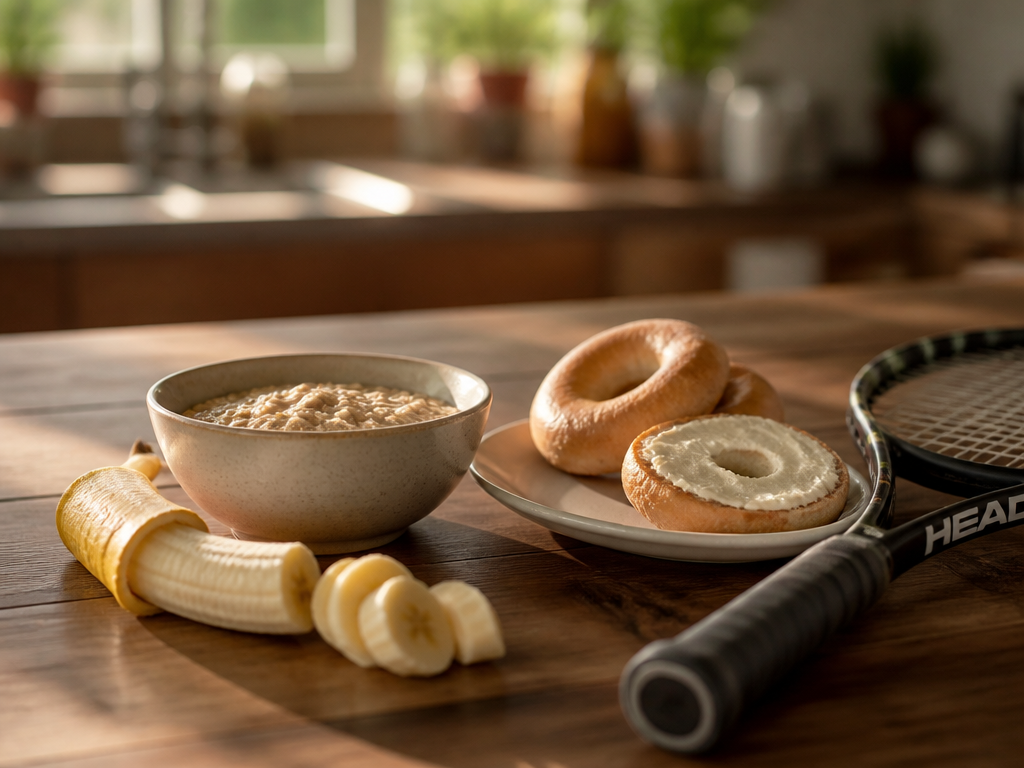
Pre-match nutrition is the part of preparation that gets the least testing and the most folklore. Players who would never restring with an untried gut tension will happily eat a brand-new burrito ninety minutes before a tournament match and then wonder why their legs feel like wet sand in the third set. The verdict, stated plainly so you can stop reading if that's all you need: for beginner and intermediate competitors, what you eat matters far less than when you eat it and whether you've tested it before — settle the timing, repeat foods you already digest cleanly, and the energy crashes mostly disappear.
We are a gear desk, not a metabolic lab. We can't put you on a treadmill with a blood glucose monitor, and we won't pretend to. What we can do is the thing we do with strings and racquets: separate the common practice from the published evidence, log our own repeatable trials, and tell you where the honest gaps are. This piece is structured in three parts — what most players do, what the evidence actually supports, and what one of us does after years of testing it on a club ladder.
What most people do
Three patterns show up again and again among competitive amateurs, and all three are guesses dressed as plans.
The first is the night-before carb dump. A large pasta dinner the evening before a Saturday match, on the theory that you're "loading." For a single match of one to three hours, your muscle glycogen was never the limiting factor, and one big dinner doesn't meaningfully top off stores you weren't going to deplete. It mostly guarantees you sleep poorly.
The second is the nervous skip. Match nerves suppress appetite, so the player eats nothing from breakfast until the warm-up, then hits a wall around the time the first set tightens up. We've watched this produce the classic mid-match collapse: clean groundstrokes for forty minutes, then a sudden loss of foot speed and decision-making that the player blames on "choking" when it was partly fuel.
The third is the untested experiment. New food, new portion, new timing — introduced on the most stressful day of the month. This is where stomach discomfort comes from. The gut is a creature of habit, and competition stress slows digestion on its own. A meal that's fine on a quiet Tuesday can sit like a stone under match pressure.
What unites all three: no rehearsal. Players test their gear and never test their fuel.
What the evidence suggests
Here the sports-science literature is more useful than the folklore, and more modest than the supplement aisle.
On carbohydrate as the working fuel for tennis, the picture is real but smaller than the pasta-night ritual implies. Match-play studies (Kovacs, 2006, reviewing tennis physiology) describe tennis as intermittent high-intensity work where carbohydrate availability supports repeated sprints and stroke quality, particularly as a match extends. The takeaway is not "load the night before" — it's "don't arrive depleted, and have carbohydrate available if you're playing long."
On timing, the most practically useful finding is about the pre-exercise window. A pre-event carbohydrate meal 1–4 hours out improves endurance performance in controlled trials (the general consensus summarized in the position stands of sports-nutrition bodies). The longer end of that window matters for nervous stomachs: more time before play means more digestion done before you step on.
On the crash people fear — reactive hypoglycemia from eating sugar shortly before exercise — the evidence is reassuring and often misunderstood. Some individuals do show a transient blood-sugar dip after pre-exercise carbohydrate, but reviews (for example, Jeukendrup and Killer, 2010, on the rebound-hypoglycemia question) find it rarely impairs performance for most people, and the effect is blunted once you start moving. So the fear of "a banana 20 minutes before will spike then crash me" is, for the majority, overstated.
On the part that's genuinely individual: gut transit and tolerance vary enough that no single timing rule fits everyone, and gastrointestinal symptoms during exercise are common and personal (de Oliveira, 2014, reviewing GI complaints in athletes). This is the honest limit. The literature can tell you the windows; it cannot tell you your stomach.

Here is the practical synthesis as a grid:
| Time before match | What it's for | Sensible choice | Watch out for |
|---|---|---|---|
| 3–4 hours | Main fuel, fully digested | Normal meal: rice or pasta + lean protein | Heavy fat, large portions |
| 1.5–2 hours | Top-up, lighter load | Toast, oatmeal, banana, yogurt | New foods, high fiber |
| 30–45 min | Quick available energy | Banana, dates, small energy chew | Anything you haven't tested |
| In-match | Maintain over long matches | Banana at changeover, diluted sports drink | Relying on it to rescue a skipped meal |
What I actually do
A reviewer note, because this part is personal and the sample is one player over a few seasons of club and local tournament play — not a controlled study, and I'll say so plainly.
I eat a normal carbohydrate-forward meal three hours before I'm scheduled on court — usually rice, chicken, and something green, nothing fried, nothing I haven't eaten a hundred times. Three hours is my number; it's long enough that nerves don't matter because digestion is essentially finished. Players I've compared notes with land anywhere from two to four hours, which is exactly what the variation in the evidence predicts.
About ninety minutes out I stop eating real meals. If I'm hungry I'll have a banana or a slice of toast with honey, and that's it. Then at roughly thirty minutes I eat one banana, every time, as a routine more than a calculation — it's predictable, it sits fine, and the ritual itself settles the pre-match jitter.
In matches that run past an hour I take a few dates or a half-banana at a changeout, sipping a sports drink cut roughly half-and-half with water so it's not too concentrated to absorb. The single most useful thing I've learned is negative: I never introduce anything new on match day. New gels, new bars, a teammate's recommendation — all of it gets rehearsed at practice first, the same way you'd hit with a freshly strung frame before bringing it to a match.
That's the whole protocol. It's boring, and that's the point. Boring digests well.
Who this is for, and who it isn't
This is for beginner and intermediate players who compete and want a starting framework they can adjust — people whose problem is uncertainty, not optimization.
It is not for elite or endurance-specialized athletes managing carbohydrate periodization, anyone with a diagnosed metabolic or digestive condition, or players cutting weight. Those situations need a dietitian, not a gear desk. And if you've had repeated, serious stomach trouble in competition, that's a clinical question and worth a real consultation.
The line you can screenshot: rehearse your fuel like you rehearse your gear, eat your tested meal about three hours out, and stop guessing on match day.
What this piece did not answer
We deliberately left things out. We didn't cover electrolyte and sodium needs, which matter enormously in heat and humidity and deserve their own tested treatment. We didn't quantify in-match fueling beyond "a banana works for me" — the dose-and-timing question over a three-hour match is real and we haven't logged it rigorously. And we couldn't resolve the individual gut-tolerance variation that the literature flags repeatedly; no general article can, because the answer lives in your own practice sessions.
For the science underneath the timing advice, the Kovacs tennis-physiology reviews and the sports-nutrition position stands on pre-exercise carbohydrate are the readable next step. For the stomach question specifically, look at the exercise-GI literature — and then, as ever, test it on yourself at practice before it ever counts.
Evidence grade for the central claim (timing and tested foods matter more than food choice for short-match amateurs): Moderate. The timing and carbohydrate findings are well supported; the individual-tolerance piece and our own protocol rest on small, uncontrolled observation.