Roughly nine of every ten men on the ATP tour string with some form of polyester. That number gets quoted constantly, usually right before someone tells you to switch. It is also close to useless as a recommendation, because the players producing it swing a racquet head at speeds most club members will never approach, and polyester's main benefit only switches on at high speed.
So before the question becomes "should you use polyester tennis strings," it has to become "what does this material physically do, and does your swing trigger the part that helps." Those are different questions. We will take them in order, because the order is the whole point.
What polyester actually is
Most of what gets sold as polyester is technically a co-polyester monofilament: a single solid strand, sometimes with a co-polymer additive or a shaped (non-round) profile. That single-strand construction is the first fact that matters. Compare it to multifilament or synthetic gut, which bundle hundreds of fine nylon fibers to behave more like natural gut — soft, elastic, forgiving.
Polyester is the opposite by design. It is stiff, dense, and abrasion-resistant. A multifilament absorbs impact by stretching; polyester resists it. That single material choice cascades into everything else, good and bad.
The mechanism, in the order it happens
Here is what actually occurs in the fraction of a second a ball is on the strings, step by step.
First, the ball lands and the strings deflect. A stiff polyester bed deflects less than a soft multifilament at the same tension. Less deflection means less stored-and-returned energy, which is why polyester is described as low-powered. The string returns less of the ball's energy as outgoing speed. On a fast swing this is a feature — you can swing hard without the ball flying long.
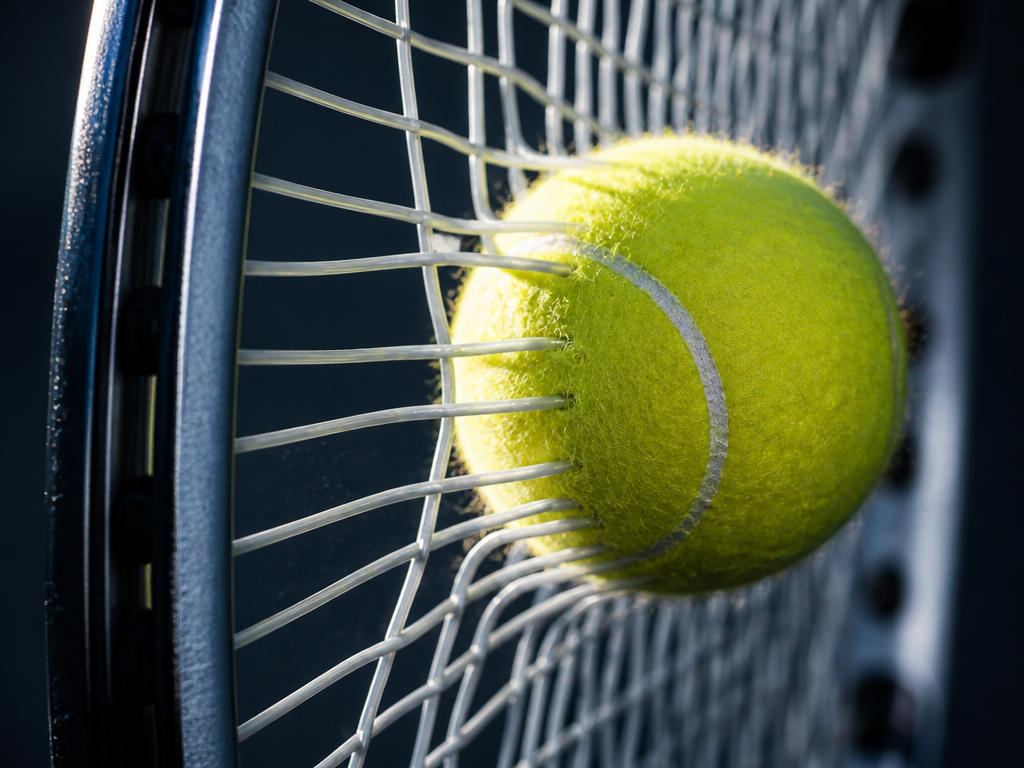
Next, the main strings slide sideways under the spinning ball. Because polyester is slick and recovers its shape quickly, the mains displace laterally during contact and then snap back to position before the ball leaves the bed. That recovery — the snapback — is the part everyone talks about.
Last, the snapping strings add to the ball's rotation on the way out. This is the spin contribution, and it is real. But the size of the contribution depends on how fast and how steeply you were already swinging. The strings amplify the spin your stroke creates. They do not manufacture it. A slow, flat swing gives the snapback very little to work with. This is the single most over-sold point in string marketing, and it is worth being precise about: the racquet-head speed and swing path are the primary causes of spin. Polyester is a multiplier on an input you have to supply.
So the honest version of the spin claim is conditional. Fast, brushing swing: meaningful gain. Modest, compact swing: marginal gain, and you may be paying the material's costs for almost none of its upside.
The cost, in the order it happens
The downsides follow their own sequence, and tracing it explains why two players can call the same string "comfortable" and "brutal."
It starts stiff. Strung at a typical tension, polyester is firmer than nylon from the first ball. Some players read that firmness as crisp, connected feedback. Others read it as harsh. This is genuinely individual and depends on the frame, the tension, and the joint in question.
Then it goes dead. Polyester loses tension faster than most other materials over the first hours of play, and — this is the part marketing blurs — it can keep playing stiff and lifeless long after the numbers have dropped. The string is no longer at the tension you chose, but it has not broken, so it feels like it is "fine." It often is not.
Finally, the arm absorbs the difference. A fresh poly bed is firm; a tired poly bed is firm and low-energy, transmitting more shock back up the chain. Whether that matters to your elbow and shoulder is the unsettled part, and we will come back to it.
Tension loss is not the same as durability
Two different clocks are running. Durability is how long the string takes to physically break. Tension maintenance is how long it holds its playable stiffness. Polyester wins the first race and loses the second. It will outlast a multifilament before snapping, which is why heavy hitters who shred multifilament every session reach for it. But it can be played past its useful life precisely because it refuses to break — the string survives while the playability is long gone. Cutting out an intact-but-dead poly job feels wasteful. Leaving it in is worse.
What changes the verdict: tension, gauge, hybrids
None of the above is fixed, because polyester's feel is heavily modulated by setup. Lowering the tension softens the bed and reclaims some power. A thinner gauge bites more and feels livelier but dies sooner. And a hybrid — polyester in the mains for the snapback and control, a softer multifilament or natural gut in the crosses for comfort — is how a large share of players actually use poly at all. If full polyester reads as harsh to you, the honest next step is usually a hybrid or a lower tension, not abandoning the material.
An honest rule of thumb
If your full-swing groundstrokes regularly sail long with multifilament, and you generate your own racquet-head speed, full polyester or a poly-main hybrid is worth a careful trial. If you play a compact, flatter game, or you have any current arm sensitivity, the material's costs arrive before its benefits, and a hybrid or a comfort-oriented multifilament is the more defensible choice.
| Your game | Reasonable starting point |
|---|---|
| Fast, brushing topspin swing | Full co-poly, mid-low tension |
| Hard but flatter swing | Poly-main hybrid |
| Compact/control swing, no arm issues | Multifilament or hybrid |
| Any current arm pain | Multifilament; poly only via cautious hybrid |
Where the evidence actually stands
The mechanism — snapback amplifying player-generated spin — is well-established and measurable in high-speed video and ball-tracking work. The low-power, high-control character follows directly from material stiffness and is not seriously disputed.
The injury question is the open one. The common claim is that stiff polyester raises tennis-elbow risk, and the biomechanics are plausible: stiffer string returns more shock to the arm. But controlled, long-term evidence isolating string material from racquet, technique, grip size, and play volume is thin, and the confidence in the claim usually outruns the data behind it.
So the unresolved question is not whether polyester is stiffer. It is. The question is whether that measurable stiffness, in a real arm over a real season, causes injury — or merely correlates with the kind of hard, frequent play that does.