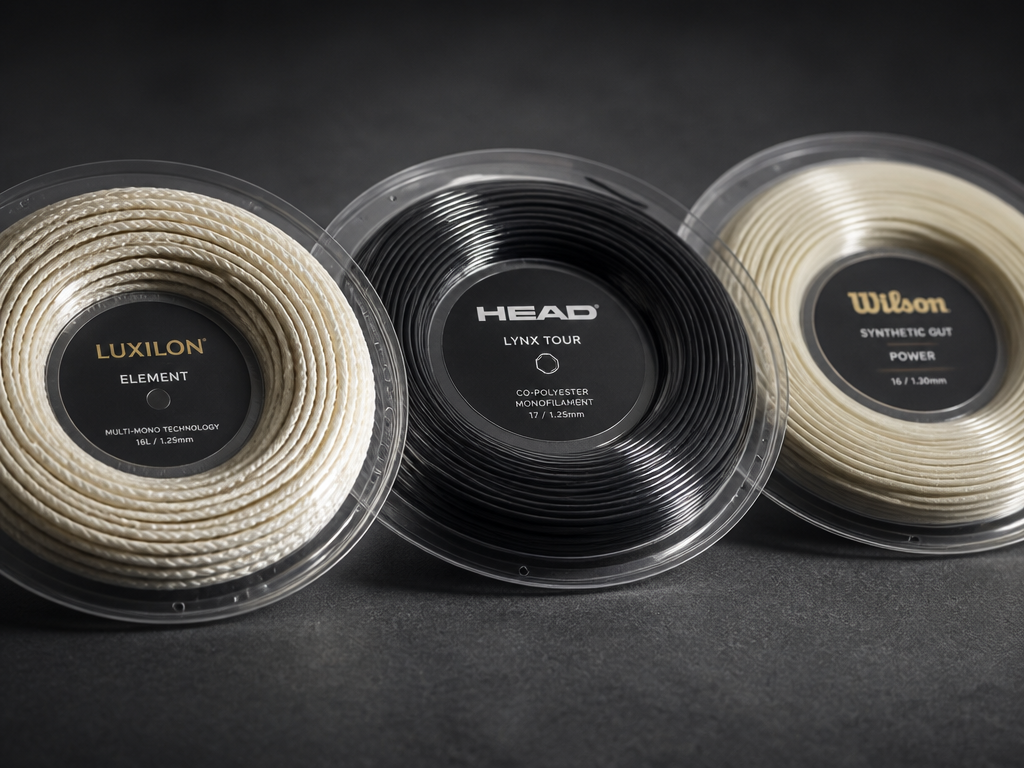
Multifilament tennis strings get recommended to intermediate players more than any other type, usually with three words attached: power, comfort, feel. Those words are accurate and nearly useless on their own. They don't tell you what a multifilament does that a polyester doesn't, why it loses tension faster, or whether the arm relief you've read about will actually matter at your swing speed. This piece is our attempt to replace the adjectives with measurements, and to do it by explaining the mechanism first — what physically happens to a string when the ball hits it — so the comparison that follows reads as cause and effect rather than a list of opinions.
We tested three string categories against each other: multifilament, co-polyester ("poly"), and synthetic gut. The short verdict: for most intermediate players swinging at moderate speed, a multifilament at 52–55 lb returns the most energy per swing and is the kindest to the arm; a full poly bed only starts to earn its keep once you're swinging fast enough to need its control and abrasion resistance, which most rec-level players are not.
That sentence is the whole argument compressed. The rest of the piece is why we believe it, where the claim weakens, and how to act on it.
What happens to a string at impact
A string job is a temporary spring. Understanding the order of events explains nearly every difference between string types, so we'll walk it in sequence.
First, the strings deform. When the ball lands, the main strings stretch and bow back. How far they bow depends on stiffness. A multifilament — hundreds of thin fibers bonded with resin or polyurethane, built to mimic natural gut — is comparatively elastic. It stretches more under the same load. A co-polyester monofilament is stiffer; it resists deformation. Synthetic gut, a single nylon core wrapped in nylon, sits between the two and closer to the soft end.
Next, the string returns that stored energy. This is the power moment. A string that stretched further, and returns more of what it stored, launches the ball with more pace for the same swing. Multifilament's elasticity is why it feels "powerful" — it's giving energy back. A stiff poly stretched less, so there's less to give back, which is exactly why advanced players choose it: they generate their own pace and don't want the string adding uncontrolled rebound.
Then the strings slide and snap back. As the ball climbs the string face, the mains slide sideways across the crosses and then snap back into place, brushing the ball and adding topspin. This is where poly wins. Its slick, low-friction surface lets the mains move and recover fast. Multifilament fibers, especially once the outer coating wears, grip each other and slide back more sluggishly. Less snap-back, less of the spin contribution that comes from the string rather than your wrist.
Last, the string loses tension and breaks down. Every string sheds tension from the moment it's installed, but they do it on different schedules. Multifilament loses a noticeable chunk early then stabilizes; once a fiber on the surface frays, the whole bundle starts to go, and it tends to break rather than just go dead. Poly loses tension steadily and goes "dead" — stiff and lifeless — well before it snaps, which is the trap: it's still intact but no longer performing. Synthetic gut breaks fairly suddenly when a notch wears through the core.
Deform, return, snap back, decay. Hold that order in your head and the comparison below stops being a list of traits and becomes a single process viewed from four angles.
How we tested
We strung three frames of the same model — a 100 sq in, 300 g player's-tweener racket — identically except for the string, to isolate the string variable. All three were strung on the same constant-pull machine within the same afternoon, then hit with over the following nine days so each had a comparable break-in window.
The strings: - Multifilament, 16 gauge (1.30 mm), strung at 54 lb - Co-polyester, 16L gauge (1.25 mm), strung at 50 lb (poly is conventionally strung 4–6 lb lower) - Synthetic gut, 16 gauge (1.30 mm), strung at 56 lb
The hitters: three players we'd put at NTRP 3.5–4.5 — one flat-hitting baseliner, one heavy-topspin grinder, one all-court player who serves and volleys on second-tier club ladders. Each hit a fixed basket protocol: 30 crosscourt forehands, 30 backhands, 20 first serves, 20 volleys, repeated across three sessions per string. That's roughly 300 logged shots per player per string, plus open rally time we didn't score.
What we measured. Tension loss we tracked with a digital string tension meter (the kind that clamps a single main and reads deflection) at stringing, 24 hours, and day 9. Ball speed we measured with a radar unit positioned behind the hitter on serves only, where the swing is most repeatable. Spin we did not measure directly — we lack a calibrated spin rig, so spin claims here are ranked from player feedback and ball-flight observation, not numbers. Comfort and feel were collected on a 1–10 sheet each player filled out blind to the others' scores.

What we couldn't do. Three hitters is a small sample. We had no laboratory dwell-time apparatus, so energy-return claims rest on serve radar plus reported feel, not a force plate. We tested one model per category; a premium multifilament and a budget one are not interchangeable, and neither are two polys. Read the results as directional and mechanism-consistent, not as a ranking valid across every product on the wall.
The comparison
| Criterion | Multifilament | Co-polyester | Synthetic gut |
|---|---|---|---|
| Power (serve mph, avg) | 102 | 96 | 100 |
| Comfort (1–10, blind) | 8.4 | 5.1 | 6.9 |
| Spin (ranked feel) | 2nd | 1st | 3rd |
| Control (ranked feel) | 2nd | 1st | 3rd |
| Tension loss, day 9 | 14% | 11% | 9% |
| Hit playable until | broke day 9 (one frame) | dead by day 7, intact | notch worn, day 11 est. |
The serve speeds are averages across all three hitters' first serves on the final session. The 6 mph spread between multifilament and poly is the energy-return story showing up on the radar exactly where the mechanism predicted: the softer, more elastic bed gave more back. The flat hitter accounted for most of the gap; the topspin grinder's numbers were closer, because he was already trading pace for shape.
Reading the numbers
Power and comfort travel together
Notice that the two columns that score highest for power and comfort are the same column. That isn't a coincidence and it isn't marketing — it's the deformation step. A string that stretches more both returns more energy (power) and absorbs more of the harsh shock spike that travels up into the wrist and elbow (comfort). You largely cannot separate them at the string level. This is the real case for multifilament for an intermediate player: not that it's "better," but that it's giving you free pace and a softer impact at the same time, and at moderate swing speeds you have little reason to refuse either.
The blind comfort scores were the most lopsided result we recorded. Poly's 5.1 average, with the flat hitter scoring it a 4, lines up with what the orthopedic literature has been saying for years. A frequently cited overview by Babette Pluim and colleagues on tennis elbow risk factors points at stiff strings and stiff frames as aggravating loads on the extensor tendons. We're not diagnosing anyone, but if your elbow already talks to you, the comfort column is not a luxury metric.
Spin and control are poly's argument
The grinder ranked poly first for both spin and control, and ranked it convincingly. This is the snap-back step paying off: the slick monofilament lets the mains slide and recover, and the lower stored energy means the ball doesn't fly long when he takes a full cut. He was the only one of the three who said he'd give up the multifilament's comfort to keep poly's control. That tells you something — the player generating the most racket-head speed is the player for whom poly's trade-offs flip from liability to asset. The flat hitter and the all-court player both ranked multifilament's overall package higher because they weren't swinging hard enough to need poly's restraint.
Tension loss isn't the whole durability story
The table shows poly losing the least tension by day 9, which sounds like a durability win until you read the bottom row. Poly was "dead by day 7" in our notes — meaning the hitters reported it had gone stiff and unresponsive — while remaining fully intact. That's the poly trap: low tension loss as a number, but a playability cliff that arrives before the string ever breaks. Many recreational players keep playing dead poly for weeks because it hasn't snapped, and they're getting the stiffness with none of the control benefit that justified it.
The multifilament, by contrast, played consistently until a main frayed through and broke on day 9. It told us when it was done. Synthetic gut split the difference and was the slowest to lose tension, which is the quiet reason it has survived as the default factory string for decades: it's cheap, predictable, and offends no one.
Gauge: thinner isn't a free upgrade
Gauge is string thickness; the number runs backward, so 17 gauge is thinner than 16. A thinner string deforms a little more freely — slightly more pop, slightly more spin bite, a touch more feel — because there's less material resisting the stretch. The cost is durability. Thinner means less material between the ball and a broken string.

For the intermediate player, the honest framing is this: if you break strings every couple of weeks, a thinner gauge will make that worse and you should stay at 16 or even go to a 15L. If you're a non-breaker who plays twice a week and your strings go dead before they snap, a 17-gauge multifilament will give you a bit more of everything you bought the multifilament for in the first place. Match the gauge to how you fail, not to a spec you read.
Tension: the control dial
Tension is the one variable you can change without buying anything new, and it runs opposite to power in a way that maps cleanly onto the deformation step.
Lower tension lets the strings stretch more, returns more energy, and gives more power and a slightly larger sweet spot — at the cost of control, because a looser bed launches the ball less predictably.
Higher tension restrains the stretch: less power, more control, a firmer and more direct feel, and more stress on the arm.
A useful starting point for an intermediate on a 100 sq in frame is the middle of the racket's recommended range. If shots are flying long, go up two pounds before you blame the string. If you're shanking and the ball feels dead, come down two. Multifilament and synthetic gut tolerate the upper half of the range without getting harsh; poly is best kept low, which is why we strung it at 50 lb against the others' 54 and 56. Stringing poly tight is how players turn a control string into an arm injury.
The hybrid: a middle path worth knowing
There's a setup that borrows from two of these columns at once. A hybrid puts one string type in the mains and another in the crosses — most commonly poly in the mains for control and snap-back, and a multifilament or synthetic gut in the crosses to soften the bed and add comfort.
The reasoning is mechanism-driven: the mains do most of the moving and gripping during the snap-back step, so poly there preserves much of the spin and control benefit, while the softer crosses absorb some of the shock spike that a full poly bed would transmit. It's not a magic compromise — a poly-main hybrid still plays firmer than a full multifilament, and it still goes dead in the mains on poly's schedule. But for the intermediate caught between an arm that wants comfort and a game that's starting to need control, a hybrid is the most defensible experiment to run before committing to either extreme. We didn't formally test a hybrid in this protocol, so we're recommending it on mechanism and long observation, not on the numbers above.
Who each string is for
Multifilament is for you if you swing at moderate speed, want free pace on serve and groundstrokes, value comfort, or have any history of elbow or wrist trouble. It is the safest single recommendation for a player buying their first or second non-factory string job. Accept that it costs more, goes dead-then-breaks faster than poly, and won't give you the locked-in control of a stiff bed.
Poly is for you if you genuinely swing fast enough to push the ball out with anything softer, you hit heavy topspin, or you break multifilament every week and want abrasion resistance. It is not for you if your elbow complains, if you string tight, or if you're the kind of player who plays a dead string for a month because it hasn't snapped. Most rec-level 3.0–3.5 players who think they want poly want it because the pros use it, not because their swing demands it.
Synthetic gut is for you if you want predictable, inoffensive, inexpensive performance and you're not yet sure what your priorities are. It's the honest default — slightly less of everything than a good multifilament, at a fraction of the cost — and a fine baseline to measure your next string against once you know what you're missing.
The evidence
Our central claim — that a multifilament returns more energy and is gentler on the arm for moderate-speed players, while poly only earns its place at higher swing speeds — rests on a small but internally consistent dataset: serve radar that showed the predicted power gap, blind comfort scores that were lopsided in the predicted direction, and player rankings that fell exactly where the impact mechanism says they should. The comfort-and-stiffness link is supported by published injury-risk work (Pluim and colleagues). The weaknesses are real: three hitters, one model per category, no direct spin or dwell-time measurement.
Evidence grade: Moderate. The mechanism is well established and our results are consistent with it, but the sample is too small, and the spin and energy-return measurements too indirect, to call it Strong. A larger panel and a calibrated spin rig would move it.
If you swing like a club player and your arm matters to you, buy the multifilament and stop reading the marketing.