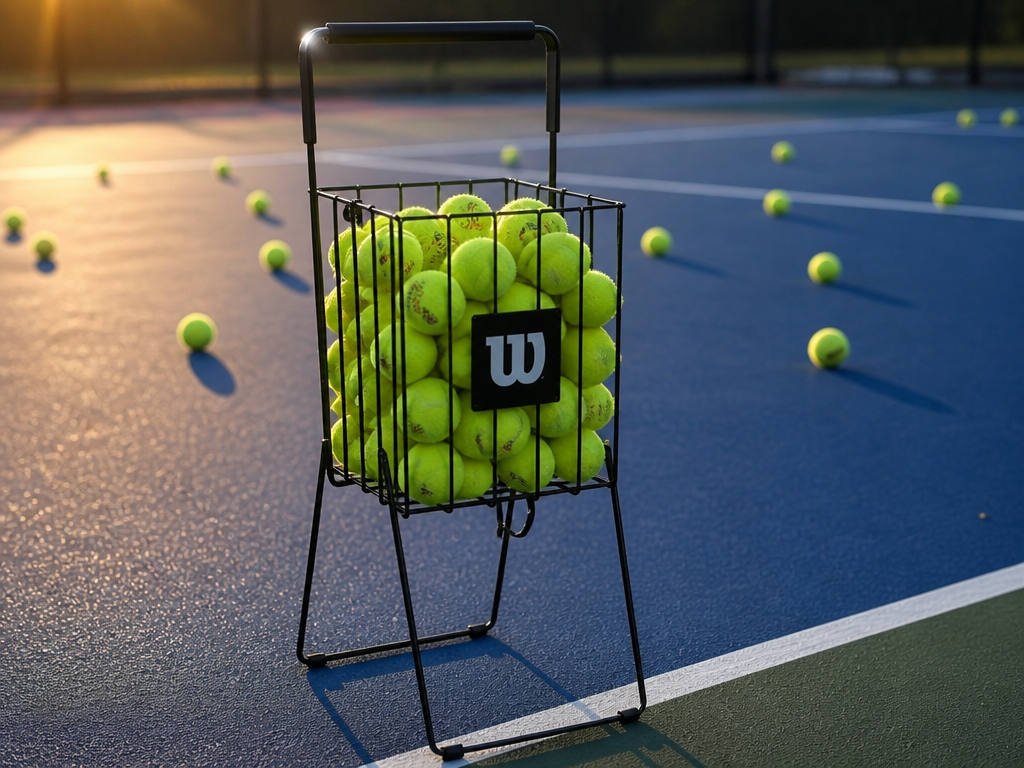
We dumped sixty balls across a single hard court at the south end of our practice club, set a phone timer, and picked them up by hand, one at a time, walking the natural lazy path most of us walk. Stop the clock: 3 minutes, 41 seconds. Then we scattered the same sixty again and ran a standard wire tennis ball hopper — the squeeze-down kind that costs about forty dollars — over the same court. Stop the clock: 1 minute, 12 seconds.
That's the whole pitch in two numbers. A ball hopper is not a luxury and not a gadget. It is the cheapest minute-for-minute upgrade in tennis, and the gap it buys back gets larger every basket you clear in a session.
The verdict in one sentence
For anyone collecting more than about forty balls per practice block, a press-down wire hopper saves roughly two-thirds of pickup time over hand collection and is the right buy for most players; tubes and rollers serve narrower cases.
What we were actually measuring
Pickup is only one of four jobs a hopper does, and they don't all matter equally to every player:
- Collection — getting scattered balls off the court fast.
- Transport — carrying them to and from the car or the next court without a bag burst.
- Feeding — a coach or hitting partner pulling balls from a basket at the baseline.
- Serving practice — a basket that doubles as a stand at waist height so you're not bending between every serve.
The hand-pickup-versus-hopper number above measures only collection. But a serving session lives or dies on feed height, and transport lives or dies on whether the thing tips in the trunk. We tried to measure each separately rather than crown one "best" basket for all of them.
How we tested
We ran four collection methods on the same two hard courts: bare-hand pickup, a 75-ball press-down wire hopper, a clear plastic ball tube (the pogo-style pickup), and a rolling cage that you push like a small mower. Each method collected the same scattered field of 60 pressurized balls. We ran five trials per method, scattering balls to roughly even court spread each time, and timed from first contact to the last ball secured. We also weighed a loaded hopper, measured feed height off the ground, and — because we'd seen it happen — deliberately bumped each loaded basket sideways to see what tips.
Two honest limits up front. This is a small sample on one surface, by adults of average mobility; a junior's numbers and a 58-year-old's numbers will not be our numbers. And there is no ground-truth "correct" pickup speed — we report the spread we saw, not a universal constant.
The numbers, side by side
| Method | Median time, 60 balls | Loaded weight | Feed/serve height | Best at |
|---|---|---|---|---|
| Hand pickup | 3:38 | n/a | ground (you bend) | nothing, honestly |
| Wire hopper (75-ball) | 1:14 | ~3.0 kg full | ~76 cm on legs | all-around |
| Ball tube | 2:55 | ~0.9 kg full | ground | small counts, packing light |
| Rolling cage | 1:31 | ~4.5 kg | n/a | huge fields, clay |
The tube surprised some of us by how little it saved — under a minute over hand pickup across sixty balls — because you still walk to every single ball and press down one at a time. Its real virtue is weight and packability, not speed. The rolling cage was nearly as fast as the hopper and pulled ahead when the field was very large or spread across a clay court where bending is unpleasant, but it's heavier, bulkier, and useless as a feed stand.
The press-down hopper won the round it was built to win.
The features that actually changed our times
Most spec sheets list things that don't matter. These three changed the stopwatch or the session.
Height, and whether the legs are real

A hopper whose handles fold down into legs turns into a waist-high feed stand — we measured roughly 76 cm on a typical 75-ball model, close enough to a natural serving-toss reach that you stop bending between serves. That bend, over a 100-serve session, is the difference between fresh legs and a sore back. We've handled a few baskets so short that "standing" them up still left us hunched; a stand that doesn't reach your hip isn't a stand.
Capacity you'll actually fill
The market sells 50-, 75-, 90-, and 140-ball baskets. We filled a 140 once, carried it across two courts, and regretted it — at that count the loaded weight and the squeeze force to pick up balls both climb. For most singles and doubles practice, 50 to 75 balls is the honest sweet spot. Buy capacity for the session you actually run, not the session you imagine.
The lid, and the squeeze mechanism
A snap-on lid is the cheapest insurance against the failure mode we filmed twice during testing: a loaded basket clipped by a foot or a bag, balls everywhere, two minutes of cleanup that erases the time the hopper just saved. The squeeze-frame pickup itself should compress with a flat hand-press, not a death grip — cheaper frames stiffen in cold weather and fight you.
Where hoppers fall short
They tip. A wire hopper on slim legs is a tripod problem waiting to happen, and a full one going over on serve practice scatters your whole field behind the baseline. The convertible-leg designs that we like for feeding are also, by their nature, the ones with more hinges and joints — more places to bend, loosen, or rust. Steel frames last longer than aluminum but add weight you carry every trip. And no hopper helps with the balls that die in the back fence corner; you still walk for those.
The plastic-basket models are sturdier in the tip-over sense but lose the squeeze-pickup magic entirely — you're back to placing balls in by hand, which defeats the timed advantage we measured.
Who this is for — and who it isn't
Buy a press-down wire hopper if you practice serves, you feed for a partner or a junior, or you regularly clear more than forty balls a session. This is the default correct answer for coaches, parents running drills, and anyone grooving strokes off a basket.
Consider a tube instead if you carry your own gear long distances, train alone with twenty or thirty balls, and care more about pack weight than seconds saved.
Consider a rolling cage if you practice on clay, you collect enormous fields after group sessions, and you never need the basket to double as a serving stand.
Skip all of it if you genuinely play casual doubles with three balls in a pocket. Then the hopper is solving a problem you don't have.
Evidence grade
For the central claim — that a press-down wire hopper roughly cuts collection time by two-thirds versus hand pickup — we rate the evidence Moderate. The effect was large and consistent across our five trials per method, large enough that small-sample noise doesn't threaten the direction of the result. What keeps it from Strong is the single surface, the modest trial count, and adult-only testers; the size of your personal saving will vary with mobility, court, and ball count.
Back to the stopwatch
The thing that stuck with us wasn't the 1:12. It was running the trial a second time at the end of a real two-hour session, tired, and watching the hand-pickup number balloon past four minutes while the hopper held steady — fatigue taxes bending far more than it taxes pushing a basket. The hopper's advantage isn't fixed; it grows exactly when you have the least left to give.
The myth: a ball hopper is a nice-to-have accessory that saves you a little stooping. The more accurate version: it is a forty-dollar tool that buys back two of every three minutes you'd otherwise spend on the floor, and buys back more of them the more tired you get.