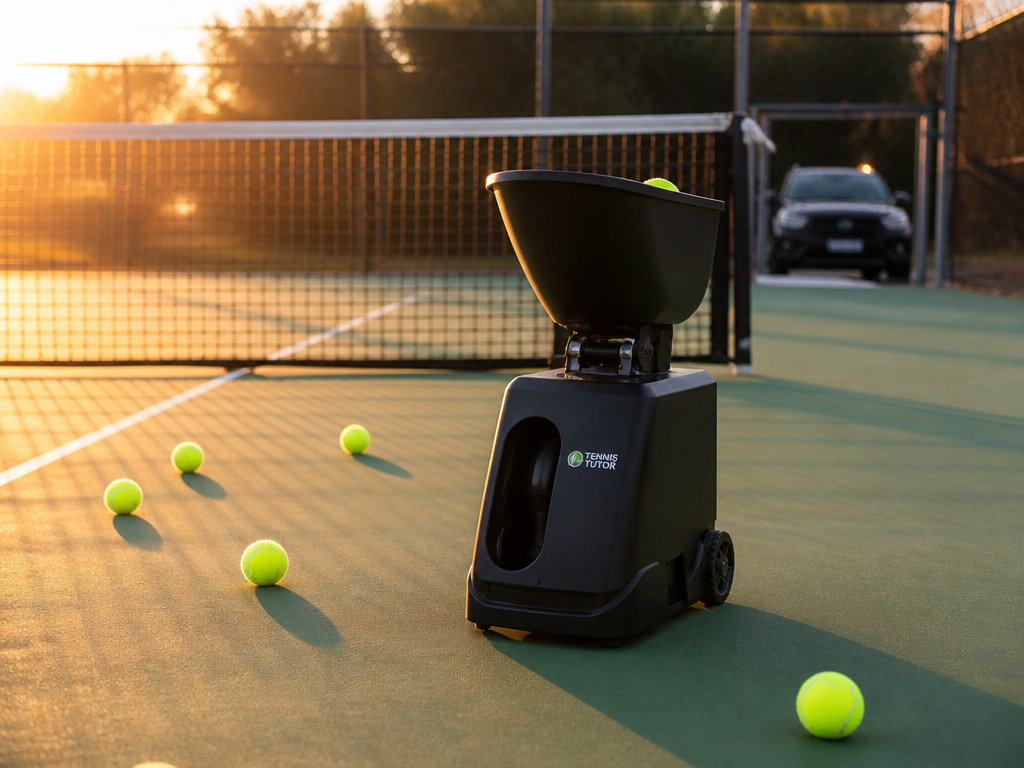
It is tempting to read a ball machine price list as a quality ladder — that the $2,800 machine simply does everything the $700 machine does, but more. We have hit balls fed from both ends of that range, and the ladder is a fiction. The most expensive tennis ball machines solve problems that many buyers will never have, while the cheapest ones fail at the one task that determines whether the machine gets used at all: getting onto the court without becoming a chore.
So here is the verdict before the reasoning: the right machine is the one matched to your court access and storage reality, not the one with the longest feature list. A 35-pound battery unit you actually carry beats a 50-pound AC unit that lives in the garage because lugging it out is a project.
To see why, it helps to walk through what happens during a session, step by step, because each step is where a specific machine either earns its price or wastes it.
What actually happens in a session
A ball machine workout runs in a fixed sequence, and every purchase decision maps to one stage of it.
First, you move it. You carry or wheel the machine from car to court, set it down behind the baseline, and either plug it in or rely on its battery. Nothing else matters until this happens, and this is where most buyer's remorse originates.
Second, you load and power on. You dump 50 to 150 balls into the hopper. The machine spins up its throwing wheels.
Third, it feeds. Balls drop into the wheels one at a time at a set interval, launching toward you. The feed rate, speed, and spin are whatever you dialed in.
Fourth, it oscillates — or doesn't. The launch head moves to send balls to different spots, or it fires to one place until you change settings.
Fifth, you retrieve. You pick up every ball you hit, refill the hopper, and repeat.
Notice that two of these five stages — moving it and retrieving the balls — have nothing to do with launch specs. They are the stages that decide whether you train twice a week or twice a month. Marketing copy lives almost entirely in stage three. That imbalance is the whole problem with shopping by spec sheet.
The first decision: where it lives, how it travels
Before anything else, answer two questions. Where will the machine be stored, and how far is it from there to the court surface?
If you store it in a car trunk and walk it across a parking lot and through a gate, weight and a genuine wheel-and-handle system are the dominant variables. We consider anything over about 45 pounds a two-trip or two-person object once you add a full hopper. Battery models in the 30–40 pound range are the ones that get used.
Power follows from this. AC machines never run out of charge but tether you to an outlet, which most public courts lack. Battery machines free you from the cord but introduce charge anxiety — a real 2 to 4 hours of play per charge for mid-tier units, less in cold weather. If your home court has power at the fence, AC removes a whole category of worry and usually costs less. If you bounce between public parks, battery is the only honest answer.
This single decision — storage and transport — eliminates more than half the catalog before you have looked at a single launch spec. Make it first.
Feeding and oscillation: the part that shapes practice
Once the machine is on the court, the feeding mechanism determines what kind of practice you actually get.
Oscillation is the headline feature, and it comes in two forms. Random oscillation sends balls to unpredictable spots, which trains reaction and footwork — useful for intermediate and advanced players grooving movement. Programmed oscillation fires a fixed sequence (deep forehand, short backhand, and so on), which is better for drilling a known pattern. Cheaper machines often offer only two-line oscillation or none. We prefer machines with both random and at least basic programmed modes, because a player's needs change month to month.
There is also a quieter distinction: internal versus external oscillation. Internal oscillation moves balls by shifting the throwing wheels inside the head, so the machine sits flush and looks like it is firing straight ahead. External oscillation visibly swivels the head, which can telegraph direction to a sharp-eyed player. For pure drilling this rarely matters; for disguised, reaction-based work, internal is the cleaner experience.
Spin, speed, and feed rate: where the spec sheet oversells
This is stage three — the numbers brochures shout about — and it is where buyers most often overpay.
Top speeds of 70–80 mph appear on many machines. Few intermediate players train productively above 50 mph, and the highest settings exist mostly to claim a number. Topspin and backspin matter more: a machine that delivers heavy, consistent topspin forces you to take the ball at a realistic height, which a flat-feeding budget unit cannot replicate. Feed rate — typically adjustable from one ball every 2 seconds to one every 10 — is the genuinely useful control, because tight intervals build the cardio and recovery that flat drilling does not.
If you are choosing where to spend, spend on spin quality and oscillation flexibility, not on a top speed you will never select.
Three tiers, compared
| Tier | Typical price | Best matched to | Honest limitation |
|---|---|---|---|
| Entry battery | $600–$900 | Public-court players who need portability above all | Limited or no programmed oscillation; lighter spin |
| Mid-range | $1,100–$1,800 | Most intermediate-to-advanced players | Often heavier; remote and app control cost extra |
| Premium / programmable | $2,000–$3,000+ | Coaches, teaching pros, players drilling complex patterns daily | Pays for software and drills many buyers never program |
These are representative bands, not endorsements of specific models — but the pattern holds across brands we have handled.
Who this is for, and who it isn't
A ball machine is for the player who has reliable court access and will train solo or with one partner on a repeatable schedule. It rewards groove-work: serves returned, approach shots drilled, footwork patterns repeated past the point a hitting partner would tolerate.
It is not for the player without dependable court time, the player who only enjoys live points and dreads ball pickup, or the parent buying it to motivate a child who is not already motivated. The machine does not create the habit; it amplifies one that exists.
If your honest weekly use is once a fortnight, rent or borrow before buying. The retrieval stage — picking up 100-plus balls every refill — is the silent reason machines end up in closets.
So return to the price ladder we started with. It is not that the $2,800 machine is worse; it is that price measures the ceiling of what a machine can do, while your court access and your tolerance for hauling and ball pickup measure what it will do for you. Buy for the second number. It is the only one you will live with.
Evidence grade: Moderate. The mechanism and trade-offs here come from sustained hands-on use across price tiers; we did not run standardized launch-velocity or battery-life benchmarks under controlled conditions, and manufacturer spin and runtime figures should be treated as ceilings, not guarantees.