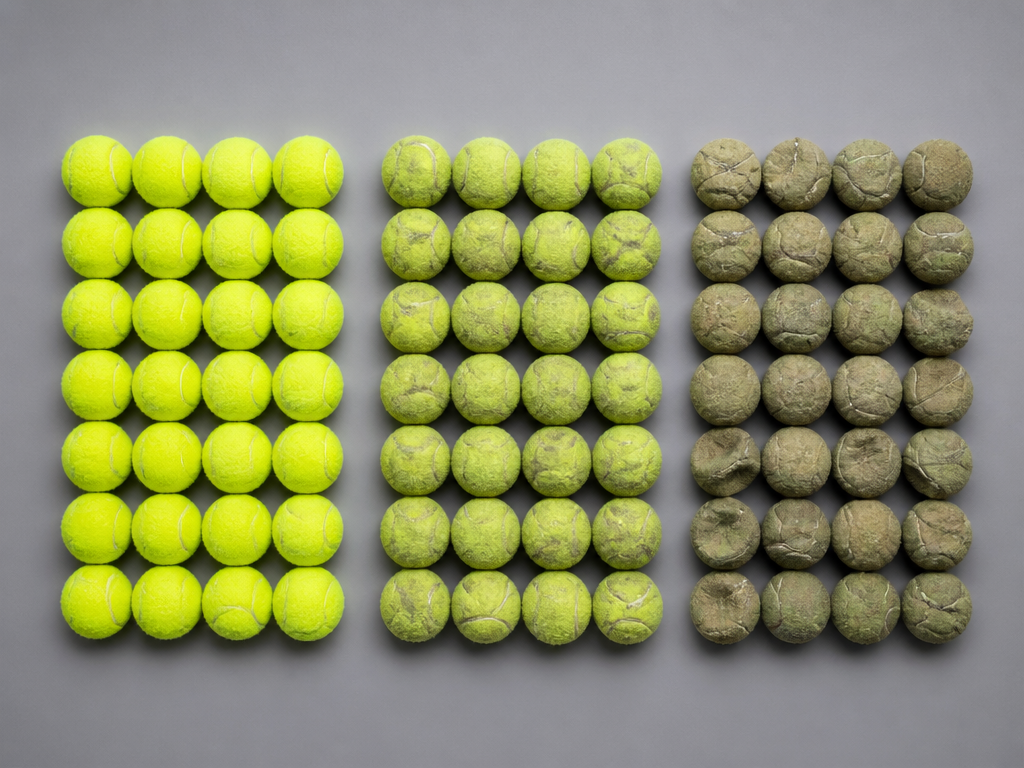
If you go through tennis balls in volume — a coach feeding a clinic, a club running ball machines, a player who hits five mornings a week — the math on new cans stops making sense fast. So does bulk tennis ball buying when you only need balls that bounce, not balls that pass a tournament inspection. A used ball at a dime or a quarter does the same job as a $1.15 new one for a lot of feeding drills, and for non-tennis uses it does the job exactly as well. The question isn't whether to buy used. It's where the used balls actually come from, and which channel gives you a predictable grade for the price.
We sourced and graded used balls from three channels over six weeks to find out.
What we set out to test
We weren't comparing new versus used — that decision is yours to make based on what you're hitting for. We were comparing the three realistic ways to buy used tennis balls in quantity and asking which one delivers usable balls at a price that beats new cans without burning a weekend on logistics.
The three channels:
- Club and facility pickup — buying the balls a tennis club or college program retires, usually by the trash-bag.
- Online marketplace lots — Craigslist, Facebook Marketplace, eBay listings of used balls.
- Dedicated used-ball resellers — outfits that collect, sort, and resell used balls in graded lots, often pitched at dog owners and dog daycares.
A note before the numbers: prices in the used market are local and volatile. The figures below are what we paid, not a national rate card. Treat them as a calibration point, not a guarantee.
How we ran it
We bought from all three channels in the same window, in the same metro area, and graded every ball we received the same way.
Bounce test. We dropped each ball from 100 inches onto a concrete slab and measured rebound height against a fresh control ball (a new pressurized ball off a just-opened can). A new ball rebounded to roughly 53–55 inches in our setup, consistent with the ITF range. We logged each used ball's rebound as a percentage of the control.
Grade buckets. We sorted into three buckets: Practice-usable (rebound within ~85% of control, intact felt, no soft spots), Low-bounce (60–85%, fine for feeding, dogs, or furniture), and Dead (under 60% or visibly compromised).
Sample sizes. Club pickup: 96 balls across two bags. Marketplace: 60 balls across three lots. Reseller: 50 balls across one graded order. Small samples, single metro, one season of wear — we'll flag where that limits the verdict.
We did not control for how the balls were stored before we got them, and we couldn't verify how many hours each had been hit. That's the honest gap in this kind of testing: with used goods, provenance is mostly a guess.
The three channels, side by side
| Criterion | Club / facility pickup | Marketplace lots | Used-ball reseller |
|---|---|---|---|
| Price per ball (our buys) | ~$0.04–0.10 | ~$0.10–0.25 | ~$0.30–0.50 |
| % Practice-usable | 31% | 22% | 8% |
| % Low-bounce | 52% | 49% | 78% |
| % Dead | 17% | 29% | 14% |
| Grade consistency | Low | Lowest | Highest |
| Sourcing friction | Medium (relationship) | High (per-listing hunt) | Low (one order) |
| Best minimum quantity | 50+ | 20–60 | any |
Price per ball
Club pickup won outright. Two clubs we asked gave us their retired balls for the price of hauling them away, which pencils out to pennies once you account for fuel. One charged a token $5 for a contractor bag of roughly 50. Marketplace lots ran higher because the seller wants something for their trouble — a typical listing was "20 used balls, $5." The dedicated resellers were the most expensive by a wide margin, because you're paying for the sorting and the convenience, plus shipping.
What you actually get for the money
This is where the cheap channel shows its cost. Club bags were a grab-bag: the 31% practice-usable rate sounds decent until you realize you're also hauling home a 17% dead rate, and you sort all of it yourself. Marketplace lots were the most unpredictable — one $5 lot was nearly all flat balls a seller clearly wanted gone, while another was a genuine bargain of recently-retired league balls.

The resellers told the opposite story. Only 8% hit our practice-usable bar, because nobody retires a still-lively ball to a reseller. But their grading was honest: when a lot was sold as "low-bounce, good for dogs," that's precisely what arrived, with the lowest dead-ball rate of any channel. You pay more and you get exactly what's on the label.
Sourcing friction
Marketplace buying was the biggest time sink — refreshing listings, messaging sellers, driving to pickups, gambling on quality sight-unseen. Club pickup took one relationship to set up and then became routine; the friction is in the asking, not the repeating. Resellers were a single online order. For anyone whose time has a dollar value, that gap matters more than the per-ball price.
The thing nobody grades: pressure, not felt
The most common mistake we saw — in listings and in our own first instinct — is judging a used ball by its felt. Bald felt looks dead. It often isn't. A scuffed, balding ball can still bounce within practice range if the core held pressure.
The opposite is the real trap. A pressurized ball loses its bounce because gas escapes through the rubber core, not because the felt wears. A ball can look nearly new and rebound at 55% of control because it's been sitting open in a hopper for a year. Steele and colleagues, working on ball degradation, have shown rebound falls off well before felt visibly fails — which is why our bounce test, not a visual inspection, drove every grade. If you buy used, drop-test a sample before you commit to a source. The listing photo tells you almost nothing about the only property that matters.
Pressureless balls, worth noting, sidestep this entirely — their bounce comes from a solid core, so a used pressureless ball plays much closer to how it started. The trade-off is that pressureless balls feel heavy and dead off the racquet even when new, so they were never lively to begin with. If a used lot is pressureless, age is less of a concern than it would be otherwise.
Who each channel is for
Club and facility pickup is for the high-volume, hands-on buyer — coaches, ball-machine owners, anyone who'll sort a bag while watching TV and doesn't mind asking a pro shop for a favor. Lowest cost, most labor, best for people feeding drills where exact bounce doesn't matter.
Marketplace lots are for the opportunist, not the planner. If you check listings anyway and can pounce on a good one, you'll occasionally beat every other channel. As a reliable supply line, it's the weakest of the three.
Dedicated resellers are for the buyer who wants a known quantity with zero hunting — dog owners, daycares, classrooms putting balls on chair legs, care facilities padding walker feet. For these uses, "low-bounce" is a feature, the grading is accurate, and the higher per-ball price still undercuts new cans dramatically. It is the wrong channel for a coach who wants the liveliest used balls available.
It isn't for the competitive player who needs consistent bounce for serve-and-rally practice. No used channel delivers that reliably. Buy new for match-prep sessions and save the used stockpile for feeding and warmups.
The verdict
For drill feeding and non-tennis uses, club pickup wins on price and resellers win on predictability — and the two should be played as a pair, not an either/or. Build a relationship with a club for your cheap bulk supply, and keep a reseller bookmarked for when you need a graded lot without the sorting. Marketplace lots are a bonus when they appear, not a plan you can build on.
Evidence grade: Moderate. The bounce method is sound and the cost gaps are large enough to survive our error bars, but the sample is small, single-metro, and one season deep. Grade rates almost certainly shift by region and time of year.
What we didn't answer
We didn't test how used balls hold up after you buy them — whether a low-bounce ball degrades further over a season of feeding, or stabilizes. We didn't price the shipping math for resellers across regions, which could flip the per-ball comparison for rural buyers. And we never found a reliable national source for bulk used balls; the supply is stubbornly local. If you want to chase that, start with college athletic departments at season's end and municipal court programs — both retire balls in volume and rarely have a buyer lined up.