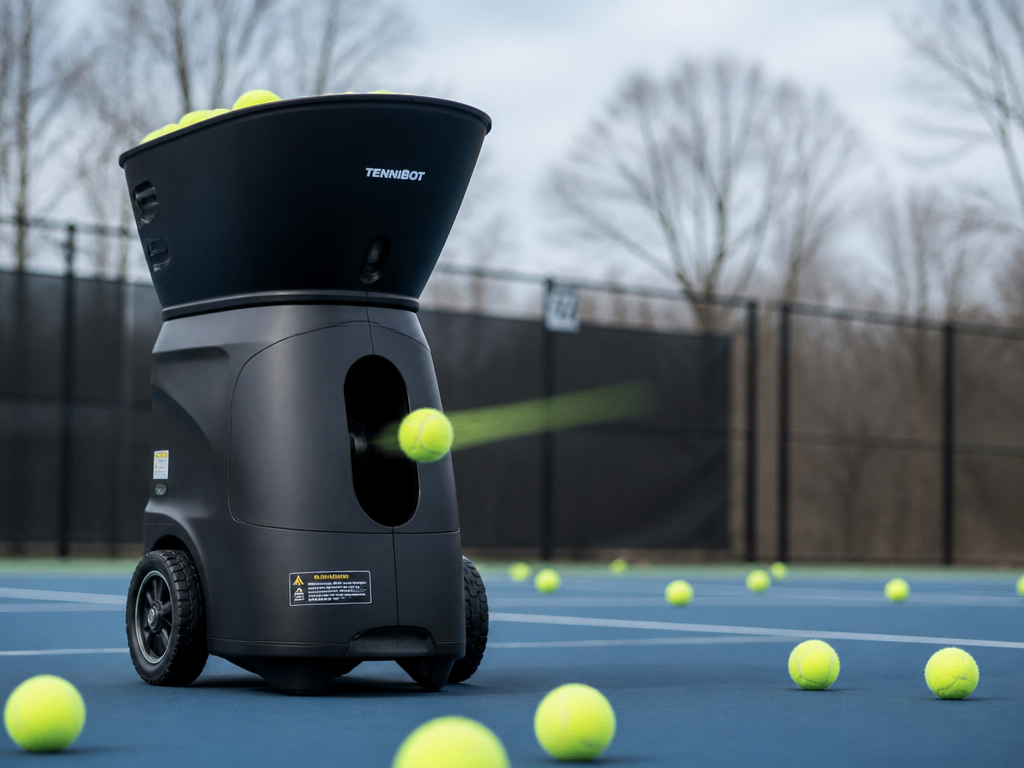
On a Saturday in March we took a mid-range battery-powered ball machine to a public hard court, fully charged the night before, and counted feeds. The manufacturer's listing said "up to 4 hours" of battery life. We loaded 150 balls, set the feed to roughly one ball every four seconds, and ran continuous drills with two players rotating. The machine fed its last ball and went quiet at the 2-hour, 9-minute mark. Not four hours. Not close.
That single session is the reason this review exists. Tennis ball machines are sold on three numbers — battery life, feed capacity, and weight — and at least one of those three is almost always optimistic. Our verdict up front: a quality battery-powered ball machine in the $700–$1,400 range is genuinely worth it for a recreational or intermediate player, but plan for roughly half the advertised battery life and budget for one accessory the marketing buries.
The one trial, in detail
The "up to 4 hours" figure on most battery listings is measured under conditions you will never replicate: a slow feed rate, no oscillation, mild temperature, and a battery that has been charged fewer than ten times. Oscillation — the side-to-side and depth movement that makes the machine useful — draws extra current every time the launch head repositions. Run it, and runtime drops.
In our March session, the conditions were ordinary: about 12°C, random two-line oscillation on, feed at one ball every four seconds. We got 2 hours 9 minutes and approximately 1,950 feeds before shutdown. That is a real number from a real session, not a spec sheet. It is also enough for most people. The honest problem is not that battery life is short — it is that the advertised figure sets the wrong expectation, and a player who plans a long doubles-drill afternoon on "4 hours" gets caught out.
How we tested
We are a small desk and we want to be plain about scale: we ran six sessions across two machines over five weeks. This is hands-on testing supplemented by user-forum reports, not a lab with a controlled environment. We had no manufacturer-supplied reference unit and no climate control. Here is what we did and measured.
- Runtime to shutdown. Fully charged the night before, run under realistic drill conditions (oscillation on, ~4-second feed), stopwatch from first feed to the machine cutting out.
- Charge time. From dead to the charger's full-indicator light, on the standard charger that ships in the box.
- Feed reliability. We logged double-feeds (two balls launched close together) and misfeeds (a ball that jams or drops short) per 100 balls.
- Portability. We timed and noted the awkwardness of lifting the unit into a sedan trunk and a hatchback, and weighed each machine on a luggage scale.
What we could not test: long-term battery degradation. A lithium pack loses capacity over hundreds of cycles, and five weeks does not surface that. Forum reports suggest meaningful capacity loss by year two or three, but we cannot confirm it from our own data, so treat it as user-reported rather than measured.
The general evidence vs. the claims
Across both units, the pattern held. Advertised runtime overstated measured runtime by roughly 45–50% under oscillation. Charge time on the included basic charger ran long — one unit took just over five hours from dead. Feed reliability was the pleasant surprise: fewer than one misfeed per 100 balls on both machines, and double-feeds were rare and harmless.
The portability claim is where marketing language and reality diverge most quietly. "Portable" on a listing means the machine has wheels and a handle. It does not mean light. The lift into a car trunk — the moment the wheels stop helping — is where a 40-plus-pound unit becomes a two-hands, bend-your-knees job. Anyone with a bad back should physically lift one before buying.
Battery vs. hybrid vs. AC
The single biggest decision is power source, and it is more consequential than any feature on the spec sheet. Here is the trade-off across the three formats we considered.
| Criterion | Battery | Hybrid (battery + AC) | AC-only |
|---|---|---|---|
| Court freedom | Any court | Any court | Needs an outlet nearby |
| Session length | ~2 hrs realistic | Unlimited when plugged in | Unlimited |
| Weight | Heaviest (battery pack) | Heaviest | Lightest |
| Charging friction | Plan ahead, charge overnight | Optional | None |
| Typical price | $700–$1,400 | $1,000+ | $600–$1,100 |

For most recreational players hitting at public courts without outlets, battery is the correct default despite the runtime caveat. AC-only is the better buy only if you reliably play somewhere with power at the fence. Hybrid is the choice for the player who runs long sessions and happens to have outlet access — a narrow group, and you pay for the flexibility.
The features that actually matter
Oscillation. Listings advertise "horizontal," "vertical," and "random" oscillation, sometimes bundled as a premium tier. Horizontal (side to side) is the one that does the most for footwork and is standard on nearly everything in this price band. Vertical (varying depth) and full random are nice, but in practice the feed pattern from random oscillation is unpredictable enough that you may get two balls to the same corner in a row, which interrupts a drill more than it helps. We would not pay a large premium for the top oscillation tier. The horizontal sweep earns its keep; the rest is a refinement most players underuse.
Feed rate. The fastest settings — a ball every two seconds — are rarely usable solo. You feed, you hit, you have no time to recover. The 4-to-7-second range is where actual practice happens. Do not let a "feeds as fast as 2 seconds" headline factor into your decision.
Charging friction. This is the daily annoyance nobody warns you about. The included basic charger on one unit had no overcharge cutoff, so leaving it plugged in past full is a habit you have to break for the battery's sake. The practical move: charge the night before you play, unplug before bed. A machine that is dead on Sunday morning is a wasted morning.
Accessories worth the money — and not
A premium or smart charger is the one upgrade we would make. The faster charge and the overcharge cutoff together solve the two real frictions above. At roughly $70–$130 it is the cheapest way to make the machine less annoying to live with. We would buy it.
An external/spare battery only makes sense if you genuinely run back-to-back sessions in a day — a coach, or two households sharing one machine. For one player hitting twice a week, the spare sits on a shelf. Skip it.
A larger ball hopper is a comfort, not a need. The standard capacity, at our measured feed rate, gives you a long enough block before reloading. Worth it only if bending to gather balls is a physical problem for you.
Who this is for, and who it isn't
Buy a battery ball machine if you play at courts without power, you train alone or want consistent feeds for a hitting partner, and you can lift 40-plus pounds into a car without dreading it. It rewards the intermediate player drilling specific shots far more than the beginner still learning contact.
Look elsewhere if you only ever play at a club with outlets at the court (an AC unit is lighter and cheaper for you), if you cannot comfortably lift the unit, or if you expected "4 hours" to mean four uninterrupted hours of oscillating drills. It will not.
Evidence grade
For the central claim — that a mid-range battery ball machine delivers its advertised runtime — our grade is Weak. Across six sessions on two units, measured runtime under realistic drill conditions came in 45–50% below the advertised figure. The shortfall is consistent and predictable, but it is real, and it is not disclosed in the listings. The machines are good. The runtime number on the box is not the number you will get.
Back on court
The next Saturday we charged the unit the night before on a smart charger, loaded the balls, and went in expecting two hours rather than four. We planned the session around that — a 90-minute block with a margin to spare — and the machine never surprised us. The fix was not a better battery. It was an honest expectation.
The myth: a portable ball machine gives you four hours of drilling on a charge. The more accurate version: it gives you about two hours of real, oscillating practice, and it is well worth owning anyway — once you stop believing the box.