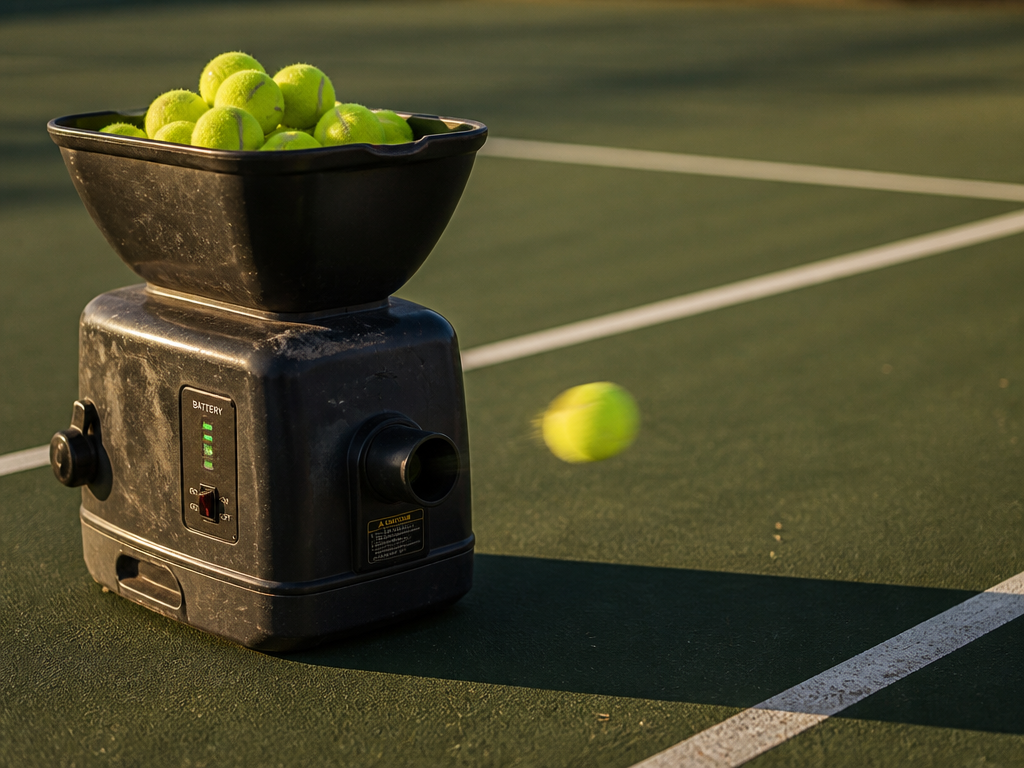
The most decisive number on a tennis ball machine's spec sheet is not the one the marketing leads with. It is not the 80 mph top speed, not the 6,000-RPM spin ceiling, not the two-second minimum feed interval. The number that decides whether the machine earns its place in your trunk — or gathers dust beside the spare net winder — is the one printed in small type, if it is printed at all: how long the battery actually lasts on a court, and how much the thing weighs when you have to lift it over a curb.
That is the claim. The rest of this piece is us earning the right to have made it.
How we evaluated
We did not run these machines through a lab and we did not hit baskets of balls against them. What we did was read the evidence the way a buyer should before spending between $700 and $2,500: we compared the published specifications from the manufacturers (Spinfire, Lobster, Hydrogen Sports, Slinger, Tennis Tutor), we cross-checked those against the independent measurements and write-ups from testers including Tennis Warehouse University and several long-form owner reviews on Talk Tennis and Reddit's r/tennis, and we weighted owner feedback heavily wherever a pattern showed up across dozens of accounts rather than one loud voice.
Where a figure is the manufacturer's own and nobody independent has verified it, we say so. Where owners and testers contradict each other, we say that too. Treat this as a synthesis of what the published record and the people living with these machines actually report — not as a verdict handed down from a stopwatch we held.
The numbers that look decisive but aren't
Spend an hour reading product pages and you would think top speed and spin separate the contenders. They mostly don't, not for the player this is written for.
Top speed. Nearly every machine above the entry tier tops out somewhere between 70 and 80 mph. The Spinfire Pro 2 is listed at up to 80 mph; the Lobster Elite series sits in the same band. For reference, a hard, flat groundstroke from a strong club player arrives around 50–60 mph at the other baseline. The point is that the ceiling on these machines already exceeds what an intermediate or advanced recreational player can usefully return in a feeding drill. A machine that maxes at 75 versus 80 mph is not a meaningful difference for almost anyone reading this.
Spin. Topspin and backspin ranges read impressively and they do matter — being able to dial in a heavy kicking ball or a low slice changes a practice session. But the consensus among reviewers is that spin generation across the mid-to-upper tier is close enough that it rarely breaks a buying decision on its own. Where it does matter is consistency of spin at speed, which the spec sheet never tells you and only owner reports reveal.
Feed rate. Most machines feed every 2 to 10 seconds. Faster than about every 3 seconds and you are no longer drilling, you are getting buried. The wide range looks like a feature. In practice players settle into a narrow window and never touch the extremes.
So the headline specs converge. What separates the machines is everything the marketing treats as a footnote.
The numbers that actually decide it
Battery: chemistry and the runtime nobody prints
Here is the figure worth interrogating hardest, because it degrades and because manufacturers quote it generously. Two chemistries dominate. Sealed lead-acid (SLA) batteries are cheaper, heavier, and slower to charge — often a full overnight cycle. Lithium batteries are lighter, charge faster, and hold runtime better as they age, at a price premium.
The numbers manufacturers publish — "up to 8 hours," "up to 4 hours" — are best-case, on a fresh battery, likely at moderate speed. The honest signal comes from owners. Across long-term owner reports, the recurring theme is that real runtime sits below the published figure from day one and erodes noticeably after roughly 18 months of regular use. One pattern that shows up repeatedly: a battery rated for several hours that, a year and a half in, no longer comfortably covers a two-hour session. That is not a defect. That is what batteries do, and it is the single most important thing a spec sheet will never tell you. Budget for a replacement battery as a cost of ownership, not a surprise.

Weight and portability
If you store the machine in a clubhouse and wheel it ten feet onto a court, weight barely registers. If you transport it — between public courts, in and out of a car trunk, up a flight of stairs — it is arguably more important than any performance spec, because a machine that is annoying to move is a machine you stop bringing.
The category spreads roughly from the mid-30s to the upper-40s of pounds for the units these readers consider. Most players manage 40-odd pounds without trouble, but the combination of total weight, whether the battery is internal or removable, and whether the wheels and handle are actually usable on grass and gravel matters more than the headline figure. A removable battery lets you carry the machine and the heavy part in two trips — a small design choice with an outsized effect on usability.
Oscillation and control
Two practical features quietly separate good from frustrating. Oscillation type — random or programmed horizontal and vertical placement — is what turns a feeder into a workout. Internal oscillation (the ball direction changes without the whole machine swiveling audibly) is quieter and steadier, which owners who use shared or public courts consistently appreciate. Control method is the other: physical remote versus phone app. App control sounds modern, but several reviewers and owners prefer a dedicated remote for a blunt reason — a phone screen sleeps, needs unlocking mid-rally, and is one more thing to drop on a hard court. Neither is wrong; the remote is the lower-friction choice for most.
Three representative machines, compared
| Criterion | Spinfire Pro 2 | Lobster Elite (mid) | Slinger Bag |
|---|---|---|---|
| Top speed (mfr) | up to ~80 mph | ~50–65 mph | up to ~45 mph |
| Battery type | Lithium (option) | SLA standard | Lithium |
| Weight | ~40 lb | ~42–44 lb | ~33 lb |
| Oscillation | Internal, random | Horizontal | None (manual angle) |
| Control | Physical remote | Remote/dial | App / on-unit |
Figures above are manufacturer-stated and rounded from published spec pages; runtime claims are deliberately omitted from the table because, as noted, the published hours are the least reliable numbers and vary with battery option and age. Treat the table as a map of where each machine aims, not a leaderboard.
Where the evidence is thin
Two honest caveats. First, long-term battery degradation data is anecdotal — it comes from owner reports, not controlled cycle testing, so the "18-month" pattern is a consensus impression, not a measured curve. Second, sources genuinely disagree on app reliability: some owners report stable connections, others report dropouts, and there is no neutral test that settles it. We lean toward the physical remote on the weight of owner preference, not proof.
Who this is for, and who it isn't
This category suits the intermediate-to-advanced player who wants repeatable groundstroke and approach reps, the instructor who needs a second feeder during lessons, and the club that wants a rentable practice tool. The premium oscillating machines reward players who will actually use programmed drills.
It is not for the player chasing complex, reactive point construction — for that, a hitting partner remains better than any machine. And it is not for someone who will resent lugging 40 pounds; if transport is your real constraint, prioritize the lightest unit with a removable battery over the one with the highest top speed.
If you transport the machine and use it twice a week, buy on battery and weight, not on top speed. That is the line to screenshot.
Evidence grade
For the central claim — that battery runtime and transport weight, not headline speed and spin, determine real-world satisfaction — we rate the evidence Moderate: strongly supported by consistent owner feedback and the convergence of published performance specs, but limited by the absence of independent long-term battery testing.
One thing to try this week
Before you buy anything, do this: find an owner of the model you are eyeing — a clubmate, a local pro, a Talk Tennis thread — and ask one question. "How long does your battery actually last now, and how old is it?" The gap between their answer and the spec sheet is the most useful number you will collect, and it costs you a single message to get it.