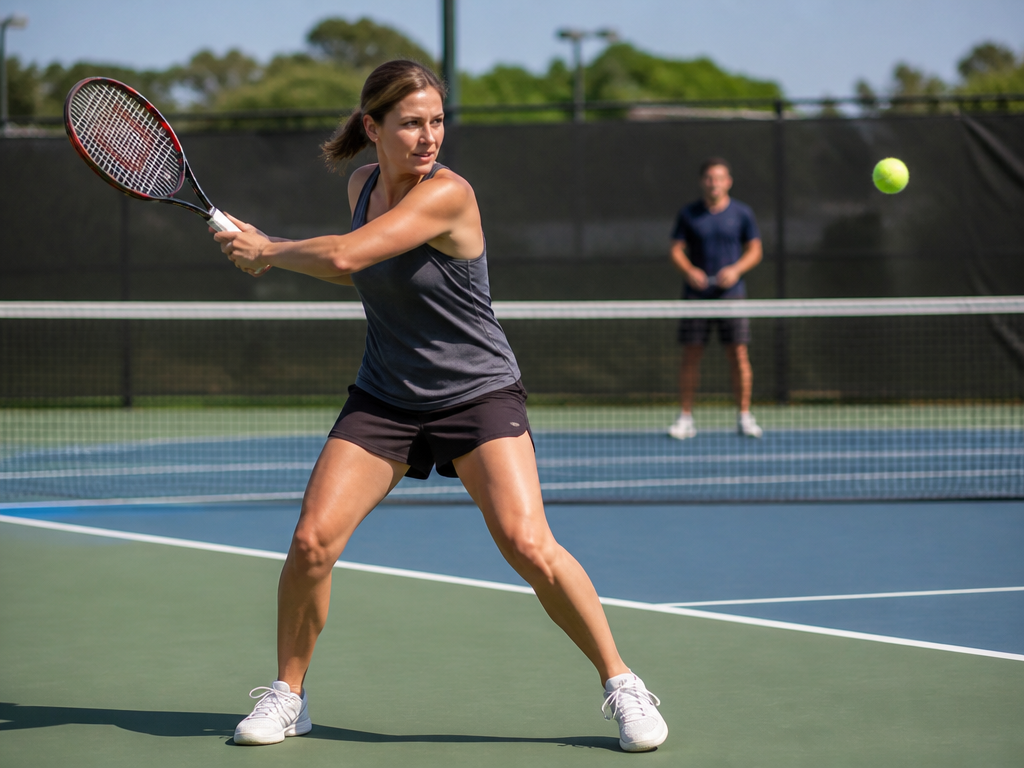
Somewhere in the coaching literature is a claim that sounds too tidy to be true: a person who has never held a racquet can sustain a back-and-forth rally with a partner inside the first 25 minutes of their first lesson. Not a graceful one. Not a winning one. But a real exchange — ball over the net, ball comes back, repeat. That figure shows up in the research and curriculum work behind the International Tennis Federation's slower-ball teaching method, and it reframes what tennis basics are supposed to feel like at the start.
We want to take that number seriously. Where it comes from, what it genuinely demonstrated, and — the part most beginner guides skip — what it quietly fails to measure.
What does learning tennis basics actually involve
For a complete beginner, tennis basics come down to four things working in sequence: holding the racquet in a usable grip, getting your body into a ready position, meeting the ball at a sensible contact point out in front of you, and keeping a cooperative rally going long enough to repeat the motion. Everything else — serve mechanics, spin, scoring, footwork patterns — is built on top of that loop. The loop is the foundation. If you can hit a ball, let it bounce, and send it back so your partner can do the same, you are playing tennis at the only level that matters on day one.
That is the whole secret, and it is far less than the sport's reputation suggests. The reputation is the problem. Tennis looks like it demands athleticism before it grants you entry. The teaching research argues the opposite, and the 25-minute rally figure is the evidence people point to.
What the number actually measured
The figure traces back to the body of work supporting the ITF's three-stage ball progression — the red, orange, and green low-compression balls now standard in introductory programs worldwide, marketed in the United States under the USTA's Net Generation framework and in modified adult formats like Tennis Xpress.
Here is the honest version of what that research established. Studies built around the slower-ball method — including work by Larson and colleagues on modified equipment, and the ITF's own program evaluations through the 2000s and 2010s — measured whether beginners could achieve and sustain cooperative rallies faster on reduced-compression balls and smaller courts than on standard equipment. The consistent finding was yes, and by a wide margin. On a foam or red ball that bounces lower and travels slower, novices reached sustained rallying — typically defined as three or more consecutive hits over the net — within a single introductory session. The 25-minute marker is a rough representative figure from this teaching context, not a single landmark trial with a famous p-value.
That distinction matters, so we will be plain about it. This is not one large randomized controlled trial. It is a cluster of program evaluations, coaching studies, and motor-learning research that together point in the same direction: slow the ball down, shrink the space, and the skill acquisition curve bends sharply upward at the beginning. Tennis Australia's Hot Shots program and the ITF's Play and Stay campaign were built on exactly this premise and have decades of field data behind their adoption, even if much of that data is operational rather than peer-reviewed.
So the strength of the claim is real but specific. It is well-established that modified equipment accelerates early rallying. It is not established that 25 minutes is a universal constant. Some people get there in ten. Some need three sessions. The number is a useful illustration of a robust effect, not a stopwatch promise.
Why the ball does the work
The mechanism is worth understanding because it explains why the number isn't magic. A standard tennis ball is pressurized and bounces high — often above shoulder height on a hard court. For a beginner, a high, fast bounce forces two hard problems at once: judging where the ball will be in space, and getting a racquet there in time. Reaction windows are short. Most early misses aren't grip failures; they're timing failures.
A red foam ball is roughly 75 percent slower through the air than a standard ball and bounces around waist height. That single change buys the beginner time — measurably more milliseconds to read the ball, set the feet, and swing. The contact point becomes predictable. Predictable contact is the thing that lets a rally repeat, and repetition is what learning actually is. The research didn't make beginners better. It removed the conditions that made beginners fail.
What the number does not measure

This is where most beginner guides go quiet, and where we won't.
The 25-minute rally figure measures one narrow, valuable thing: how quickly a novice can enter the cooperative loop under favorable conditions. It says nothing about the parts of tennis that take months.
It does not measure fitness. Rallying gently across a small court for a few minutes is not the same load as chasing balls across a full court for an hour. People coming from the gym sometimes assume their conditioning transfers cleanly; it transfers partially. Tennis demands repeated short accelerations, lateral changes of direction, and overhead shoulder work that few other activities rehearse. Soreness in the first weeks usually shows up in the forearm, the calves, and the side of the torso — places general fitness rarely prepares.
It does not measure footwork retention. Getting to the ball is the skill that separates someone who can rally from someone who can play, and it is slow to build. The early lesson hides this because a coach feeds the ball directly to you. Real play does not.
It does not measure competitive scoring. Tennis scoring — the 15, 30, 40, deuce, advantage system, plus the geometry of when to switch sides — is genuinely confusing and entirely unrelated to whether you can hit a ball. You can rally competently and still have no idea who is serving. That's normal.
It does not measure injury risk or retention past week one. We have no good evidence on how many adults who rally successfully in their first session are still playing six months later. The drop-off in recreational sport generally is steep, and tennis is unlikely to be exempt. The honest position: the data on adult beginner retention is thinner than the enthusiasm of the programs promoting it.
So the number is true and it is incomplete. It describes the doorway, not the house.
The first hour, in the order it actually happens
Walk through what a good first session does, step by step, and the research becomes intuitive.
First, the grip. A coach will almost always start you with the Continental or Eastern forehand grip — the simplest way to describe it is to hold the racquet like you'd shake hands with it, or set the racquet face flat on the ground and pick it up. This isn't a detail to agonize over on day one. It's a starting position you'll refine. The point is to remove one variable so the others can be learned.
Second, the ready position. Knees slightly bent, weight forward on the balls of the feet, racquet held out in front with the non-dominant hand lightly supporting the throat of the frame. This posture does one job: it puts you in a place from which you can move in any direction. Beginners stand flat-footed and upright, then arrive late. The ready position is the cheapest footwork improvement available.
Third, the contact point. The ball should be struck out in front of the body, roughly at hip height, with the arm extended but not locked. This is where the slower ball earns its keep — a waist-high, slow bounce arrives at exactly the contact point you're trying to learn, instead of jumping past it.
Fourth, the cooperative rally. Not competitive. Cooperative. The goal is to keep the ball in play with a partner, both of you trying to make the next shot easy rather than impossible. This is the loop the 25-minute figure describes, and it is the single most important thing to protect in early practice. The instinct to "win" a rally is the fastest way to stop learning.
Notice what isn't in the first hour: the serve, spin, the full court, the score. Good introductory teaching withholds these deliberately. The method's whole logic is to defer complexity until the core loop is stable.
Where trustworthy instruction actually lives
The frustration that brings most people to a search engine isn't a lack of information about tennis. It's a flood of it, with no way to tell the reliable from the confident-but-wrong. A few honest distinctions help.
A live coach or a structured beginner clinic is, for most adults, the highest-value option — not because coaches are infallible, but because the single thing video cannot give you is real-time feedback on a ball you actually hit. Tennis is a motor skill, and motor skills are corrected through feedback loops. A coach watching you shortens the loop from days to seconds. Group adult clinics, often built on the Tennis Xpress or equivalent modified-ball curriculum, are usually the cheapest way into this and are explicitly designed for people who have never played.

Video instruction is excellent for understanding and terrible for correction. Watching a clear explanation of grip or footwork builds a mental model, which genuinely helps. But video cannot see your error, and the most common beginner mistakes — late contact, no unit turn, a death grip on the handle — are invisible to you precisely because you can't feel them. Use video to learn what good looks like. Don't expect it to tell you what you're doing wrong.
A useful filter for any free instructional content: be wary of anyone selling certainty about "the one correct technique." Good coaches teach principles and acknowledge that grips, swing paths, and styles vary legitimately across players. Content that promises a single secret fix is usually optimizing for views, not for your forehand. The instruction worth trusting tends to sound less certain, not more.
As for apps and AI swing analyzers — the category is young. Some can flag gross timing or contact-point issues from a phone video. None we've seen replaces a competent human watching you rally. Treat them as a supplement, and treat their confidence with the same skepticism you'd apply to any product describing itself as revolutionary.
An honest starter checklist
If you take nothing else from the research, take this: the conditions you start under matter more than your natural ability. Set the conditions in your favor and the early curve takes care of itself.
A small directive, supported by the slower-ball evidence:
- Start on the slowest ball available to you — foam or red low-compression — even as an adult, and don't let pride push you to a standard ball before you can rally consistently.
- Protect the cooperative rally. In your first weeks, count consecutive hits, not points won.
- Get one session of live feedback early, before you drill a mistake into a habit.
- Expect your forearm and calves to complain before your lungs do, and build volume gradually.
Here is how the ball progression maps to where you actually are, which is the one piece of equipment knowledge that changes the first month:
| Ball type | Speed vs. standard | Typical bounce | Who it's for |
|---|---|---|---|
| Red (foam or felt) | ~75% slower | Low, ~waist height | First sessions; building the rally loop |
| Orange | ~50% slower | Lower than standard | Rallying confidently, learning to move |
| Green (regular-duty) | ~25% slower | Near standard | Transitioning to the full court |
| Standard / yellow | Full speed | Full, often shoulder-high | Once the rally is reliable and you can move to the ball |
None of this requires buying much. A used racquet in a reasonable weight, a tube of slower balls, and access to any flat surface with a net or a line is enough to begin. The gear discussion gets more interesting later — and it does get genuinely interesting — but it is not the gate.
What this piece didn't answer
We built this around one number because the number is honest about the beginning and silent about everything after. So we'll be silent in the same places, on purpose.
We didn't tell you which racquet to buy, because the right beginner frame depends on your physique, your budget, and whether you'll actually keep playing — and a head-heavy, larger-headed, forgiving frame is a different recommendation than the players' racquets that dominate review sites. We didn't touch string type or tension, which matter far less in your first months than the internet implies but begin to matter once your swing stabilizes; our string coverage is the place to go when that day comes. We didn't resolve the retention question, because the field hasn't either — we genuinely don't know how many adult beginners who clear that first-session rally are still on court by spring.
And we didn't answer the question only you can: whether the cooperative loop, once you find it, feels like something you want to keep doing. The research can get you to the rally in 25 minutes. Whether you stay is a measurement no study has made for you.
The fastest way to learn tennis is to make the ball slow enough that you can't fail at the only thing that matters first. A note on the evidence: the 25-minute figure is a representative illustration drawn from the ITF Play and Stay / slower-ball teaching tradition and supporting motor-learning research, not a single citable trial. The underlying effect — that reduced-compression balls and smaller courts accelerate early skill acquisition — is well-supported across program evaluations and coaching studies. The specific minute count is best read as a useful demonstration, not a guarantee.