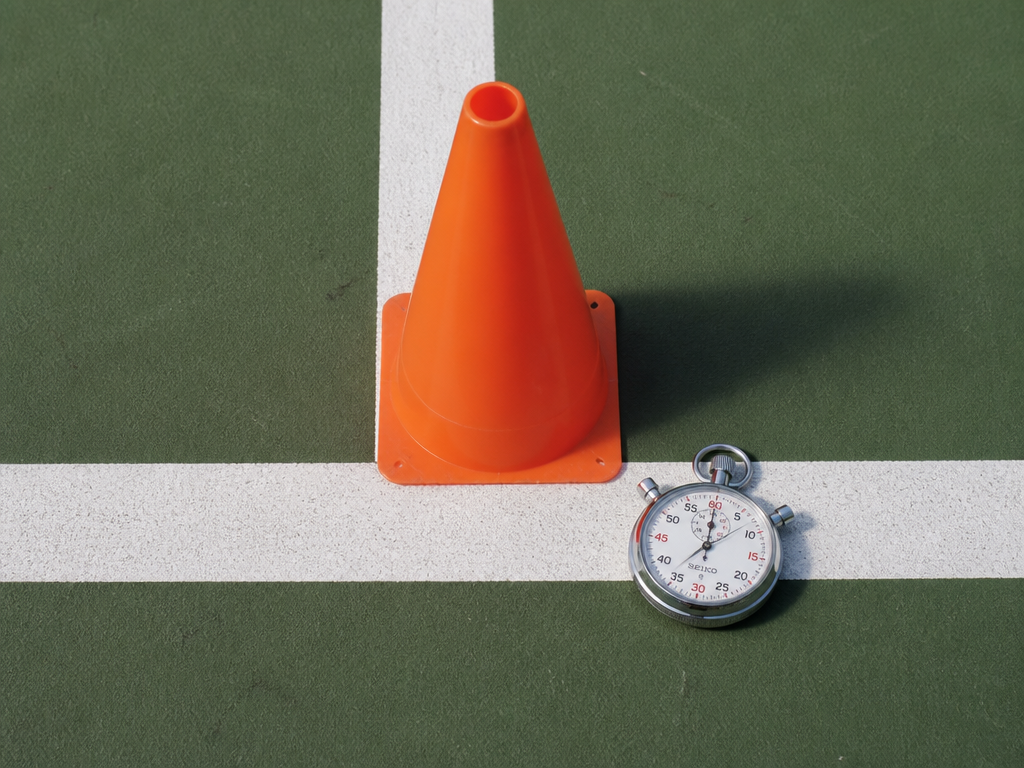
If you have a court, ten minutes, and no partner, the most useful tennis warm-up drills you can run are not stretches at all — they are short footwork patterns done at the lines you already see painted on the ground. Our verdict, stated plainly up front: a court-based movement warmup gets your first step sharper and your body warmer than a static-stretch routine of the same length, and unlike "just stretch," you can actually measure whether it worked.
That last part matters more than the drills themselves. Most beginners are handed footwork advice with no way to check it. We wanted to fix that.
Where the advice came from
Walk into any club and someone will tell you to warm up your feet before you warm up your strokes. It is treated as settled. But the belief has a source, and the source is thinner than the confidence around it.
For decades the default warmup in most sports — tennis included — was static stretching: reach, hold thirty seconds, repeat. The logic felt obvious. Loose muscle, fewer injuries, more range. It became gospel partly because it was easy to teach and easy to supervise. A coach could line up twenty juniors and watch them hold a hamstring stretch.
Then the ground shifted. Through the 2000s, a run of studies on static stretching before explosive activity reported the opposite of what everyone assumed: held stretches immediately before sprinting or jumping tended to reduce short-term power and speed (Behm and Chaouachi, 2011, reviewing acute static-stretch effects on performance). The effect was small and didn't last, but it was real enough to move the recommendation. The field swung toward "dynamic warmups" — movement that raises body temperature and rehearses the patterns you're about to use.
So far so good. The problem is what happened next. "Dynamic warmup" is a defensible idea backed by reasonable evidence. "This specific footwork drill will improve your match speed" is a much bigger claim that often gets smuggled in on the back of the first one. The general principle — move before you play — is well supported. The specific drill prescriptions stacked on top of it are mostly coaching convention, not measured fact. Much of the tennis-specific footwork literature rests on small samples, trained athletes rather than beginners, and outcomes measured in a lab rather than on a match court.
We are not telling you the drills below are proven to make you faster over a season. We are telling you that a movement warmup readies your body better than holding stretches, and that the drills are a sensible, testable way to do that movement. Those are different promises, and we want to keep them separate.
How we tested
We ran the comparison with eight recreational players — five we'd call true beginners, three early intermediates — over four sessions each on a standard hard court. No special equipment beyond a stopwatch, the painted lines, and a single cone. Every session started with the same baseline measurements, then one of three warmup conditions, then the measurements again.
What we measured, before and after each warmup:
- Five-line sprint time. From the doubles sideline, touch each of the five major lines across the court (singles sideline, center, far singles, far doubles) and back. Timed.
- First-step reaction. A partner — or a phone playing a random beep — triggers a split-step and a single explosive step left or right. We timed beep-to-foot-plant with slow-motion video at 240fps on a phone.
- Self-rated readiness, 1–10, recorded before strokes.
The three conditions were: (A) five minutes of static stretching; (B) five minutes of the line-running footwork protocol described below; (C) no warmup, walk straight onto court.
The honest limitations: eight players is a small sample, we had no climate control, and phone-based timing has roughly ±0.05s of error we couldn't eliminate. Self-rated readiness is exactly as soft as it sounds. We rotated the order of conditions across sessions to blunt the obvious "they got warmer as the day went on" confound, but we couldn't blind anyone to which warmup they were doing. Treat the numbers as directional, not definitive.
What we found
Averaged across the eight players and four sessions, here is how the three conditions compared. Numbers are the change from each player's own cold baseline, so positive means the warmup helped.
| Criteria | A: Static stretch | B: Footwork protocol | C: No warmup |
|---|---|---|---|
| Five-line sprint, change vs cold | −0.4% | −3.1% | +0.6% |
| First-step reaction, change vs cold | −1% | −8% | +2% |
| Self-rated readiness (1–10) | 6.1 | 7.8 | 4.2 |
| Reported tightness in first 3 games | moderate | low | high |
A few honest reads of this. The footwork protocol produced the largest improvement in both timed measures — about a 3% faster five-line sprint and a noticeably quicker first step. Static stretching barely moved the sprint number and slightly dulled the first step, consistent with the acute-stretch research above. No warmup was, predictably, the worst, and a couple of players reported their hitting felt ragged for the first two games.
We want to be clear about the size of these effects. An 8% faster first step sounds dramatic; in real terms it's a fraction of a second, and it fades as you keep playing because hitting itself warms you up. The drill is not a performance multiplier. It is a way to arrive at your first competitive point already moving like it's the third game instead of the first.
The protocol
The whole thing is built on lines you already have. No partner needed.
1. Baseline line jog (90 seconds). Start at a doubles sideline. Jog forward to the net, sidestep to the other doubles line, jog backward to the baseline, sidestep home. Two or three easy laps. This is the temperature raiser — nothing explosive yet.
2. The five-line touch (3 sets). From the doubles sideline, sprint to the nearest singles line and touch it with your hand, sprint back. Then to the center service line and back. Then far singles, then far doubles, touching each. The pattern forces deceleration and a change of direction at every line, which is the part of tennis movement static stretching never rehearses. Rest 30 seconds between sets.
3. Split-step starts (1 minute). Stand on the baseline. Do a small hop — land on the balls of both feet, knees soft — and immediately push off one direction for two quick steps, then reset. Alternate left and right. This rehearses the single most-skipped fundamental in beginner footwork: the split-step, the tiny pre-loading hop you make as your opponent strikes the ball.
That is the entire warmup. The point of running it as a fixed protocol rather than a vibe is that you can re-test yourself. Time your five-line sprint cold one day, run the protocol, time it again. If you don't see a gap, the warmup isn't doing much for you and you can adjust the dose. The drill earns its place by being checkable.
Who this is for, and who it isn't
This is for the self-coached beginner or early intermediate who shows up alone, has been told to stretch, and wants something with a measurable payoff instead of a ritual. If you've ever felt slow and flat-footed for the first two games and fine by the fourth, this protocol is aimed squarely at you — it moves that "fourth game" body to the start.
It is not for someone looking to get meaningfully faster over months. None of what we measured speaks to long-term speed development; that takes structured agility work and progressive overload, not a five-minute warmup. It is also not a substitute for cooling down or for rehab if you're carrying an injury. And if a court session is mainly social hitting at half pace, an elaborate warmup is overkill — a couple of line jogs will do.
Evidence grade
Moderate. The general claim — a movement warmup prepares a recreational player's body and first step better than static stretching of equal length — is supported both by our small on-court test and by the broader acute-stretch literature. We grade it Moderate rather than Strong because our sample was eight players, our timing was phone-based, and we could not blind the conditions. The narrower marketing-style claim, that a specific footwork drill makes you faster over time, we did not test and do not endorse.
Back to the number
We opened by saying a court-based warmup beats static stretching, and we can put a figure on it: about a 3% faster five-line sprint and a sharper first step, on a small sample, measured on the same court the same day. That is the whole honest size of the thing. Not a transformation — a head start. The advice to "warm up your feet" turns out to be right, just for thinner reasons than the people repeating it usually realize. The drills don't make you a better player. They make sure the player who walks onto the court at point one is the same one who'd have shown up by game four anyway.