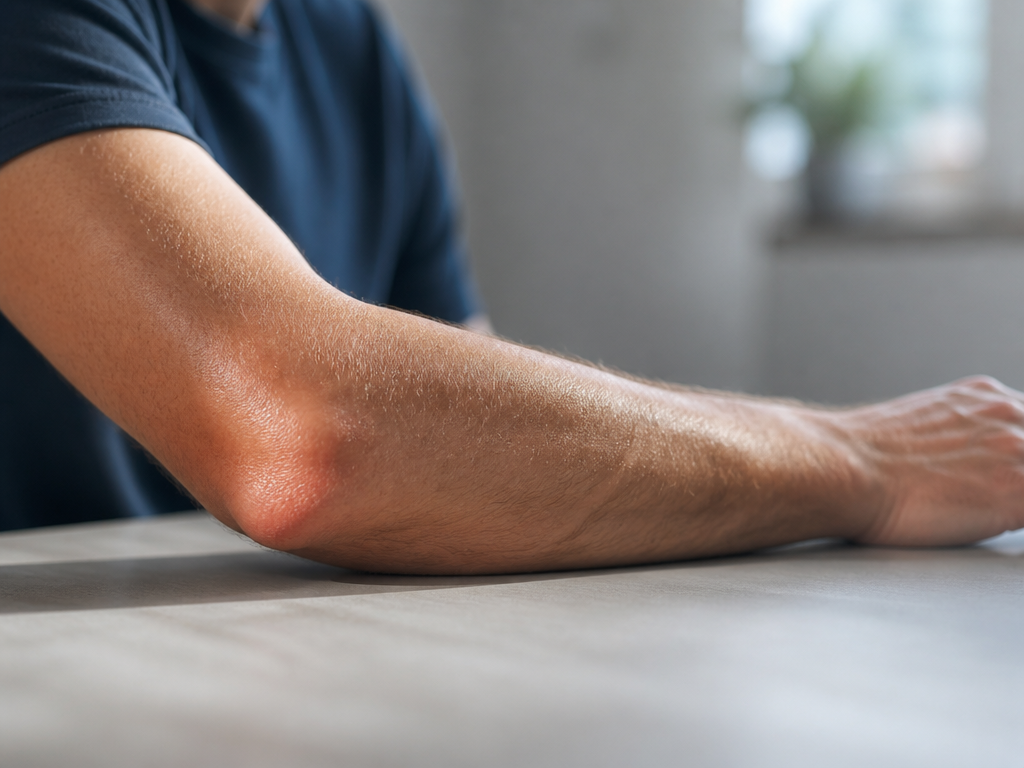
Here is the claim, stated plainly so we can spend the rest of the piece earning the right to have said it: if you have tennis elbow, parking your arm in a sling and waiting for it to feel better is probably the worst thing you can do. Resting it completely tends to make the tendon weaker, not the pain shorter. That sounds backwards. It is also where the better evidence has been pointing for two decades.
If your forearm is screaming and you are scrolling instead of sleeping, you have our sympathy. The pain is real, it is common, and it is — annoyingly — not the simple "inflamed from overuse, ice it and rest" story most of us were handed. Let us walk through what is actually happening in there, because the mechanism is the whole reason the rest advice falls apart.
What tennis elbow actually is
The medical name is lateral epicondylitis, and that name is part of the confusion. The "-itis" suffix means inflammation. But the tissue findings tell a different story. The Mayo Clinic describes tennis elbow as the result of repeated stress to the tendons that attach the forearm muscles to the bony bump on the outside of your elbow (the lateral epicondyle). The American Academy of Orthopaedic Surgeons (AAOS) frames it as damage to those wrist-extensor tendons, particularly the one called the extensor carpi radialis brevis.
The key shift came from histology. The commonly cited work here is Nirschl and colleagues, who looked at the actual tendon tissue and found not classic inflammation but what they called angiofibroblastic degeneration — disorganized collagen, failed healing, abnormal blood vessel growth. That is why a growing number of clinicians prefer the term tendinosis (degeneration) over tendinitis (inflammation). It matters because the two call for nearly opposite treatments. You calm inflammation. You rebuild degeneration.
And to be clear about prevalence: tennis elbow is not rare and it is not mostly about tennis. Estimates commonly cited put it at roughly 1 to 3 percent of adults per year, and the majority of cases show up in people who never pick up a racquet — painters, plumbers, anyone doing repetitive gripping. The racquet just gets the blame in the name.
How do I know if it's tennis elbow and not something worse
The honest answer is that you cannot be certain without a clinician, and arm pain has several causes that mimic each other. But the classic pattern, per WebMD and AAOS descriptions, is fairly distinctive: pain and tenderness on the outer part of the elbow, often radiating down the forearm, that flares when you grip, lift, shake hands, turn a doorknob, or extend your wrist against resistance. It usually builds gradually over weeks rather than arriving with a single pop.
A few things should push you toward a doctor sooner rather than later, because they are not the tennis-elbow pattern: numbness or tingling in the fingers (more suggestive of a nerve issue), pain on the inner side of the elbow (that is golfer's elbow, medial epicondylitis), the elbow locking or giving way, or swelling, redness, and warmth that look like infection. Pain after a fall or sudden trauma also belongs in a clinic, not a blog post. We are guides here, not your physician, and nothing below replaces an exam.
What is actually failing, in the order it fails
Walk through it as it happens. First, repetitive gripping and wrist extension load the extensor carpi radialis brevis tendon at its anchor point. Normally the tendon adapts to that load. But when the load outpaces the tissue's ability to repair, microtears accumulate faster than they heal.
Second, the body attempts to fix it — and botches the job. Instead of laying down clean, aligned collagen, it produces the disorganized, weaker tissue Nirschl described, threaded with new blood vessels and nerve endings. Those new nerve endings are part of why it hurts.
Third, because the repair tissue is mechanically inferior, it fails again under loads the old tendon shrugged off. You get a cycle: pain, protective avoidance, deconditioning, then re-injury the moment normal life resumes. This is exactly the trap that full rest sets. Rest removes the load that the failed-healing tissue actually needs to remodel itself into something stronger.
Why rest underperforms and what does better
The most quoted comparison here is Smidt and colleagues (2002, published in The Lancet), a randomized trial of 185 patients comparing corticosteroid injections, physiotherapy, and a "wait-and-see" approach. The injections won big at six weeks — and then lost. By 52 weeks the injection group had the worst outcomes and the highest recurrence, while physiotherapy and even plain waiting overtook it. The lesson many clinicians took from it: the quick anti-inflammatory fix can undermine the slower tissue remodeling that actually resolves the problem.
What the loading evidence supports is the opposite of immobilization. Progressive resistance — particularly eccentric exercise, where the muscle lengthens under load (think slowly lowering a weight by extending your wrist) — appears to stimulate the tendon to rebuild organized collagen. The trials here are mostly small and methods vary, so we will be honest about the tiers:
- Well-established: Tennis elbow is usually a degenerative tendon problem, not simple inflammation, and most cases improve within 6 to 12 months regardless of treatment.
- Plausible and reasonably supported: Progressive loading and eccentric exercise beat passive rest for long-term recovery and reduced recurrence.
- Folk wisdom that the data undercuts: Cortisone as a cure. It buys short-term relief and tends to cost you long-term, per Smidt 2002 and later reviews.
A rough map of the options
| Approach | What it targets | Honest read |
|---|---|---|
| Complete rest / sling | Avoids pain | Relieves short-term, weakens tendon long-term |
| Ice / NSAIDs | "Inflammation" | Modest symptom relief; doesn't fix degeneration |
| Cortisone injection | Pain signaling | Fast relief, worse 12-month outcomes |
| Counterforce brace | Off-loads the tendon anchor | Cheap, low-risk, symptom help |
| Progressive / eccentric loading | Tendon remodeling | Slow, mildly uncomfortable, best long-term evidence |
A reasonable rule of thumb from this evidence: load it gently rather than freeze it, and judge the load by the next morning. Mild discomfort during a controlled exercise is acceptable; pain that is clearly worse the following day means you went too hard, not that the approach is wrong.
Something modest to try this week
This is not a prescription and not a substitute for a clinician — but it is low-risk and grounded in the loading evidence. Rest your forearm on a table, palm down, hand off the edge, holding a light object (a soup can, a 1-pound weight). Use your other hand to lift it, then slowly lower it over about three to five seconds by extending the wrist. Ten or so reps, once a day, stopping well short of sharp pain. Watch how the elbow feels tomorrow morning, not just tonight.
The tendon does not want to be protected from work. It wants the right amount of it.