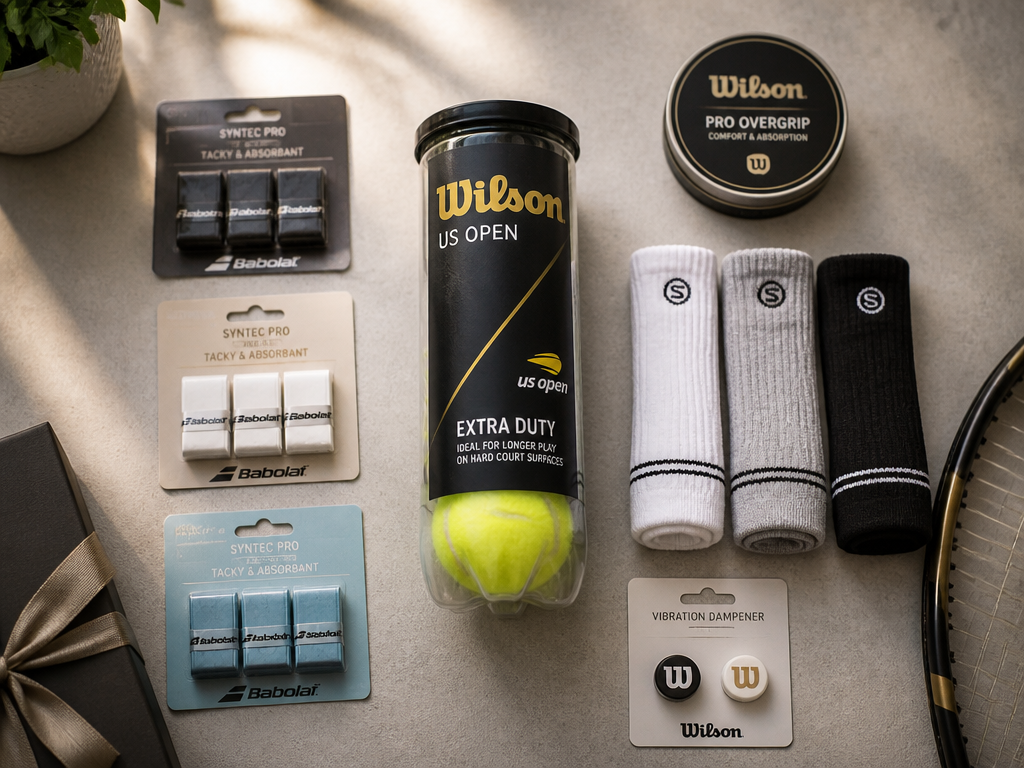
The pitch behind most tennis gift guides is that the woman in your life already owns everything, so you have to find something rare, clever, or expensive to impress her. That premise is wrong, and it is the reason so many of these gifts end up in a drawer. A player who takes the sport seriously does not have everything. She has a steady list of things she runs out of, things she keeps meaning to replace, and one or two upgrades she has not justified to herself yet. The trick is knowing which is which.
We read through a stack of the popular gift roundups so you do not have to, and the pattern is consistent: they confuse novelty with usefulness. A wine glass with a racquet etched on it is novelty. A grip she actually likes is usefulness. The buyer's real problem is not a shortage of ideas. It is a shortage of confidence about what a tennis player wants, made worse by the fear of either overspending or looking like you grabbed the first themed mug you saw.
What do tennis players actually want as gifts
If you want the short answer: most competitive recreational players are quietly delighted by good consumables and small comfort upgrades, and indifferent to themed decor. The reason is mechanical, not sentimental. Tennis chews through certain items on a schedule. Overgrips wear out in a few sessions of heavy hands. Strings break or go dead. Socks thin at the heel. A regular player is restocking these constantly, usually with whatever is cheapest, and rarely treats herself to the nicer version. That gap between "what she buys for herself" and "what she'd enjoy" is exactly where a thoughtful gift lives.
This is also why price and thoughtfulness are not the same axis. The expensive themed jewelry can feel more generic than a twelve-dollar tin of her grip in the color she likes, because the second one proves you noticed how she plays.
The decision, in the order it actually happens
The mistake is starting with products. Start with what you can observe, then narrow. Here is the sequence that works.
First, read the skill signal. Watch how seriously she takes it without asking her to rank herself. Does she have a dedicated racquet bag, or a racquet in a tote? Does she talk about leagues, ladders, or a coach? A casual hitter and a 4.0 league player want different things, and the single biggest buying error is aiming above or below her actual investment in the sport. A beginner does not need a second frame. A league regular does not need a starter set of foam balls.
Second, choose consumable before durable. This is the safest lane in the entire category, and the most underused. Consumables are low-risk because there is no fit, no sizing, no taste in design to get wrong. Overgrips are the clearest example: brands like Tourna, Wilson, and Yonex sell them in packs, players burn through them, and almost nobody buys themselves a fresh box of ten. A tube of premium balls she would not splurge on, a set of dampeners, fresh athletic socks in a real running brand rather than cotton, a good water bottle that survives a gym bag. None of these can miss badly.
Third, only then consider durable gear, and weigh the fit risk. Durables are where money goes and where mistakes get expensive. The rule is simple: the more personal the fit, the more you need her input or a return policy. Shoes are the worst offender. Tennis shoes are sized and shaped to the foot and to the court surface, and a wrong guess is both costly and useless, so unless you know her size, brand, and whether she plays on hard court or clay, leave shoes alone. Apparel runs the same risk on size and on taste. A racquet is the deepest trap of all, because weight, balance, grip size, and string pattern are personal to her game.
There is one durable category that sidesteps most of this: bags and accessories with no fit dimension. A well-built racquet bag, a dampener set, a stringing tool kit if she strings her own, an electrolyte stash, a stand-alone water bottle. These carry the weight of a "real" gift without the sizing gamble.
Fourth, layer personalization only on top of something useful. Personalization multiplies a good gift and cannot rescue a useless one. Monogramming a quality bag she will carry to every match works. A custom item she will never use does not. The order matters: pick the useful object first, then make it hers.
A quick map by budget and risk
| Budget | Safe pick (low fit risk) | Avoid unless you know specifics |
|---|---|---|
| Under $25 | Overgrips, premium balls, dampeners, good socks | Apparel sizing |
| $25–75 | Quality water bottle, stringing tools, electrolyte kit, monogrammed accessory | Shoes |
| $75–150 | Well-made racquet bag, court bag, a stringing job gift certificate | A racquet |
| $150+ | Lessons or clinic credit, club gift card she chooses against | A frame chosen for her |
The standout in that last row is worth naming: a credit for lessons or a clinic, or a gift card to her club or local pro shop, is not a cop-out. It is the move that respects how personal the deep gear choices are, and it hands her the part of the decision only she can make well.
An honest rule of thumb
When you are unsure, buy the best version of something she already uses up. Spend the money on quality and quantity of a consumable, not on novelty of a durable. A box of her grip, a tube of good balls, and a real water bottle will outperform a clever themed object almost every time, and it tells her you watched how she plays.
The myth says a serious tennis player already has everything, so a gift has to be rare or expensive to land. The truer version is that she runs out of the small things constantly and rarely buys herself the nicer ones, and the gift that lands is the one that notices that.