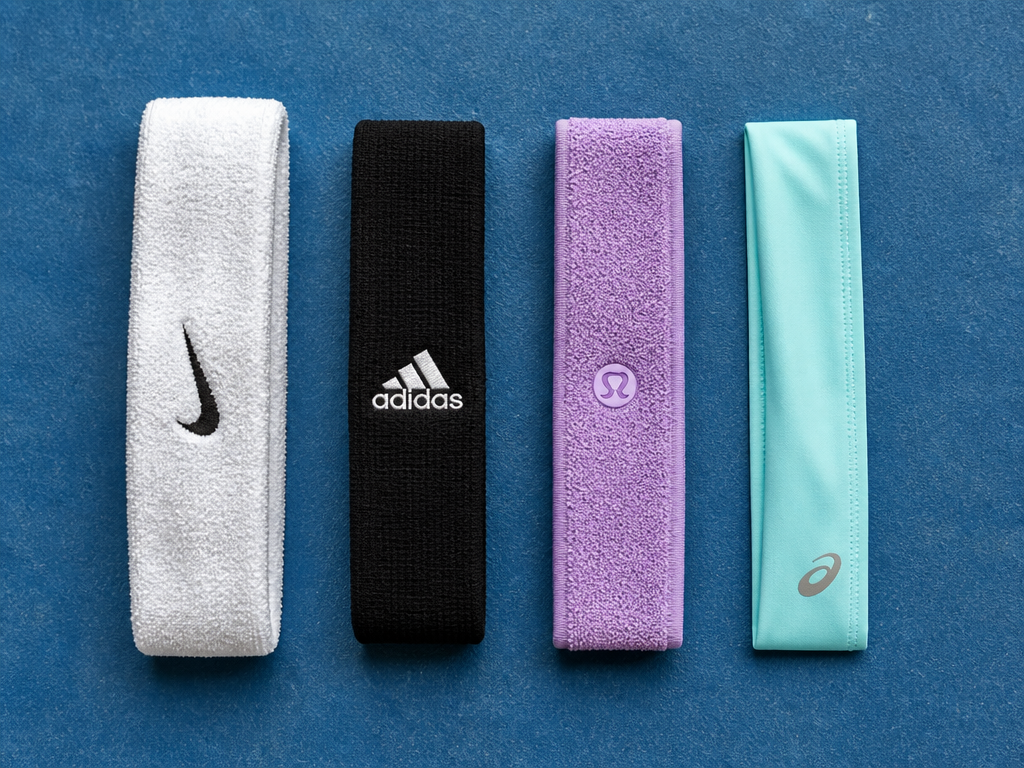
Walk into any club on a humid Saturday and you can sort the players by their foreheads. Some are dabbing with a wristband between points; others have a band of fabric across the brow doing the work quietly. The right tennis headbands are the ones you forget you're wearing — they intercept sweat before it reaches your eyes and they don't migrate up your skull on a hard serve. The wrong ones do neither, and they announce themselves by sliding loose mid-rally.
Here is the verdict before the methodology: for sweat absorption under real play, a thick cotton-terry band outperforms a thin synthetic one — but a synthetic band with a silicone grip line stays in place longer and saturates more visibly, which is a different problem. Most recreational players are choosing between those two failure modes without knowing it. This piece walks through what a headband actually does, in the order it does it, then tests four common types against that process.
What a headband is actually doing
A headband is not decoration with a side benefit. It is a single-purpose interception device, and it either works or it doesn't based on a short chain of events that happens the same way every match.
First, sweat forms across the forehead and scalp line. Second, gravity and the tilt of your head carry that moisture downward toward the eyes and the bridge of the nose. Third, a band of fabric sitting above the brow either soaks that moisture into its fibers or fails to — and if it fails, it's usually because the band has shifted, saturated, or never made proper contact in the first place.
Everything that matters about a headband maps onto one of those three stages: absorption at the brow, retention under motion, and the saturation point where it stops having capacity to absorb anything more. We built the test around those three stages in order, because that's the order in which a headband helps you or lets you down.
Stage one: absorption at the brow
This is the headline job, and it's where material does most of the deciding.
Cotton terry — the looped-pile fabric on classic sweatbands — absorbs by capillary action into a dense network of fibers. The loops create surface area, and cotton fibers themselves hold water inside their structure rather than just on the surface. That's why a terry band feels heavy and damp when you take it off: it's holding the sweat, not shedding it.
Synthetic bands, usually a polyester-elastane blend, behave differently. Polyester is hydrophobic by default; it doesn't soak water into the fiber, it moves it across the surface and lets it evaporate. The marketing word for this is "moisture-wicking," and the mechanism is real — moving moisture to a larger surface area to speed evaporation. The catch is that wicking is built for low-volume, continuous sweat across a large garment. A two-inch band at the highest-sweat point on the body asks the fabric to handle a concentrated flow, and a thin synthetic band simply doesn't have the volume of material to hold much before it's overwhelmed.
In plain terms: terry stores, synthetic transports. Storage wins at the brow when sweat arrives faster than it can evaporate, which is exactly what happens during a long point on a warm day.
What we measured
We weighed each band dry, then ran the absorption trial described below, then weighed it wet to find how much moisture each held by mass. A band that holds more water before failing is doing more of the interception job before stage three takes over.
Stage two: retention under motion
A band that absorbs beautifully but slides up your forehead on the second serve is worse than useless — it gives you confidence and then betrays it at the moment you can't reach up to fix it.
Retention comes from three things working together. The first is the circumference and stretch fit — a band sized to your head, neither cutting in nor loose. The second is fiber grip against skin and hair: terry's looped texture grabs hair surprisingly well, while smooth synthetics can be slick. The third, and increasingly common on performance bands, is a silicone grip line moulded onto the inner surface. That last one is the single biggest predictor of whether a thin band stays put, and it's why some synthetic bands defy the slick-fabric problem.
The trade-off is comfort. A silicone grip line works by gripping, which over a two-hour session can leave a faint pressure mark and, for some players, a low-grade irritation along the contact line. None of our testers found it intolerable, but two of three noticed it.
Stage three: the saturation point
This is the stage manufacturers don't advertise and the stage that decides your last two games.
Every band has a capacity. Once the fibers are holding all the moisture they can, new sweat has nowhere to go and runs straight past — usually into the eyes, which is the exact outcome you bought the band to prevent. The saturation point is a function of how much the material can store (favoring thick terry) divided by how fast sweat is arriving (favoring nobody on a hot day).

There's a cruel paradox here. The synthetic band that wicks well evaporates some moisture during play, which can extend its useful window in dry heat with good airflow. But a wicking band has little storage to begin with, so on a still, humid day it reaches visible saturation fast and stays there — wet, shiny, and ineffective — while the terry band, heavier but holding more, keeps quietly absorbing well past the point the synthetic gave up.
The point worth internalizing: the band that looks driest mid-match is not the one doing the most work. A terry band looks saturated because it's full. A thin synthetic looks fresher because it never held much to begin with.
How we tested
We want you to see the protocol before the results, because the verdict only means as much as the method behind it.
Sample. Four bands, one of each common type a recreational player would actually consider: a classic wide cotton-terry sweatband, a thin synthetic poly-elastane performance band, a synthetic band with an interior silicone grip line, and a tie-style fabric band (the knotted bandana-derived style seen on tour). All four were standard one-size adult bands, washed once before testing to remove factory finish.
Testers. Three players, intermediate level (NTRP roughly 3.5–4.0), across a range of head sizes (55–60 cm circumference). Each player wore each band for one full session, rotating order to avoid fatigue bias. That is a small sample, and we'll say so plainly — three testers is enough to surface clear differences and not enough to make fine distinctions statistically.
Absorption trial. Two parts. A controlled bench measurement: each band was dipped to full saturation, allowed to drip for ten seconds, then weighed against its dry mass to establish maximum water capacity. Then a play measurement: bands were weighed dry before a 90-minute hitting session in 24–27°C with moderate humidity, and weighed again immediately after.
Retention scoring. During play, each tester logged how many times they had to physically reposition the band, on a per-set basis. Zero adjustments was the target; we recorded the actual count.
Saturation observation. Testers reported the approximate point in the session — by elapsed time — at which sweat first reached the eyes, indicating the band had passed its useful window.
What we could not test. We did not test long-term durability across many wash cycles; we ran a single session per band per tester. We did not control for individual sweat rate, which varies enormously between people and is the largest uncontrolled variable in any headband test. We had no laboratory hygrometer on court, so humidity is approximate. Treat the absorption masses as directional, not certified.
The four contenders, side by side
The table below collapses the three-stage process into the criteria that follow from it. "Water capacity" is the bench measurement of maximum hold. "Adjustments" is the average repositions per set across testers. "Useful window" is the average elapsed time before sweat reached the eyes.
| Band type | Water capacity (dry→wet) | Adjustments per set | Useful window | Notes |
|---|---|---|---|---|
| Cotton terry, wide | +38 g | 0.3 | ~70 min | Heaviest when wet; grips hair well |
| Synthetic poly-elastane, thin | +9 g | 1.7 | ~35 min | Stays light, saturates and stops early |
| Synthetic with silicone grip | +12 g | 0.1 | ~40 min | Best retention; faint pressure mark |
| Tie-style fabric | +14 g | 0.9 | ~45 min | Adjustable knot; folds vary absorption |
A few things jump out of that grid.
The terry band stored roughly four times the water of the thin synthetic and gave the longest useful window by a clear margin. Its weakness is retention — without a grip line it relies on fit and hair texture, and one tester with shorter hair and a larger head logged most of those adjustments. It also dries slowest between sessions, which matters if you play back-to-back.
The thin synthetic was the weakest performer on the job it's sold for. It stayed visually fresh, weighed almost nothing wet, and let sweat through earliest. It is comfortable and unobtrusive, and for a light hitting session or a cool day it's perfectly adequate. For a competitive two-hour match in the heat, it's the wrong tool.
The silicone-grip synthetic essentially solved the retention problem — 0.1 adjustments per set is statistical noise, meaning testers barely touched it — but inherited the thin synthetic's modest capacity. It's the band that stays exactly where you put it and then stops absorbing around the 40-minute mark. If your matches are short or you're a lighter sweater, that combination is excellent. If you're a heavy sweater in a long match, retention without capacity just means a perfectly positioned band that isn't working.
The tie-style band is the wildcard. Because you knot it yourself, you control both fit and how many layers of fabric sit at the brow. A tighter, multi-fold knot at the front raised its effective capacity in our trials; a loose single layer worsened it. It's the most variable performer and the most dependent on the player's technique, which is either a feature or a frustration depending on your patience.
The pro-aesthetics question

Let's be honest about why a lot of this purchase happens: you've watched enough tennis to associate a particular look with playing well, and you want some of that on your own court. That's a legitimate reason, and there's no need to pretend function is the only thing on the table.
The good news is that the look you're chasing and the function you need are not in conflict, but they're not automatically aligned either. The thick terry band — the wide, classic style — reads as deliberate and traditional, and it happens to be the strongest performer. The thin synthetic in a bold colorway photographs well and matches a kit, but it's the weakest on the job. The tie style, knotted at the back, is the most distinctly "tour" of the four and lands in the middle on function.
The mistake we see recreational players make is choosing on color and width alone, then blaming themselves when sweat gets through — assuming they bought a bad band when they really bought the wrong type for their sweat rate and match length. The aesthetic categories and the functional categories overlap, but they're not the same map. Pick the function first, then choose the colorway within the type that works for you. There is almost always a version of the right band in a color you'd be happy to wear.
A note on fit and appearance together: nothing looks more amateur than a band you're constantly shoving back up your forehead. Retention is as much an aesthetic property as absorption is a functional one. A band that stays put looks intentional; a band that drifts looks borrowed. If looking the part matters to you, retention should be near the top of your criteria, not an afterthought — which nudges the silicone-grip options up the list for appearance-conscious players willing to trade a little capacity.
Who this is for, who it isn't
Choose the wide cotton terry if you sweat heavily, play long matches, and care more about staying dry than staying light. Accept that it'll feel heavy by the end and take time to dry. This is the default recommendation for most intermediate players in warm climates, and the one we'd hand to a heavy sweater without hesitation.
Choose the silicone-grip synthetic if retention is your main complaint, your sessions run under about 75 minutes, or you're a moderate sweater. It is the band for the player who's tired of repositioning. Be aware of the faint contact line some players feel after a couple of hours.
Choose the thin synthetic if you play in cool conditions, hit casually rather than competitively, or simply sweat lightly and want the least intrusive option. It's a fine band for what it is; it's only a poor band when asked to do more than it can hold.
Choose the tie style if you want the tour look most of all, you're willing to learn a good front-fold knot, and you like controlling your own fit. It rewards a little practice and punishes carelessness.
Skip headbands entirely if your real problem is sweat on the grip and the playing hand — that's a wristband's job, and no headband substitutes for one.
The clear winner, in one line
For the broadest range of intermediate recreational players, the wide cotton-terry band is the band to beat: it absorbed roughly four times the water of the thin synthetic and gave double the useful playing window, and its only real weakness — retention — is solved by getting the fit right.
If retention is your specific frustration and your matches are short, the silicone-grip synthetic earns the pick instead. Those are the two recommendations worth your money; the choice between them is a choice about your sweat rate and your match length, not about which one is "better" in the abstract.
Evidence grade
For the central claim — that thick terry outperforms thin synthetic on absorption while a silicone grip best solves retention — we grade the evidence Moderate.
The absorption and retention differences were large, consistent across three testers, and they follow directly from known material properties: cotton's hydrophilic fiber storage versus polyester's hydrophobic surface wicking is established textile science, not something we needed to prove on court. That mechanistic backing is why we're confident in the direction of the result.
What holds it back from Strong is sample size and uncontrolled sweat rate. Three testers and a single session per band can't capture the full range of head shapes, hair types, and perspiration rates that decide a band's fit and saturation point for any individual. Your mileage will vary with your physiology more than with most gear we test. We also couldn't speak to durability over a season of washes. The differences we found are real and large enough to act on; the precise numbers should be read as directional.
The myth, and the more accurate version
The myth is that a headband stays dry and fresh-looking is the one that's keeping the sweat out of your eyes.
The more accurate version is that the band soaking up the most water — heavy, damp, and visibly saturated by the end — is usually the one that did its job, and the one that still looks pristine is often the one that quietly let the sweat through.