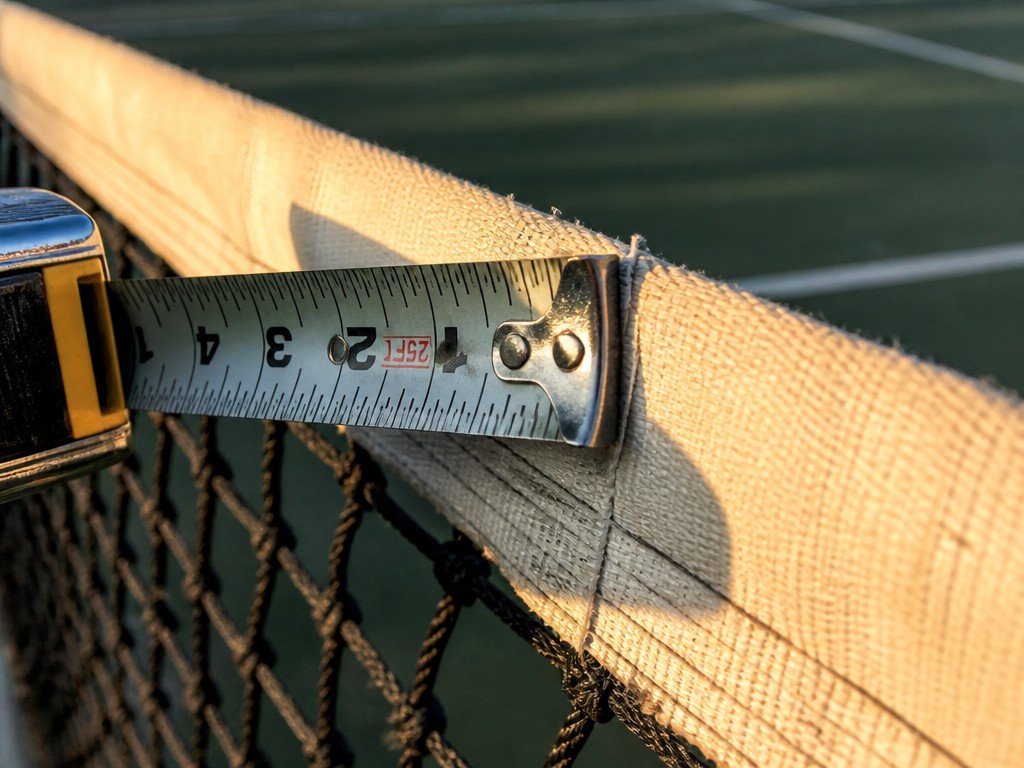
A few weeks ago I dropped a tape measure on the center strap of a public court I'd played for years. The reading was 35 inches — an inch low. Not catastrophic, but enough that I'd spent seasons grooving a margin that didn't exist anywhere else. My crosscourt forehand, the one I trusted, had been clearing by an inch I'd never actually earned. On a properly set net it would have caught tape.
That single measurement is the whole reason for this piece. Tennis net height regulations are simple to state and easy to assume; the consequences for your footwork and weight transfer are neither.
The verdict, in one line
The regulation sets a fixed target — but it's footwork and weight transfer that decide whether you clear it on demand, and an out-of-spec net quietly trains the wrong habits by giving you false feedback about your margin.
In other words: the net is the test, your feet are the answer, and a sagging or over-tight net grades the test wrong.
How we evaluated this
We are not on a court as we write this, and we did not re-measure a sample of municipal nets ourselves beyond the one case above. What follows is a synthesis. We weighed four kinds of evidence:
- Published rules. The ITF Rules of Tennis and the USTA's adoption of them for the official net dimensions.
- Manufacturer specs. Net and post makers' stated cable tensions and sag tolerances.
- Coaching consensus. What instructional sources broadly agree on regarding weight transfer and clearance — treated as reasoned consensus, not as measured fact.
- Owner and administrator feedback. Recurring complaints from players and club staff about inconsistent center-strap heights on public courts.
Where a claim rests on reasoning rather than a measurement, we say so. Where sources agree, we lean on it. Where the evidence is thin — and on the footwork-to-clearance link, it is thinner than anyone selling a drill will admit — we flag it.
The regulation baseline
The ITF Rules of Tennis specify a net that is 3 feet (0.914 m) high at the center and 3 feet 6 inches (1.07 m) at the posts, with the posts set 3 feet outside the singles court for singles play (achieved with singles sticks when a doubles net is in use). The USTA adopts these dimensions for sanctioned play. That much is not in dispute and is easy to verify in the published rulebook.
The center is the lowest legal point by design, held down by the center strap so the cable above it doesn't bow upward. Net manufacturers state their cables to a working tension, but tension relaxes over a season, posts lean, and straps loosen. The result is the most common defect players and court administrators report: a center that reads above or below 36 inches while the posts look fine. The mechanism is mundane — gravity and slack cable — but the effect on practice is not.
Why the wrong height corrupts your footwork feedback
Footwork has one job in the contact equation: deliver your body to a balanced, repeatable position so weight transfer can do its work. The net is the feedback device. You aim for a clearance margin — say a foot over the center on a rally ball — and the ball either makes it or doesn't.
If the center sags low, every ball clears with room to spare. You stop being punished for the small errors that footwork is supposed to eliminate: arriving late, leaning back, transferring weight onto the back foot instead of through the shot. The low net forgives all of it. Then you play a match on a compliant net and the same swing catches tape, and it reads as a bad day rather than a footwork pattern that was always there.
An over-tight or post-leaning net does the reverse — a center sitting high makes you flatten your aim and rush your weight forward to compensate, building a different distortion.
Three nets, three lessons for your feet

| Net condition | Center reading | What it teaches your footwork |
|---|---|---|
| Compliant | ~36 in (0.914 m) | Honest feedback; balanced setup and full weight transfer are rewarded, errors are punished proportionally |
| Sagging center | below 36 in | Over-forgiving; masks late arrival and back-foot transfer, inflates your sense of margin |
| Over-tight / high center | above 36 in | Forces flattened aim and rushed forward weight shift; trains compensation, not technique |
The middle and right columns are where most public-court frustration lives. The compliance figure is from the published rules; the footwork consequences are coaching-consensus reasoning, not measured study results, and we'd grade that reasoning as plausible rather than proven.
What the evidence actually says about weight transfer
Here the honesty matters. The instructional consensus is strong and old: forward weight transfer — initiating the kinetic chain from the ground up, moving mass from back foot to front through contact — adds pace and, more relevant here, stabilizes the racquet face at contact. A stable face is what makes your clearance margin repeatable.
What we could not find is clean, independent measurement isolating net clearance consistency as a function of weight transfer for recreational players. Biomechanics work on the kinetic chain in the serve and groundstrokes is well established; the specific downstream claim — "better weight transfer tightens your net-clearance distribution" — is a reasonable inference from that work, not a directly published result. So treat the direction as well-supported and the magnitude as unknown.
The practical takeaway survives the caveat: you cannot diagnose a weight-transfer problem on a net that lies to you about your margin. Fix the feedback device first.
Measuring and adjusting it yourself
You don't need a pro to verify a court. A tape measure or a folded racquet trick (a stacked racquet-and-a-bit reaches roughly net height for a rough check) confirms the obvious cases.
- Measure at the center, on the strap, not between posts. The center is the regulated low point.
- Check the posts too — a high post reading with a low center usually means a loose center strap, which is the easiest fix: tighten the strap buckle until the center sits at 36 inches.
- If the whole net is low or high, the cable tension or post height is the culprit. Most posts have a crank or internal winder; back off or add tension a little at a time and re-measure.
- Report persistent defects to the facility with the reading and the rule citation. Administrators act faster on "center reads 35 inches, ITF spec is 36" than on "the net feels off."
If a public net stays wrong, the value of carrying a tape isn't to fix their court — it's to know what your practice was actually teaching you.
Who this is for, and who it isn't
This is for intermediate-to-advanced players who practice regularly on courts they don't control, and for club staff who field the "the net feels weird" complaints. If your groundstrokes are technically inconsistent and you train on varied public courts, the net is a variable worth eliminating.
It is not for beginners, for whom net height is far down the list of what's limiting clearance, and it's not a promise that fixing a net will fix your footwork. It removes an excuse and restores honest feedback. The work is still the work.
Evidence grade
- Regulation dimensions: Strong. Directly published in the ITF rules and adopted by the USTA.
- Sag mechanism and prevalence of center-strap defects: Moderate. Consistent with manufacturer specs and widely reported by players and administrators.
- Footwork-and-weight-transfer link to clearance consistency: Weak-to-moderate. Well-reasoned from established kinetic-chain work, but not, as far as we found, directly measured for this outcome.
After that 35-inch reading, my own habit changed in one small way: I check the center strap before a practice session the way I'd check string tension, and if it's off and won't budge, I aim my rally ball a hand-width higher than feels necessary — not as advice, just because I no longer trust a net to tell me the truth about my feet.