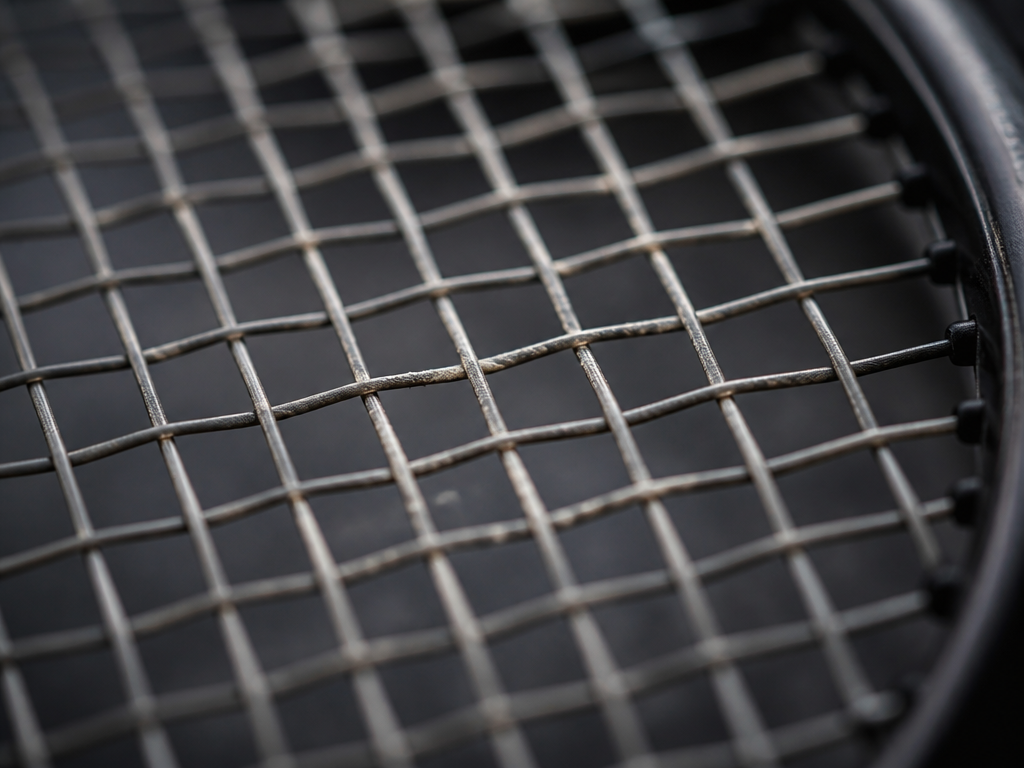
Good tennis string maintenance is not a date on a calendar — it is a function of how many hours you play, what string is in the racquet, and how attuned you are to the moment your control quietly walks out the door. If you take one thing from this piece, take this: restring by accumulated playing hours and a few specific feel cues, not by a fixed number of times per year. The "play three times a week, restring three times a year" rule is the most repeated advice in the sport, and for most recreational and intermediate players it is either too much, too little, or coincidentally right for the wrong reasons.
We wrote this because the calendar rule keeps colliding with reader reality. A player who hits 30 focused minutes twice a week is told the same thing as someone grinding three-hour singles matches. That cannot be correct, and it isn't.
Why strings degrade in the first place
Before any rule makes sense, the mechanism has to. A freshly strung racquet loses tension immediately — the steepest drop happens in the first 24 to 48 hours, before the racquet is even hit. Across the broad body of stringing-machine and lab measurements, that initial settling commonly runs in the range of 8 to 15 percent depending on string and tension, and it happens whether you play or not. This is why a racquet strung last month and left in the bag is not "fresh."
Two distinct things then happen as you play:
- Tension continues to fall. Every impact stretches the string bed slightly and it does not fully recover. The bed gets looser, the launch angle climbs, and balls that used to land in start landing long. Players unconsciously add spin or shorten their swing to compensate, which is where elbows and wrists start complaining.
- The material stiffens and stops snapping back. This matters most with polyester (often sold as "co-poly"). Polyester loses its elasticity faster than it loses tension. The string bed can still read near its target tension on a gauge while the strings have stopped sliding and snapping back into place. That snapback is most of where modern spin comes from. When it dies, the bed feels "dead" — boardy, low-powered, and harsh — even though a tension meter says it's fine.
That second point is the one the calendar rule completely ignores. A polyester string can go dead while still holding tension. Feel degrades before the number does.
What most people do
Most people follow the rule of thumb their first coach or first pro shop gave them: take the number of times you play per week, and restring that many times per year. Three times a week, three times a year. It is clean, it is memorable, and it has the authority of being repeated everywhere.
It survives because it is roughly defensible for one specific player: someone playing competitive-ish tennis a few times a week on a multifilament or synthetic gut string at a moderate tension. For that exact profile, three restrings a year lands in the right neighborhood.
The problem is that almost nobody is exactly that player. The rule has no input for:
- Session length. Two 30-minute social hits and two 2.5-hour singles matches are both "twice a week." They are not the same wear.
- String type. Polyester, multifilament, synthetic gut, and natural gut age on completely different schedules. The rule treats them as identical.
- Whether you break strings. If you break strings, frequency is decided for you — the question of when never arrives.
- Tension and stiffness. Strung tighter, strung in a stiff frame, strung thin gauge — all change the timeline.
So players following the rule split into two unhappy groups. The first restrings on schedule, never breaks a string, and quietly suspects they're wasting money — and often they are. The second plays on a dead polyester bed for months, blames their technique for a sudden loss of control, and never connects it to the strings because the calendar said they had time left.
A second common habit is even simpler and worse: restring only when the string breaks. For polyester especially, breakage is the last event in a long decline. A poly bed that's been dead for six weeks will eventually snap, and the player thinks they got every last day out of it. They got every last bad day out of it.
What the evidence suggests
There is more measurement here than the calendar rule implies, and it points consistently in one direction: tension loss is real, fast, and string-dependent, and feel degradation can outrun tension loss.
The well-documented behaviors, drawn from stringing-lab measurements and the testing community rather than any single headline study:
- Initial settling is unavoidable. The first day or two after stringing accounts for the largest single chunk of tension loss. Restringing the night before a tournament does not give you a "fresh" bed for the match — it gives you a bed mid-drop.
- Natural gut holds tension best over time; polyester holds tension reasonably but loses elasticity fastest; multifilament and synthetic gut sit in between on tension but tend to keep a livelier feel longer than poly relative to their own decline.
- Stiffness, not just tension, drives arm comfort. A stiff, dead polyester bed transmits more shock. This is the practical link between worn strings and arm discomfort, and it's why "it still has tension" is not the same as "it's still safe for your elbow."
Here is how the common string families compare on the things that actually decide when you restring:
| String type | Tension holding | Feel longevity (snapback/liveliness) | Arm comfort as it ages | Typical practical lifespan* |
|---|---|---|---|---|
| Polyester / co-poly | Moderate | Poor — goes "dead" before it loses much tension | Worsens noticeably | ~15–25 playing hours |
| Multifilament | Moderate | Good | Stays comfortable | ~25–40 playing hours |
| Synthetic gut | Moderate | Moderate | Moderate | ~20–35 playing hours |
| Natural gut | Best | Very good | Stays comfortable | ~30–50 playing hours (if it doesn't fray/break first) |
*These are working ranges from the testing community for moderate intensity, not lab guarantees. Hard hitters, high tensions, and thin gauges shorten everything; gentle hitters extend it. We treat them as starting points to be adjusted by feel, not as targets.
The throughline: the right unit of measurement is playing hours, and the right string-specific signal is feel, not the date. Tension loss is measurable, the rate differs by string family, and for polyester the feel cliff arrives before the tension number tells you anything is wrong. That is exactly the failure mode the calendar rule cannot catch.
What we cannot claim from this evidence: a precise, universal hour count for your setup. The published and community measurements give ranges, not a single number, because tension, frame stiffness, gauge, string brand, swing speed, and even temperature all push the figure around. Anyone offering you a precise number for all players is selling certainty that does not exist.
What we actually do
Here is the framework we use on our own racquets and recommend to readers who tell us the calendar rule never fit. It is built on hours and signals, with explicit room for the two things that actually decide most people's behavior: budget and string breakage.
Count hours, not weeks
Estimate your real playing hours per week — honestly, including warmup but not the time spent picking up balls. Then set a target window by string type using the lifespan column above. A practical default for the most common case:
- Polyester: plan to restring around 15–20 hours of play, sooner if you hit big.
- Multifilament / synthetic gut: plan for 25–35 hours.
- Natural gut: ride it until it frays or the feel drops, often 30–50 hours.
For a player doing two 90-minute sessions a week (three hours weekly), a polyester bed reaches 15–20 hours in five to seven weeks — meaning roughly seven to nine restrings a year if they play year-round, not three. The same player on multifilament reaches their window in eight to eleven weeks. Notice how far both are from "twice a week, twice a year."
Trust three feel cues over the gauge
The hour count tells you when to start paying attention. These three cues tell you the bed is actually done:
- Your normally-in balls start landing long. This is the tension drop showing up as launch angle. If you find yourself swinging easier to keep balls in, the bed is loose.
- The string bed feels boardy or harsh on contact, and off-center hits sting more than they used to. That's the stiffening polyester transmitting shock — the arm-comfort signal.
- The mains stop snapping back. Glance at the strings: if they're sitting badly out of alignment and not sliding back after rallies, the snapback that gives you spin is gone, even on a poly bed that "looks fine."
When two of those three show up, the bed is done regardless of what the calendar or a tension meter says.
Let budget and breakage override the science honestly
If you break strings, none of the above applies as a waiting question — you restring on break, and the only real decision is whether to drop to a more durable string or thicker gauge to break less often. There is no shame in choosing durability over peak performance if restringing cost is a real constraint.
And if the ideal schedule costs more than you can spend, cut the schedule, not the awareness. A player who can afford four restrings a year but theoretically "should" do eight is better off doing four well-timed restrings — strung fresh into the weeks they play most, replaced the moment the feel cues hit — than eight they resent. The worst outcome is playing on a dead bed and paying for restrings you didn't notice you needed. Knowing the bed is gone, and choosing to play it anyway because of budget, is a legitimate decision. Not knowing is the failure.
One more thing we do that the calendar rule discourages: we don't restring the night before a match. Because of the first-48-hours tension drop, we string two to four days out so the bed has settled by match time. If you only restring for events, restring early enough that you're playing on a stabilized bed, not a sliding one.
Reviewer note
I switched from the calendar to the hour count three seasons ago after spending most of a winter blaming a sudden loss of depth control on my forehand mechanics. The strings — a stiff polyester I'd had in for over two months of regular play — were the whole story. Restrung, the depth came back the same afternoon. I now log rough hours in my phone's notes and restring poly at 18 hours whether or not it's broken. It has cost me a little more in string and saved me an embarrassing amount of pointless self-coaching. — one of our testers
Who this framework is for
This is for the recreational-to-intermediate player who plays anywhere from once a week to most days, owns one or two racquets, and has felt the disconnect between the standard rule and their actual results. It's especially for anyone who has recently noticed their game slipping — balls flying long, contact feeling harsh, spin dropping off — and hasn't connected it to the strings.
It is also for budget-conscious players, because the framework gives you permission to spend less without playing blind. You make the trade-off knowingly.
Who it isn't for
If you break strings every few sessions, the timing question is already answered for you and your real decision is durability and cost, not when. If you are a competitive player whose results depend on a known, repeatable string bed, you likely already restring on a tight hour count and a feel standard stricter than anything here — keep doing that. And if you genuinely cannot feel the difference between a fresh and a worn bed yet, don't fake it; play a fresh string set, deliberately note how it changes over the next month, and build your own cues from there.
The honest limits
We're describing ranges, not guarantees. We did not run a controlled longitudinal tension study for this piece, and the hour figures come from the broad testing community and our own logged restrings, not from a single instrumented experiment we can hand you. Your frame, swing, tension, and string brand will move every number. The mechanism — tension loss in the first 48 hours, continued loss with play, and polyester losing elasticity before tension — is well established and consistent across sources. The exact hour at which your setup crosses from fine to done is something only your own logging will tell you.
Evidence grade for the central claim — that playing hours plus feel cues beat the calendar rule: Strong on mechanism (tension loss and polyester stiffening are repeatedly measured and not in dispute), Moderate on the specific hour ranges (consistent across the testing community but range-based, not a single controlled figure we can cite as ground truth).
The one rule you can use tonight
Check the racquet you'd play with tomorrow: if it's polyester and has more than fifteen hours on it, or any string where your normal balls are landing long and contact feels harsh, restring it before your next session — and never the night before a match.