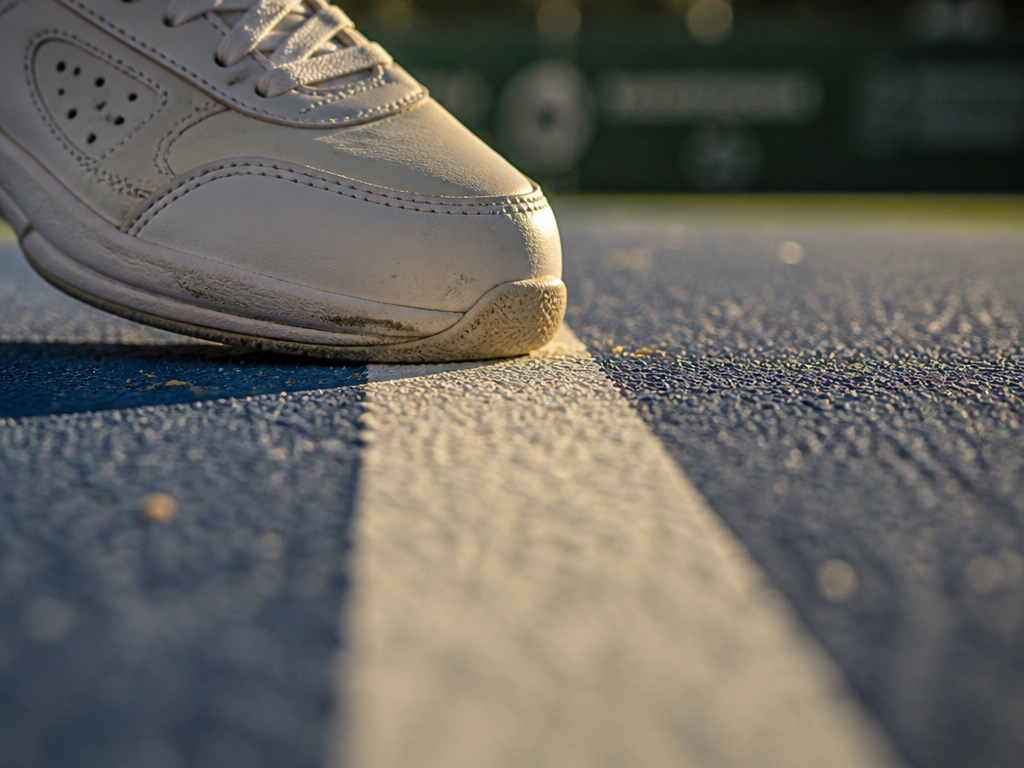
Watch a busy public court for an hour and you will see dozens of serves that break the same rule. Almost none get called. The foot fault is, by a wide margin, the most frequently violated and least enforced item in the tennis rules — a regulation that everyone has heard of, few fully understand, and almost nobody polices on a Tuesday-night court with no umpire in sight.
That gap, between what the rulebook says and what actually happens, is where the frustration lives. So let us start with the rule itself, then trace exactly where in your service motion the fault is born, and finish with fixes that target each stage rather than vague advice to "be careful."
What counts as a foot fault, exactly
A foot fault happens when, during the service motion and before you strike the ball, your foot touches the baseline, the imaginary extension of the center mark, the sideline, or the court itself. The relevant section is Rule 18 of the ITF Rules of Tennis. The key detail most casual players miss: it is not about where your foot ends up after contact. It is about contact with the wrong patch of ground at any point from the moment you begin the motion until the racquet meets the ball.
Two things follow from that. First, you are allowed to leave the ground entirely — jumping into the court is fine, as long as you launch from behind the line. Second, the line itself is out of bounds for your feet. Touching the baseline counts. The rule does not require you to cross it.
There is also the often-forgotten clause about position. You must stand behind the baseline, between the center mark and the sideline extensions. Step too far toward the center, sole on the imaginary line, and that is a fault too — though we have honestly never seen it called at the recreational level.
Why nobody seems to call it
The simplest reason is structural. Foot faults are normally a line judge's job, and your local court does not have one. In a self-officiated match, the receiver is technically allowed to call a foot fault — but doing so feels aggressive, the receiver is twenty feet away and watching the toss rather than the feet, and the social cost of being "that person" is high. So the rule goes uncalled by default, not by conspiracy.
At the professional level it is barely better. Foot faulting at the baseline is widely believed to go unpunished the vast majority of the time, and the most famous flashpoint — Serena Williams's 2009 US Open semifinal, where a foot fault call at a critical moment triggered a point penalty and a meltdown — became infamous precisely because the call was so rare. The anger was about timing and selectivity, not really about the rule.
The result is a regulation enforced unevenly enough that most players never learn whether they break it. Many do. The fix starts with understanding when, in the swing, the violation actually occurs.
Where the fault is born: the motion in order
A foot fault is not a single event. It is the end of a chain that usually starts before you toss the ball.
First: the setup
Most habitual foot faulters set up too close to the line. They place the front foot a fraction of an inch behind the baseline, leaving zero margin for everything that follows. Nothing has gone wrong yet — but the error is already loaded.
Next: the toss and the lean

As you toss, your weight shifts forward and your body leans into the court. This is good technique. The serve is a forward-moving action, and that momentum is where pace comes from. But the lean pulls the front foot's pressure toward the line, and on a platform stance the front foot can creep or roll forward as the heel lifts.
Then: the trailing foot
In a pinpoint stance — where the back foot slides up to meet the front before launch — the dragging back foot is the usual culprit. It scrapes forward across the court as you load, and that scrape often kisses the baseline. Because it happens behind you, mid-motion, you never see it. This is the single most common foot fault we observe, and the player committing it is almost always unaware.
Last: contact and launch
By the time the racquet meets the ball, the violation, if there is one, has already happened. Either a foot touched the line during the load, or the front foot slid across it during the lean. The jump that follows is legal. The damage was done a half-second earlier.
Fixes that match the stage
Because the fault is a chain, the fix is to interrupt it early.
- Start farther back. Set your front foot two to three inches behind the baseline. This single change fixes most recreational foot faults because it builds in margin for the lean and the drag. You lose almost nothing in court position.
- Quiet the trailing foot. If you use a pinpoint stance and keep faulting, try a platform stance, where both feet stay planted and apart. No slide, no drag, no scrape across the line.
- Film it from behind. Set a phone on the ground behind the baseline and serve ten times. Awkward as it is to watch yourself, the trailing-foot drag is invisible from your own point of view and obvious on video.
A quick reference
| What you do | Where the fault tends to come from | First thing to try |
|---|---|---|
| Stand right on the line | No margin for the lean | Move back 2–3 inches |
| Pinpoint stance, back foot slides | Dragging trailing foot | Switch to platform stance |
| Jump into the court | Usually legal | Check launch foot, not landing |
| Feel rushed on second serve | Hurried, sloppy footwork | Slow the whole motion down |
On calling it against an opponent
If you suspect an opponent is faulting, the etiquette is to mention it once, calmly, between points — not to start barking it on every serve. The Code of conduct for unofficiated matches asks you to give your opponent the benefit of the doubt and to raise persistent issues for resolution rather than self-enforce mid-rally. Repeated, deliberate foot faulting is worth flagging. A toe grazing the line in a friendly hit is not worth the war.
The question we can't close
Here is what the cheerful coaching advice tends to skip: we do not actually have good public data on whether a baseline foot fault confers a meaningful advantage at recreational pace. Stepping a few inches into the court shortens the distance to the net and changes the angle slightly. Whether that translates into measurably more aces or service points won — at 70 mph, on a park court, against an opponent who can't punish much anyway — is genuinely unsettled. The rule treats every fault as equal. The physics may not.
So the honest question isn't whether you foot fault. Most of us occasionally do. It's whether the few inches you're gaining are worth anything at all.