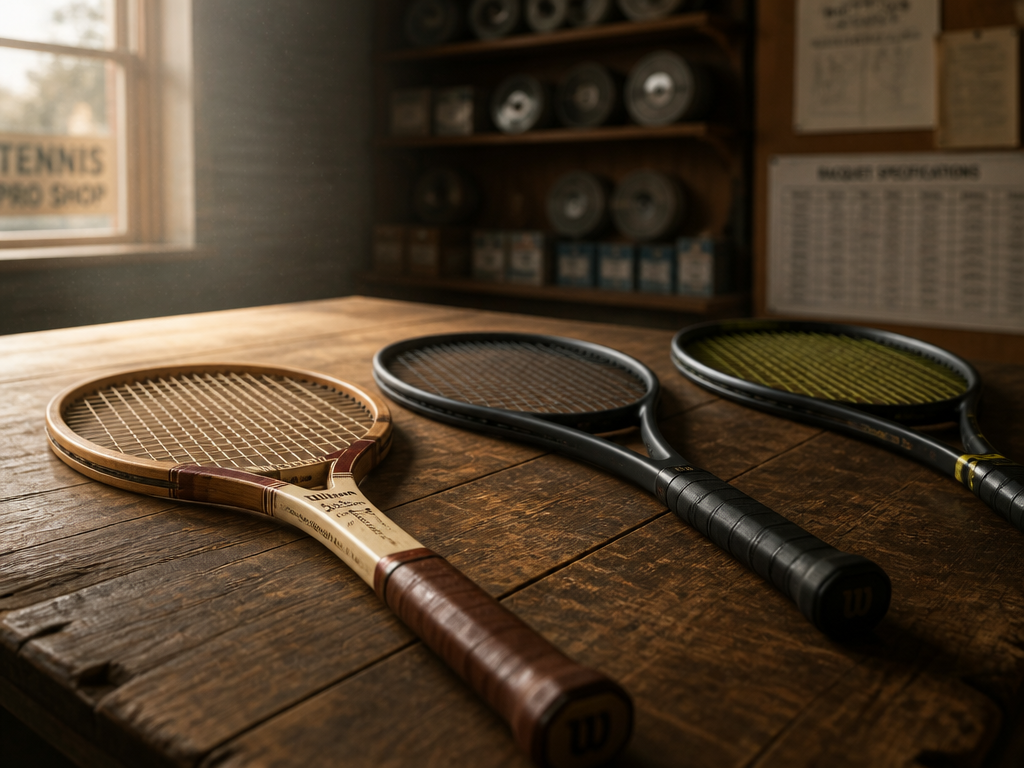
There is a quiet promise underneath most tennis marketing: that the right racquet, the right string, the right setup is the thing standing between you and the player you could be. Buy correctly and the game opens up. We started this desk partly because tennis gear selection has been sold to recreational and intermediate players as a solution to problems that gear cannot actually solve — and partly because, some of the time, it genuinely can. Both things are true. Sorting one from the other is the whole job.
This piece is a founder's note, so we'll be plain about why we're here. But we want to do it the way we intend to do everything: by tracing where a belief came from, and checking whether the source holds the weight people put on it.
Where did the idea that gear "unlocks" your game come from
The short answer is that it came from a real shift, which then got oversold. Before the late 1970s, racquet choice was close to trivial. You played with wood, the head was roughly 65 square inches because physics and laminated ash made it so, and the meaningful variables were weight and grip size. There was almost nothing to select. The "right gear" conversation barely existed because the options barely existed.
Then two things happened. Howard Head's oversize aluminum Prince Classic arrived in 1976 with a head around 110 square inches, and graphite composites went mainstream through the early 1980s. Suddenly head size, stiffness, weight distribution, and string pattern were all adjustable. The equipment became a design space. And a design space needs a salesperson.
So the pro shop became an advice engine, the tennis magazine filled with spec charts, and the message settled into its modern form: your equipment is holding you back, and we can fix it. That message was not a conspiracy. It grew out of a true observation — that a 110-square-inch graphite frame was genuinely more forgiving than a wood stick — and then kept its momentum long after the frames stopped changing that dramatically.
The source is thinner than the belief
Here is the part the spec charts skip. The largest, most reliable equipment effects in tennis were front-loaded into that first generation of change. Wood to oversize graphite was a revolution you could feel on the first swing. Most of what's sold today as transformative — a few points of stiffness, a slightly different string, a 5-gram swingweight shift — operates in a much narrower band, and the evidence for any single one of those changes producing a measurable performance gain in a club player is thin.
We want to be careful here, because this is exactly the kind of claim that gets stated with more confidence than it has earned, and we'd be hypocrites to do that. So: what's actually established?
The clearest body of work concerns string tension, comfort, and injury, not winning. Research on impact load and arm stress — for example work coming out of groups like the International Tennis Federation's Technical Centre, and the broader sports-biomechanics literature on grip size and forearm load — supports the idea that gear changes can reduce discomfort and the forces transmitted to the arm. Lower tensions and softer strings reduce peak impact shock. That is a mechanism, and it is plausible to well-supported depending on the specific claim.
What's much thinner is the leap from "this setup feels better" to "this setup makes you a better player." We've found no convincing evidence that, holding technique constant, a marginal racquet swap reliably moves an intermediate player's results. The honest verdict on the popular version of gear-as-performance-unlock is folk wisdom with a kernel of truth: real at the extremes, oversold in the middle, where most of the buying happens.
What this desk is actually for
So why run a gear review site at all, if we're this skeptical about gear?
Because the skepticism is the product. Most equipment advice fails recreational players in one of two directions. It's either generic to the point of uselessness — "find what feels comfortable," which tells you nothing — or it's so technical that it assumes you already know what swingweight, stiffness rating, and string gauge do to a ball, and quietly gatekeeps everyone else out.
We're trying to sit in the gap. We test gear the way you'd actually use it: over a week of real sessions, restrung mid-cycle, played until something tells us the truth. We bring an honest technical background to it, but we translate. When we don't know something, we say we don't know. When a claim is marketing, we'll name it as marketing. When a setup genuinely helped, we'll tell you the mechanism, not the vibe.
The mission is small and we like it that way. Help one player make one decision they don't regret. That's the unit of work.
How an honest gear decision actually unfolds
Walk through it in the order it happens, because the order matters more than the catalog.
First comes the body. Before frame and string, the question is whether anything currently hurts. If the elbow or shoulder complains, that constraint outranks every other preference, and it points toward softer strings, lower tensions, and a frame that isn't maximally stiff. This is the one area where the evidence for gear effects is strongest, so it goes first.
Second comes the swing you already own. Gear should fit the stroke you have on a Tuesday, not the stroke you hit twice a year. A heavier, lower-powered frame rewards a long, fast swing and punishes a short one. Matching here prevents most buyer's remorse.
Third — and only third — come the fine adjustments: string type, gauge, tension, a few grams of weight. These are real, but they are tuning, not transformation. Treat them as tuning and you'll be calibrated correctly.
An honest rule of thumb
If you're an intermediate player choosing equipment, spend your attention in proportion to the size of the effect. Get the comfort and the swing-fit right first, because those are where the evidence lives. Then stop optimizing and go practice, because that's where the rest of the improvement actually comes from.
A rough guide to where the effects are real:
| Decision | Effect on comfort/injury | Effect on performance | Evidence |
|---|---|---|---|
| Frame stiffness & string softness | Meaningful | Small | Well-supported for comfort |
| Grip size | Meaningful | Small | Plausible |
| Swingweight / frame match to stroke | Moderate | Moderate | Plausible, player-dependent |
| Marginal string/tension tweaks | Small | Small to none | Thin |
None of this means gear doesn't matter. It means it matters in specific, knowable ways, and the marketing blurs exactly those edges.
We built this place to keep those edges sharp. Good gear won't hand you a better game — but the wrong gear can quietly cost you one, and knowing the difference is worth more than any racquet.