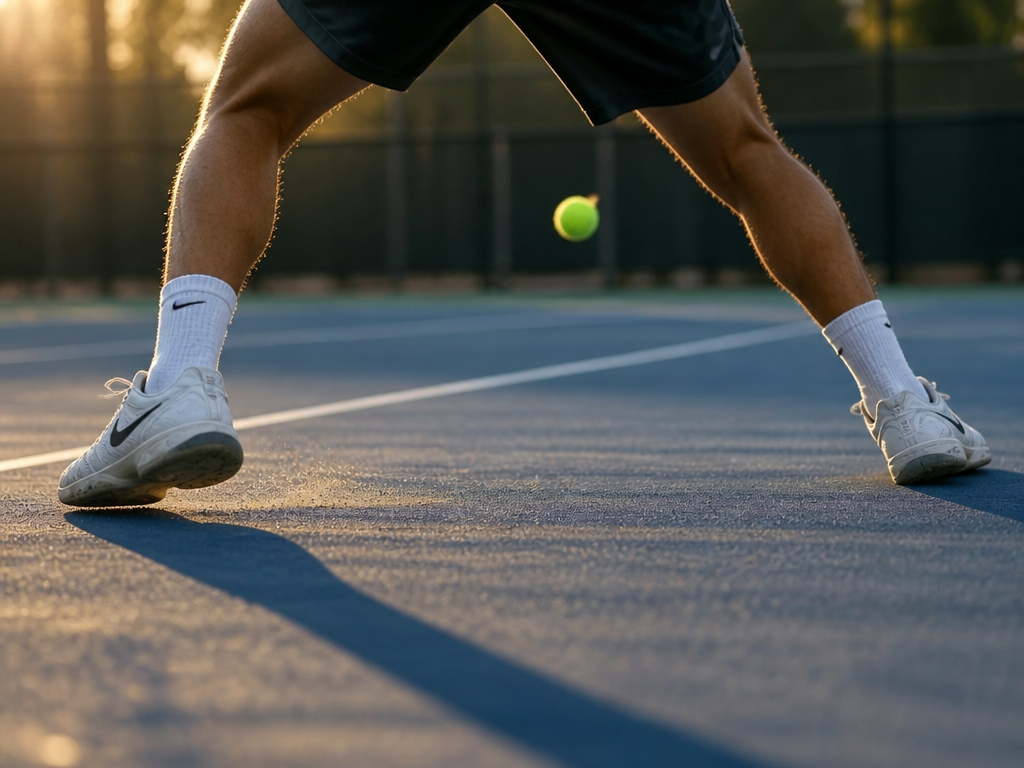
Your swing path is not the cause of your forehand errors. It is the receipt.
That is a strange thing to say in a piece about swing path mechanics, and we mean it fairly literally: on a stroke this fast, the shape of the forward swing is mostly an output of decisions already made — where your feet put the ball relative to your hip, whether the racquet was turned and set before the bounce, and what you were actually aiming at. Forehand consistency at the 3.0–4.5 level tends to improve fastest when a player stops trying to steer the path and starts controlling the three upstream variables that set it. The rest of this piece is us trying to earn that sentence.
How we evaluated this
We did not hit a ball to write this. There is no lab bench here, no radar gun, no swingweight scale, no session log. What we did is read, compare, and weigh — and it matters that you know the order we weighed things in.
Four classes of source went into this piece. First, peer-reviewed tennis biomechanics: kinematic comparisons of forehands across skill levels, and studies isolating which joints contribute how much racquet-head speed. Second, the motor-learning literature — attentional focus, practice scheduling, mental rehearsal — because "how do I change my swing" is a learning question before it is a mechanics question. Third, the physics-of-tennis books by Howard Brody, Rod Cross and Crawford Lindsey, which are the only place we know of where the geometry of margin is computed rather than asserted. Fourth, the applied layer: match-charting data published by analysts, coaching curricula from the national federations, and the accumulated consensus of teaching pros and league players about which cues actually stick.
We weighted them in that order for mechanism and in reverse for prescription. Biomechanics tells you what varies between good and less-good forehands; it does not tell you what to say to yourself on Tuesday night. Coaching consensus is the opposite — rich in usable cues, thin in controlled evidence. Where the two agree, we say so plainly. Where they don't, we flag it rather than smoothing it over. And where a number is a single analyst's charting rather than a replicated finding, we label it that way, because the difference is the whole point.
The claim, in a form you can argue with
Here is the strong version, stated so it can be attacked: for an intermediate player, the forward swing path is largely determined before the forward swing begins, and cues aimed directly at the path produce smaller and less durable error reductions than cues aimed at spacing, preparation timing, and target intent.
That is a real claim with real failure conditions. If it were wrong, we would expect to see players who consciously rehearse "low to high" during points show durable drops in error rate, and we would expect elite-versus-club kinematic comparisons to locate the biggest differences in the hitting arm. Neither is what the evidence looks like.
The timing problem nobody coaches around
Start with the clock, because the clock is what makes the claim plausible.
Studies of tennis groundstrokes generally report forward-swing durations — from the end of the backswing to impact — in the low hundreds of milliseconds. The motor-control literature on visually guided corrections, going back to Carlton's work on visual processing time in aiming movements, generally puts the latency for detecting an error and altering a limb trajectory somewhere in the region of 100 to 200 milliseconds. We are quoting ranges rather than a single figure deliberately: these numbers vary by task, by measurement method, and by how you define the start of the movement.
But even the generous reading is unkind to conscious path control. If the swing lasts roughly as long as one correction cycle, you get approximately one chance to intervene, and it arrives too late to be useful. This is an inference we are drawing across two literatures rather than a finding either one reports, so treat it as reasoning rather than measurement. It also matches something every player has felt: you know the forehand is wrong while it is happening, and you cannot stop it.
What this does not mean is that swing path is unimportant. It is enormously important — it is the mechanism by which spin and margin are produced. It means the path is a variable you set, not a variable you steer.
What a swing path actually is: three numbers and a very small window
Strip the coaching language away and a forehand path reduces to about three measurable quantities: the vertical swing angle (how steeply upward the racquet is travelling through contact), the contact location (height, and depth relative to your body), and the racquet-head speed. Those three, plus string and ball behaviour, determine launch angle, spin rate, and pace — which is to say, whether the ball goes in.
The reason this is unforgiving is geometry. In the physics treatments by Brody, Cross and Lindsey, the range of vertical launch angles that will both clear the net and land inside the baseline — what Brody termed a window of acceptance — is startlingly narrow for a flat, fast ball hit from behind the baseline: a matter of a couple of degrees, depending on speed, contact height, and spin. Their calculations are the source here, not any measurement of ours, and the exact figure shifts considerably with the assumptions you feed in.
The practical consequence is the single most useful thing in this piece. Topspin widens that window, because a ball launched higher will still drop. Speed narrows it. So does contact below net height. That means "more margin" and "more spin" and "a steeper upward path" are three descriptions of the same adjustment — and it also means that when a player's path flattens out under pressure, they are not making a technique error so much as spending margin they cannot afford.

As for where topspin numbers on a modern forehand actually sit: John Yandell's high-speed video analysis, published over the years at Tennisplayer.net, reported rally-forehand spin rates for top men in the rough neighbourhood of 2,500 to 3,500 rpm, with Rafael Nadal's the outlier at the top. Those figures are independently gathered but come from one analyst's video work rather than a replicated study, and club-level forehands sit far below them. Use them as a direction, not a target.
Five cues, compared
This is where a synthesis earns its keep — not by inventing a test but by putting the common prescriptions side by side against the same criteria.
| Cue | What it actually changes | Evidence behind it | Where it fails |
|---|---|---|---|
| "Low to high, brush up the back" | Attentional focus on the hitting arm; sometimes raises the finish | Weak for durable change; contradicted by external-focus findings | Reverts under pressure; encourages arm-only swings with no trunk contribution |
| "Get your racquet back earlier" | Preparation timing — the right variable | Moderate, via skill-level kinematic comparisons | "Back" and "earlier" are not checkpoints; unfalsifiable in the moment |
| "Racquet turned and set before the ball bounces" | Same variable, with a binary pass/fail | Moderate, same source, better operationalised | Genuinely rushed balls will fail it — at which point it should trigger a defensive choice, not a harder swing |
| "Three feet over the net, deep to the middle" | Ball-flight intent; the path adapts to serve it | Moderate-to-strong, from the attentional-focus literature | Drifts into pushing if speed intent is silently abandoned |
| "Contact off the front hip, arm comfortably extended" | Spacing and contact location | Moderate; consistent across coaching curricula and mechanism | Needs feeds or a cooperative partner to calibrate; hard to self-diagnose live |
The pattern is not subtle. Every cue that survives contact with the evidence points at something happening before or outside the swing. The one aimed at the swing itself is the weakest of the five.
Upstream variable one: spacing
Of the three, spacing is the one club players underrate most, and the reason is that its symptom looks like a different problem. A ball taken too close to the body forces the elbow to fold, which shortens the effective radius and flattens the path. The resulting error is a ball into the net — which the player then diagnoses as "I didn't brush up enough," and treats with a bigger arm swing. The mechanics are downstream of a footwork failure.
The checkpoint that works without a coach is positional rather than kinesthetic: at contact, the ball should be far enough in front and to the side that your hitting arm is comfortably extended, not jammed. If your elbow is trapped against your ribs, no amount of upward intent will restore the path, because the geometry to produce it no longer exists.
We want to be honest about the evidence class here. This is mechanism plus near-universal coaching agreement, not a controlled trial showing that spacing cues outperform path cues. It is the least contested item in this piece and also the least formally tested.
Upstream variable two: preparation timing
This is where the peer-reviewed work is most directly relevant. Landlinger and colleagues, publishing in Sports Biomechanics in 2010, compared forehand kinematics between elite and high-performance players — note that both groups were good — and, as we read their results, the meaningful differences clustered in trunk rotation and the preparation phase rather than in the hitting arm's action through contact. The elite group was not swinging a different swing. It was arriving earlier and rotating more, which produced a different swing.
Elliott, Takahashi and Noffal's 1997 study in the Journal of Applied Biomechanics on grip position and upper-limb contributions to racquet-head velocity points the same direction: racquet speed is assembled from multiple segment contributions, and the arm is one term in a sum, not the sum.
So the operational cue is timing with a hard edge on it: the racquet should be turned and set before the ball bounces on your side. Not "early." Before the bounce. You can grade yourself on it, ball by ball, without video and without a partner — and unlike "brush up more," you will know whether you passed.
When you fail it — and you will, on genuinely fast balls — the correct response is not a faster swing. It is a shorter, higher, more spun ball that buys you time. That is a tactical decision made in the same half-second, and it is where most league sets are quietly lost.
Upstream variable three: intent, aimed at a window
The third variable is what you are aiming at, and here the motor-learning evidence is the strongest in the piece. Gabriele Wulf's 2013 review in the International Review of Sport and Exercise Psychology, summarising fifteen years of attentional-focus research, found a consistent advantage for an external focus — attention on the implement or the intended effect — over an internal focus on body parts, across a wide range of tasks and skill levels.
Applied to a forehand, that means "a metre over the net, landing inside the service line's depth on the far side" is a better instruction than "finish over your shoulder." The first specifies the ball flight and lets your motor system solve for the path. The second specifies a body position and leaves the ball flight to chance.
One honest caveat: the external-focus literature is mostly built on laboratory and simpler sport tasks, and the effect sizes vary. We are extrapolating to a complex open skill. The extrapolation is reasonable and widely made by coaches, but it is an extrapolation.
The kinetic chain, minus the mysticism

We are going to be brief here on purpose, because the kinetic chain is the most over-explained and least usefully explained idea in tennis instruction.
What the biomechanics literature supports is straightforward: racquet-head speed at contact is the sum of contributions from the legs, trunk, shoulder, arm and hand, and efficient players sequence those contributions so that each one accelerates the next. What it does not support is the popular corollary — that you can consciously order the sequence during a 200-millisecond swing. You cannot, for exactly the timing reasons above.
What you can do is remove the constraints that force an arm-only swing: arrive early enough to rotate, and space the ball far enough away to use the rotation. Both of which are the two upstream variables we have already described. The kinetic chain is what you get when they are in place, not a separate skill to install.
A progression you can run alone
The motor-learning evidence has something specific to say about how to practise this, and it is not "hit a hundred forehands the same way."
Shea and Morgan's 1979 study, the origin of the contextual-interference effect, found that randomised practice produced worse performance during acquisition but better retention and transfer than blocked practice. Guadagnoli and Lee's 2004 challenge-point framework refined this: the optimal amount of practice difficulty depends on skill level, and too much variability too early degrades learning rather than deepening it. Together those give you a sequence rather than a drill.
Phase one — shadow swings, no ball. Rehearse the preparation with the checkpoint attached: an imaginary bounce, racquet already set. Driskell, Copper and Moran's 1994 meta-analysis in the Journal of Applied Psychology found mental practice produces a real if smaller effect than physical practice, and that it works best for tasks with a substantial cognitive component. Preparation timing is exactly that kind of task.
Phase two — blocked feeds, one variable. Same ball, same place, single cue: racquet set before the bounce. This is the low-challenge condition Guadagnoli and Lee would predict you need while the pattern is still fragile.
Phase three — cooperative rally with a target window. Switch the cue to external: a specified height over the net and a depth zone. Count consecutive balls that clear the height and land in the zone.
Phase four — randomised and directional. Vary the incoming ball. Now the checkpoint becomes diagnostic rather than instructional: when a ball goes long or into the net, ask only whether you were set before the bounce.
Coaching curricula commonly gate these phases with hit-rate thresholds — something in the region of 70 per cent success before advancing, or 20 to 40 consecutive balls in phase three. We are reporting those as widely used heuristics, not validated thresholds; we have not found a study that establishes a specific gate. They are useful because they are concrete, and because any fixed criterion beats advancing on how you feel.
Where the sources disagree
Three places, and we would rather name them than pretend to a consensus that isn't there.
Grip. Eastern and semi-western both produce reliable forehands at every level; the Elliott, Takahashi and Noffal grip study found differences in how upper-limb segments contributed, not that one grip was superior. Grip changes the natural contact height and swing plane. It is not a consistency fix.
How much spin. Most coaching sources push club players toward more spin, and the margin geometry supports it. But spin costs racquet-head speed spent vertically rather than forward, and past some point you are hitting a ball that a competent opponent attacks. Nobody we read gives a defensible number for where that line sits at 3.5 level.
Practice variability. The contextual-interference literature is robust in the aggregate but its application to lower-skilled learners is genuinely contested — which is why we put a blocked phase in the progression at all.
Who this is for, and who it isn't
This framework is for the player whose forehand is technically functional and situationally unreliable — the one who hits clean in a warm-up basket and sprays under score pressure, and who is averaging double-digit errors a set in league play. If your errors are concentrated on balls that arrived faster or deeper than you expected, the preparation checkpoint is the highest-yield thing on this page.
It is not for someone without a repeatable swing yet. If your contact point moves by a foot from ball to ball, spacing and timing cues have nothing stable to attach to; you need feeds and a coach, in that order. It is also not for the player whose errors are tactical — going for a winner off a defensive ball is not a path problem, and no amount of mechanics work will fix a decision.
And it is not a substitute for footwork conditioning. Arriving early is partly a technique habit and partly whether your legs can get you there in the third set.
The verdict
If you fix one thing this month, fix whether your racquet is set before the ball bounces — it changes the swing path more reliably than thinking about the swing path ever will.
On the central claim — that path-directed cues underperform cues aimed at spacing, preparation timing, and target intent — we grade the evidence Moderate. The mechanism is well supported by tennis biomechanics; the attentional-focus finding is strong but extrapolated from simpler tasks; the timing argument is an inference across two literatures rather than a measured result. What is missing is the direct study: a controlled comparison of cue types against unforced-error rates in intermediate players. We could not find one. Anyone who tells you the question is settled is going beyond what the literature currently supports.
Tonight, judge every forehand by one thing only — whether your racquet was turned and set before the ball bounced — and let the path take care of itself.