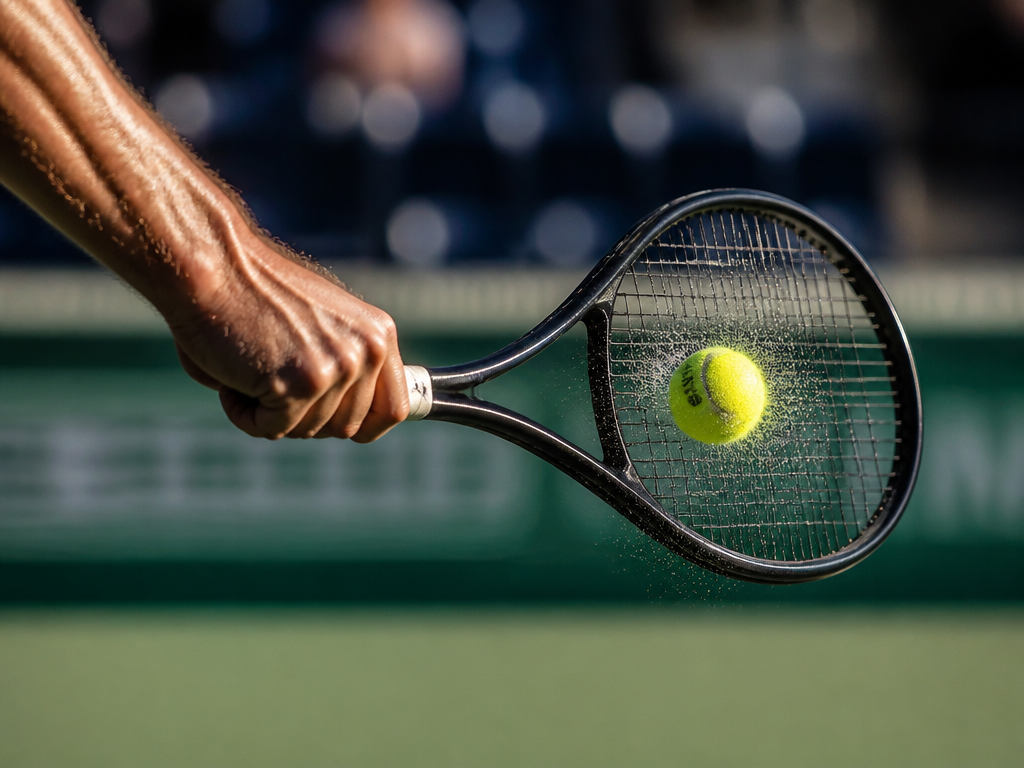
Heavy topspin makes your forehand slower. Not slower to develop — slower through the air, on the same swing, from the same legs. That is not a flaw in the design. It is the design, and once you accept it, the whole subject of forehand topspin technique stops being mysterious and becomes a budget you learn to spend.
The question almost every 3.0–4.5 player is really asking is different. It's: how do I keep hitting the ball exactly as hard as I hit it now, and have it land in more often? Read the physics and the biomechanics honestly and the answer is that you can't. Racquet-head speed is finite. Spin is bought out of the same account as pace, and the transaction is not optional.
The verdict: topspin is produced almost entirely by the upward component of racquet-head speed at contact, it is paid for in ball speed, and it is worth paying for — because spin converts into net clearance, into dip inside the baseline, and into a bounce that pushes your opponent backward, none of which flat pace gives you. The wrist, the grip, and the finish that consume most club-level practice time are, at best, indirect contributors.
The rest of this piece is us earning the right to have opened that way.
How we evaluated
We are a review desk, not a lab and not a coaching academy. Nobody here went out and measured a ball. What we did was read, compare, and weigh four distinct classes of source, and it's worth being specific about which is which, because they are not equally reliable.
Racquet-and-ball physics. The most trustworthy layer. Rod Cross, the retired University of Sydney physicist who has spent two decades on the mechanics of impact, and Crawford Lindsey, his frequent collaborator, have published measurements of dwell time, string movement, and the relationship between racquet velocity and resulting spin. These are bench measurements of a small, well-defined system. They generalise well because they don't depend on who is swinging.
Three-dimensional biomechanics. Bruce Elliott and colleagues at the University of Western Australia, and later Brian Gordon's motion-capture work published through Tennisplayer.net, decomposed the forehand into segment contributions — how much racquet-head speed comes from trunk rotation, from shoulder, from internal rotation of the upper arm. Reliable, but drawn from small samples of high-level players, which limits how confidently it transfers to a 3.5 with a different body and half the swing speed.
Publicly reported ball-tracking numbers. The RPM figures everyone quotes — Nadal at roughly 3,200 revolutions per minute against a men's tour average nearer 2,700 to 2,900 — trace back to Hawk-Eye-derived datasets popularised by John Yandell's analysis in the late 2000s. We use them as indicative only. The underlying data was never published in a form anyone can independently check, the collection conditions varied, and the figures have been recopied so many times that the provenance is now effectively folklore. Treat them as ranges, not measurements.
Coaching consensus and motor-learning research. The weakest evidentially, and the most immediately useful. Coaching cues are not tested claims; they're compressed heuristics. Where a cue is supported by the motor-learning literature — particularly Gabriele Wulf's body of work on external versus internal focus of attention — we say so.
When these disagree, we side with the physics. When the physics is silent on a practical question, we say the evidence is thin rather than manufacturing a number.
"Heavy" is a perception, not a measurement
Start by admitting the word is imprecise. There is no unit of heaviness. No tracking system reports it. When a player says a ball felt heavy, they are describing a compound experience: the ball arrived, kicked up higher than expected, forced a contact point above the comfortable strike zone, and required more force than anticipated to redirect. Some of that is spin. Some of it is depth. Some of it is the player's own late preparation.
What is measurable is what spin does to a ball in flight and at the bounce, and both effects are well established.
In flight, a topspinning ball experiences a downward aerodynamic force — the Magnus effect, the same phenomenon that curves a struck football. The force scales with both spin rate and ball speed, which produces the property that makes topspin tactically valuable: the harder you hit a heavily spinning ball, the harder it dives. A flat ball hit with more pace flies longer and goes out. A spinning ball hit with more pace flies faster and drops sooner. That asymmetry is the entire strategic case for the shot.
At the bounce, topspin does two things at once. Friction with the court converts some of the ball's spin into forward and upward motion, so the ball rebounds at a steeper angle and retains more of its speed off the surface than a flat ball does. Your opponent's contact point rises. Their swing gets more cramped. They start taking the ball late or backing up — and a player who has backed up four feet behind the baseline has surrendered the court whether they've lost the point yet or not.
None of this requires you to hit harder than you already do. That's the part club players consistently miss.
The trade, stated plainly
At the moment of impact, your racquet is moving in some direction. That velocity decomposes into two components: one perpendicular to the string bed, which drives the ball forward, and one parallel to the string bed, which brushes across the ball and generates spin. The total is capped by how fast you can swing. Tilt the path more steeply upward and you move budget from the first column to the second.
| Swing path | What you get | What you give up | Fails when |
|---|---|---|---|
| Flat drive (path near horizontal) | Maximum ball speed, lowest launch angle | Almost all margin — net clearance measured in inches | The ball sits up mid-court or clips the tape; errors cluster long |
| Moderate topspin (mild low-to-high) | Usable pace with a workable net window | Some speed; bounce stays in the opponent's strike zone | Against a player who steps in and takes it early |
| Heavy topspin (steep upward path, high racquet speed) | Big net clearance, sharp dip, high kick that pushes opponents back | Meaningful ball speed; demands more racquet-head speed to stay penetrating | Swing speed is too low — the ball loses pace without gaining enough spin, and floats |
| Over-spun loop | Extreme safety | Depth and penetration; the ball becomes a gift on the rise | Any opponent willing to move forward |

The fourth row is where players end up when they chase spin without the racquet speed to fund it. This is the honest caveat that spin evangelism tends to skip: heavy topspin is only heavy if the swing behind it is fast. Steepening the path on a slow swing produces a moonball, and a moonball is a worse shot than the flat drive you started with.
Where the spin actually comes from
Here is the finding that should reorganise your practice. Cross's impact measurements put the ball's dwell time on the strings at roughly four to six milliseconds. Four to six thousandths of a second. Human voluntary reaction time is on the order of 150 to 200 milliseconds — between thirty and fifty times longer.
The consequence is not a matter of opinion. You cannot do anything to the ball while it is on your strings. Whatever spin the shot has was determined by the racquet's velocity and face angle in the instant before contact. Every cue built around "snapping the wrist through the ball" or "rolling over it at the last second" is describing something that either happened before the ball arrived or happened after it left.
That doesn't make forearm rotation useless. The biomechanics work from Elliott's group and from Gordon's motion-capture analyses consistently identifies internal rotation of the upper arm as a substantial contributor to racquet-head speed in the final phase of the forward swing. It matters enormously — as an accelerator, feeding the budget. It is not a spin-application mechanism. A player who consciously tries to roll the wrist at contact is trying to steer a car that has already left the road.
So the mechanical target is narrower than most instruction implies: get the racquet head travelling upward, fast, at the moment it meets the ball, with a face angle that isn't wide open. That's the whole of it. Everything else in the technique exists to make that possible or repeatable.
The string caveat, and a marketing claim that doesn't survive
Since this is a string desk, the relevant sub-finding: strings contribute to spin, but not the way the packaging says. Cross and Lindsey's work on inter-string friction found that spin is boosted when the main strings slide laterally under the ball and then snap back before the ball leaves the bed — the snapback adds tangential impulse. What determines whether that happens is the friction between the strings, which is why slick, low-friction polyester monofilaments produce the effect well.
What did not hold up was the marketing premise behind textured, shaped, and twisted profiles. In their comparative testing, surface texture was a poor predictor of spin production; smooth low-friction strings routinely matched or beat aggressively shaped ones. If you have been buying heptagonal string on the theory that the edges bite the ball, the published evidence does not support the mechanism you're paying for.
Worth noting the limit: snapback requires enough impact force to displace the mains in the first place. Whether a 3.0 swinging at moderate speed generates enough to trigger it meaningfully is not something we've seen cleanly measured, and we'd rather say so than guess. Add the well-documented stiffness of polyester and its association with arm discomfort, and the recreational case for it is genuinely contested.
The grip does less than you've been told
The semi-western grip is the default recommendation, and the recommendation is sound — but the usual justification for it is wrong. A grip does not create spin. It rotates the natural face angle of the racquet relative to your arm, which means it changes which contact height produces a square face on an upward path.
With an eastern grip, the face comes to vertical at a contact point around waist to chest height. Swing steeply upward from there and you either open the face and float the ball or you have to compensate somewhere else. With a semi-western, the face squares up at a higher contact point and stays slightly closed through a steeper path. The grip makes the upward swing survivable at the heights modern topspin rallies actually produce. That is a real and significant advantage. It is also a permissive change, not a productive one.
The counterexamples settle it. Federer generated substantial topspin from a grip closer to eastern for an entire career. Nadal's extreme semi-western is at the other end of the range. Alcaraz and Sinner sit in the conventional middle. All four hit heavy forehands. The variable they share is racquet-head speed with an upward path, not a grip position.
One practical warning, because grip changes are the most commonly attempted and most commonly abandoned fix at club level: shifting your grip perturbs your contact point, your timing, and your spacing simultaneously. Expect several weeks of worse tennis. If you are not willing to lose matches during that window, don't start.
What the legs and torso are actually for
They fund the budget. The biomechanics literature is consistent that a large fraction of racquet-head speed at impact originates in the ground reaction and the sequenced rotation of the trunk, transferred outward through the kinetic chain. Elliott's group has documented the contribution repeatedly; the general principle — proximal segments accelerate and decelerate to drive distal ones — is uncontroversial across racquet and throwing sports.
But note what that means for spin specifically. Legs and trunk don't tilt the swing path. They increase the total velocity available, and they position the contact point at a workable height. A player with good leg drive and a horizontal swing path hits a hard flat ball. A player with a steep path and no leg drive hits a slow loopy one. You need both, and the sequencing matters more than the effort: a player who simply pushes harder off the ground while keeping their upper body rigid gains very little, because the chain doesn't transfer.
The practical translation is unglamorous. Get there early enough to load, take the ball at a height where your grip's natural face angle works, and let the swing be uninterrupted. Most spin deficits at 3.0–4.5 are not swing-path problems at all — they're late-preparation problems that force a defensive, decelerating swing in which no path is available.
The finish is a symptom, not a cause

The over-the-shoulder finish, the windshield-wiper, the buggy-whip — these are deceleration patterns. They are what a fast upward swing looks like on the way to stopping. They do not create the spin; they are evidence that spin was created.
Which is why copying a finish, on its own, does nothing. A player who lifts the racquet to their shoulder after a flat, decelerating swing has changed the photograph and not the shot.
And yet finish cues work in practice, and there's a reason worth knowing. Wulf's motor-learning research, summarising two decades of studies across skills, found consistently that an external focus of attention — on the effect of the movement, on an object, on a target — produces better learning and performance than an internal focus on the body part itself. "Finish with the racquet over your shoulder" is external. "Rotate your forearm through contact" is internal. The first is a worse mechanical description and a better instruction, because it recruits the whole pattern rather than fragmenting it.
So use the cues. Just don't confuse them with the mechanism.
A progression that follows from the evidence
This is where we're furthest from hard data, so treat it as a structured reading of coaching consensus rather than a validated protocol. Each stage has an exit criterion, because the common failure is moving on before the previous layer holds.
Stage one — establish the path, ignore the outcome. Drop-feed to yourself and swing steeply upward with a shortened, relaxed motion, aiming only to make the ball rotate. Don't aim for depth. Don't aim for pace. The measurable feedback is the bounce: a genuinely spinning ball kicks forward and up off the court and climbs the back fence rather than hitting it flat. Exit when you can produce visible forward rotation on eight of ten drop-feeds.
Stage two — put a window on it. Rally at maybe sixty percent, over a target well above the net — a rope, a ball-machine bag on the tape, a coach's arm held up. Coaching convention converges on a window roughly a metre or more above the net for a rally ball, and while we've seen no controlled study fixing that number, the direction is right: club players habitually aim too low and then compensate by decelerating. Exit when you can hit ten consecutive balls through the window that land past the service line.
Stage three — restore the speed. This is the stage everyone skips. Having built an upward path at reduced pace, you now have to re-fund it, because a steep path at low speed is the moonball failure mode from the table above. Same window, same path, progressively faster swing. The ball should get faster and land shorter, not longer. If it starts sailing, your path flattened under the extra effort. Exit when increased effort no longer changes where the ball lands.
Stage four — vary the height. Feed yourself and rally balls at knee height, waist height, and shoulder height, and notice that the same upward path requires different footwork at each. Short low balls are where club players revert to flat under pressure. Exit when the short ball no longer produces a different swing.
The honest markers that it's working, none of which require equipment: your errors migrate from long to short, opponents start taking your ball above shoulder height, and your main strings visibly shift out of line during a set and need straightening.
Where the sources disagree
We'd rather flag the soft spots than paper over them.
The RPM figures are the weakest link in this entire subject and are quoted with unearned precision everywhere, including by us above. Nobody reading this can verify them.
The biomechanics community does not agree on takeback structure. Gordon's classification of forehand types by arm structure has been influential, and the argument that the most efficient pattern should be taught directly to developing players is credible — but it is derived from elite motion capture, and whether an adult recreational player benefits from being taught it explicitly is an open question rather than a settled one.
The string question is genuinely unresolved at recreational swing speeds, as covered above.
And "heavy" remains undefined. Every claim in this piece about heaviness is a claim about spin rate, dip, and bounce angle standing in for a perception that nobody has quantified.
Who this is for, and who it isn't
This is for you if your errors go long more often than into the net, if your hardest forehands are the ones that miss, if opponents routinely attack your mid-court ball, or if you've never consciously decided how far above the net you intend to hit. The single largest gain available to a 3.5 who hits flat and hard is not more power. It's converting some of the power they already have into margin.
This is not for you if your problem is that you already loop everything safely and lose points to players who step inside the baseline — you need the opposite adjustment, more forward drive and a flatter path. It's also not for you if your contact point is inconsistent from one ball to the next, because a swing-path change built on unreliable spacing will make things worse before it makes them better; footwork first, path second. And if you have current elbow or wrist pain, the string advice above deserves a conversation with someone who can see your arm, not a purchase.
Evidence grade
Central claim — that topspin is generated principally by the upward component of racquet-head speed at contact, traded against ball speed: Strong. It follows from impact mechanics, it's supported by independent measurement, and no credible source contradicts it.
Magnus dip and bounce behaviour: Strong. Standard, well-replicated aerodynamics.
String snapback as a spin contributor: Moderate to Strong in bench testing; Unclear at recreational swing speeds. Textured-string spin marketing: Weak, and contradicted by the comparative work we've read.
Specific RPM figures: Weak. Widely repeated, not independently verifiable.
The drill progression: Moderate. Consistent with motor-learning principles and coaching consensus; no controlled trials specific to the forehand that we're aware of.
The myth is that heavy topspin is something you add to a hard forehand by rolling your wrist over the ball at the last moment. The accurate version is that heavy topspin is something you buy with upward racquet-head speed, at a price paid in the flat pace you were unwilling to give up.