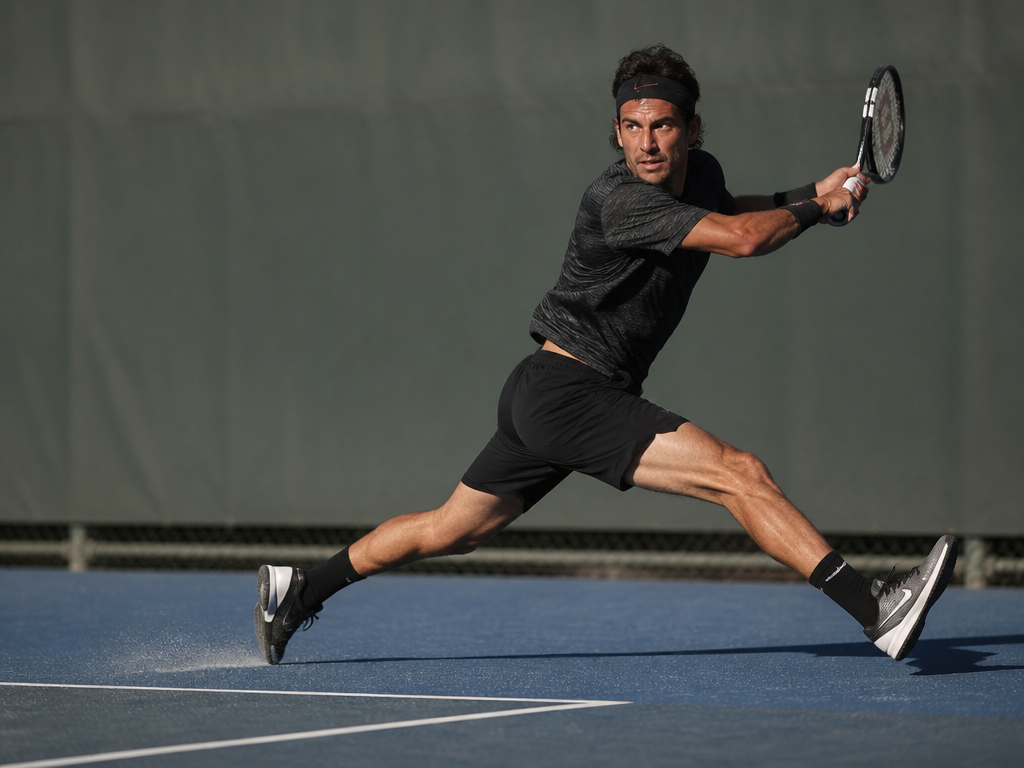
The standard answer to how to hit a backhand that survives a match is four words long: step into the ball. Front foot across, hip and shoulder turned, weight moving forward through contact. Nearly every club player has heard it, most have drilled it, and a fair number have watched it disintegrate the moment an opponent works out that the backhand wing is where the free points live.
Our verdict: "step into it" is excellent instruction for the backhand you have already arrived at, and misleading instruction for the one you are still running to — and in a match, the backhand being attacked is almost always the second kind.
How we evaluated
We are a review desk, not a coaching staff. Nobody here filmed you, ran a motion-capture session, or counted your unforced errors. What we did was read.
We weighed three bodies of evidence, in this order. First, peer-reviewed biomechanics — Bruce Elliott's review work on tennis mechanics in the British Journal of Sports Medicine, Mark Kovacs's 2007 review of applied tennis physiology in the same journal, Duane Knudson's textbook treatment of tennis technique, and the movement studies published through the ITF's coaching and sport science channels. Peer-reviewed work is the only source we let make mechanism claims: what force comes from where, and in what order.
Second, coaching-federation and published instructional consensus — the material the ITF, national federations, and the larger independent coaching outfits put out. This is where prescriptions come from, and it is not research; it is accumulated practitioner judgement, which is worth a great deal and is also frequently untested.
Third, the pattern of complaint from recreational players themselves — the recurring, remarkably consistent report that the backhand "feels fine in a rally and disappears in a match."
The honest limit: backhand footwork specifically is thinly studied. The published biomechanics is heavily weighted toward the serve and the forehand, because those are the strokes labs get funded to film. Where we cite a mechanism, it is usually a general principle of stroke production applied to the backhand, not a backhand-specific finding. We flag it below where that's the case.
Where the advice is genuinely right
The closed or neutral stance earns its reputation, and the reason is not aesthetic.
Elliott's biomechanics reviews describe groundstroke force production as a kinetic chain: ground reaction force through the legs, transferred up through hip and trunk rotation, arriving last at the racquet. A stance with the front foot planted across the body gives the trunk something to rotate against. The front leg accepts load; the base stops moving; the upper body accelerates over a braced platform.
This matters more on the backhand than the forehand for a structural reason. The backhand is hit across a shorter, more constrained arc — on the two-hander the arms are linked and the swing is trunk-driven almost by definition, and on the one-hander the racquet arm has no independent power source worth the name. Both versions are unusually dependent on what the legs and trunk hand them. On a ball in the strike zone at rally pace, with a full second to spare, stepping across is the highest-percentage thing a club player can do.
So the advice isn't wrong. It is under-specified. It describes what to do at the end of a movement while saying nothing about the movement.
Where it breaks down
The ball above your shoulder
Stepping forward into a ball landing near the baseline with heavy topspin puts your contact point in the worst place available: high, behind you, and rising. The forward step commits your weight to a ball that is still climbing away from it. Coaching consensus here is fairly settled — you want to move back first and let the ball drop into a strike zone, or take it early on the rise before it gets above shoulder height. Both are footwork solutions. Neither is a forward step.
The ball that pulls you wide
This is the one that ruins club backhands. To step across into a wide ball, you must have already stopped. Kovacs's review collates match-play data showing that most points on faster surfaces resolve inside roughly ten seconds, with heavy repeated changes of direction — the sport does not routinely give you time to arrive, settle, and then step. When a player is still travelling laterally at contact, the front-foot step becomes a step away from the ball's line, and the swing has to reach to compensate. That reach is what club players experience as "my backhand is weak." It is usually not the swing.
The ball hit into your body
Jammed backhands are a footwork problem misdiagnosed as a technique problem more often than any other shot in the sport. There is no room to step forward because the room is already occupied by you. The fix is a small step back and away with the outside foot — creating space rather than closing it. The instruction "step in" is precisely inverted here.
The options, compared
| Footwork pattern | Fits best | What it costs | Evidence strength |
|---|---|---|---|
| Neutral / closed step-across | Mid-height ball you've arrived at early | Slow to recover; unusable when still moving | Strong — well supported by kinetic-chain research |
| Semi-open (outside foot planted, hips partly open) | Most rally backhands under time pressure | Slightly less forward weight transfer | Moderate — coaching consensus, limited backhand-specific data |
| Fully open, load on outside leg | Wide balls, high balls, defence | Hardest to time; demands leg strength | Moderate — extrapolated largely from forehand stance research |
| Slice with a crossover step | Emergency retrieval, low balls, direction change | Concedes pace and initiative | Strong on utility, weak on measurement |
The row that matters for most readers is the second. Semi-open is the pattern that most published instruction now treats as the default backhand base under match conditions, and it is also the one club players are least often taught, because it sits awkwardly next to the step-into-it rule they were given first.
What the split step actually buys
One piece of footwork research is worth naming precisely. Uzu, Shinya and Oda reported in the Journal of Sports Sciences (2009) that the split step's landing pre-loads the legs eccentrically and shortens the time required to initiate the first step toward the ball. It is a small-sample study on skilled players, and it is about movement initiation generally rather than the backhand in particular — but it is real evidence for something coaches have asserted for decades on feel alone.
That is the honest size of the claim. The split step buys you fractions of a second at the start of the movement. It does not fix your stance, your contact point, or your grip. It buys time, and time is the resource every failure above is actually short of.
Who this is for — and who it isn't
This is for the 3.0–4.0 player whose backhand holds up in a cooperative rally and vanishes when someone starts hitting to it deliberately. If the shot breaks down in the warm-up too, the problem is upstream of footwork and you should fix the grip and contact point first.
It is not for players with a genuine strength or mobility limitation in the outside leg — open and semi-open stances load one leg hard, and pushing that pattern on a knee that won't take it is a poor trade. Slice and early contact are the better route there, and there is no shame in the trade.
The honest version of the rule
Step into the backhand you have already arrived at. For every other backhand, your feet have one job: get you stopped, outside the ball, and set — even if "set" means open, even if it means moving backwards.
That is a less quotable rule than "step into the ball." It is also the one that matches what the evidence describes and what happens on a club court at 5–5.
What to try this week
In your next warm-up, spend five minutes on cross-court backhands doing nothing to your swing at all. One rule only: say the word "set" out loud at the exact moment your outside foot plants. Not before, not after.
Count the balls where you couldn't say it until after the bounce on your side. That number is your actual problem, and it will be higher than you expect. Nothing about your swing needs to change until it comes down.
Evidence grade for the central claim — that late footwork, not swing mechanics, is the primary failure mode of the club-level backhand: Moderate. The kinetic-chain mechanism is well supported and the coaching consensus is broad and consistent, but we found no controlled study isolating backhand footwork as a cause of error rate in recreational players. Anyone who tells you that number exists should be asked to name it.