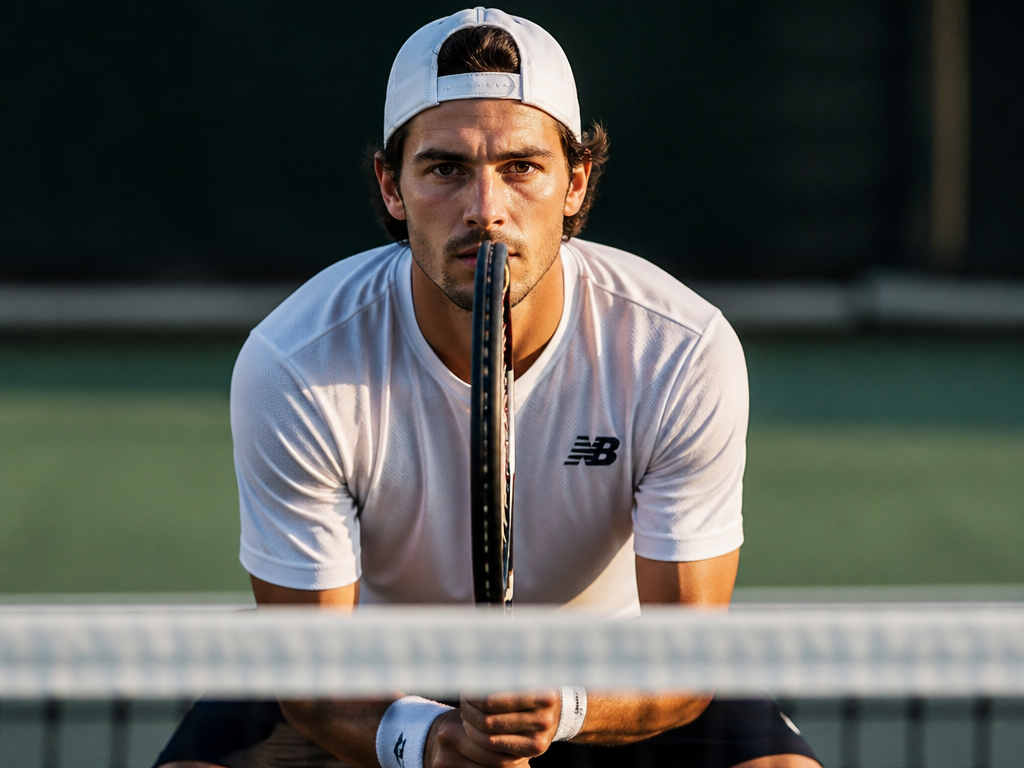
The ball sits on your strings for roughly four to five thousandths of a second. Rod Cross, the physicist at the University of Sydney who has spent decades putting tennis impacts in front of high-speed cameras, puts normal dwell time in that range; a very soft touch stretches it slightly. Simple visual reaction time in humans runs somewhere around 180 to 250 milliseconds. So by the time you feel the volley, it has been over for something like fifty times as long as it took to happen.
That gap is the whole story. Volley technique and mechanics at the net is almost entirely a question of what was already true when the ball arrived — and the thing most club players never do beforehand is stop moving.
Why volleys pop up
A volley pops up when the racquet face is open — tilted back toward the sky — by more than the contact height required. That is the mechanism. Everything else is a cause of it. A grip rotated toward a forehand grip opens the face on the backhand side. A contact point behind the body forces you to open the face, because a square face from there sends the ball into the net. Forward momentum leaves the racquet head trailing the hand, which opens the face without your permission. And a ball taken below the level of the tape has to be lifted, which is not an error, only geometry — the error is using that same face angle on a ball at chest height.
The rebound off strings is not a perfect mirror; string-bed grip, incoming spin, and racquet speed all intervene. But the direction of the effect is dependable, and it is worse than one-for-one: a few degrees of unwanted face opening moves the launch angle by more than a few degrees. Over the length of a service box, five degrees you didn't intend is measured in feet, not inches.
What most people do
The reflex, when volleys float, is to do something with the arm. Swing at it harder, on the theory that a floater is an underhit ball. That makes the pop-up worse, because a longer swing means a longer arc, and an arc that is still rising at contact opens the face at exactly the wrong moment.
The second reflex is to soften everything — grip loose, hands quiet, "just guide it." Softer hands do reduce rebound speed, which is useful on a drop volley and useless on a ball that is floating because of angle rather than pace. You end up with the same trajectory, arriving slower, which is the version your opponent most enjoys.
The third is volume: two hundred fed balls in a row, same height, same side, same tempo. Reps are not the problem. Reps of an unexamined shape are. Blocked, identical repetition reliably makes a movement feel better inside the session — that is one of the oldest and most replicated findings in motor learning, and it is also the reason so many players leave practice encouraged and lose the volley in the first tiebreak.
Underneath all three sits the habit nobody notices: moving through the ball. You approach, you keep traveling, the racquet lags behind a body still going forward, and the face opens to compensate. There is no swing fix for that. It's a movement problem, and it wants a movement solution.
What the evidence suggests
The face is set before you feel anything
Cross's impact work, and Howard Brody's before it, established the part that isn't in dispute: within the contact window there is no steering. Four to five milliseconds is shorter than any voluntary correction a nervous system can make — visuomotor adjustments need at least a hundred milliseconds, and usually more. Whatever the strings are pointing at when the ball arrives is what the ball gets. This reframes the whole coaching question. You are not making a stroke. You are arriving at an angle, on time.
The movement break, in the order it happens
Here is the sequence, as it actually unfolds. Your opponent begins their forward swing. Somewhere around their contact, you make a small hop — feet leave the ground barely at all, landing wide and balanced. That hop is a movement break: a deliberate interruption of whatever direction you were already traveling. It does two things at once. Mechanically, the landing loads the legs eccentrically, so the first push-off comes out of a pre-stretched muscle rather than a cold one. Tactically, it converts momentum into a neutral state from which any direction is equally available.
The commonly cited experiment here is Uzu, Shinya, and Oda (2009), in the Journal of Sports Sciences, which had trained players perform a choice reaction step-and-reach in a simulated tennis task with and without a split step. Players got to the target faster with the hop, and the authors attributed it to the stretch-shortening cycle in the loaded leg. It is a small lab study — roughly ten skilled players — and it measured reaching speed, not volley quality. Nobody has run the trial that would settle our specific question: whether split-stepping reduces the rate of floated volleys. We think the inference is reasonable, because a body that has stopped can let the racquet head get in front of the hand. We also think it should be labeled an inference.

After the break comes the part that decides the face angle: turn from the shoulder rather than the elbow, keep the racquet head above the hand when the ball is above the net, step across with the opposite foot, and let the contact happen out in front — around a foot ahead of the lead hip is the usual coaching cue, and it is a cue rather than a measurement. The step is what supplies depth. The arm's only job is holding an angle steady for five milliseconds.
The other kind of break
The practice research points the same direction, and it is more robust than the split-step literature. Meta-analyses on the distribution of practice — Lee and Genovese (1988) in Research Quarterly for Exercise and Sport, and Donovan and Radosevich (1999) in the Journal of Applied Psychology — consistently find spaced practice beating massed practice on retention, with the advantage growing for tasks that carry over between sessions. Three twenty-minute blocks across a week outperform one long Saturday. Shea and Morgan (1979) added the uncomfortable half of the picture: varied, randomized practice feels worse during the session and holds up better afterward. Feeding yourself high forehand, low backhand, body ball, high backhand in unpredictable order will produce a worse-looking practice and a better volley in three weeks.
One more lever, cheap to apply: attentional focus. Gabriele Wulf's program of work supports directing attention externally — at the target, the ball's path, the string bed — rather than internally at your own wrist or elbow. Effect sizes are modest and some findings have drawn replication scrutiny, so treat it as a free experiment rather than a law.
The five floats, and what's under each
| What you see | What's actually happening | What to change |
|---|---|---|
| Floats high and short, both sides | Face open several degrees at contact, usually from late contact | Meet it in front of the lead hip; step for depth |
| Floats only on the backhand | Grip rotated toward forehand, which opens the backhand face | One grip for both wings, checked during the break |
| Floats when moving forward | Body still traveling, racquet head trailing the hand | Break the movement as the opponent strikes |
| Floats on low balls | Geometry, not error — below the tape the ball must be lifted | Open on purpose, bend the knees, aim deep and slow |
| Floats only under match pressure | The older, larger swing returns when attention narrows | Practice varied and unpredictable, not blocked |
What we actually do
Three sessions a week, twenty minutes each, is enough — and it works better than one long one, per the spacing literature above.
Session one is catching, not hitting. Racquet in the non-dominant hand or set down entirely. Partner feeds; you split-step at their release and catch the ball in front of your lead hip with the free hand. If you can't catch it in front, you can't volley it flat, and the drill tells you which of the two failures is yours — late break, or late hands.
Session two adds the racquet and takes away predictability. Feeds alternate side, height, and pace without a pattern. Aim at a cone or a specific spot on the fence — an external target, per Wulf — rather than thinking about the wrist. Expect it to feel worse than blocked feeding. That is the finding, not a side effect.
Session three is a phone on a fence post. Film thirty volleys from the side, then watch for one thing only: where the racquet head is relative to the hand at contact, and whether your feet were still traveling. Video is the cheapest substitute for a coach standing behind you, and self-observation is where most of these fixes actually land.
Reviewer note: when I've watched club players do the catching drill, the split step usually reappears within two sessions, and the pop-ups fade before anyone changes their grip. That's an impression from a handful of players, not data — take it as a place to start looking, not as proof.
A plain accounting of confidence. Well-established: contact is too brief to steer, so the face angle at arrival determines launch angle; spaced practice beats massed practice for retention. Plausible but thin: the split step's timing advantage rests largely on one small lab study plus observational work on professionals, and no one has tested it against float rate specifically. Folk wisdom: "squeeze at contact," "punch it," and "never let the head drop below the wrist" — the last is sound above the net and simply wrong below it.
Tonight, before every fed ball, land a small hop as your partner strikes it, and if you can't reach the ball in front of your lead hip, let it go — the volley you didn't hit teaches you more than the one that floats.