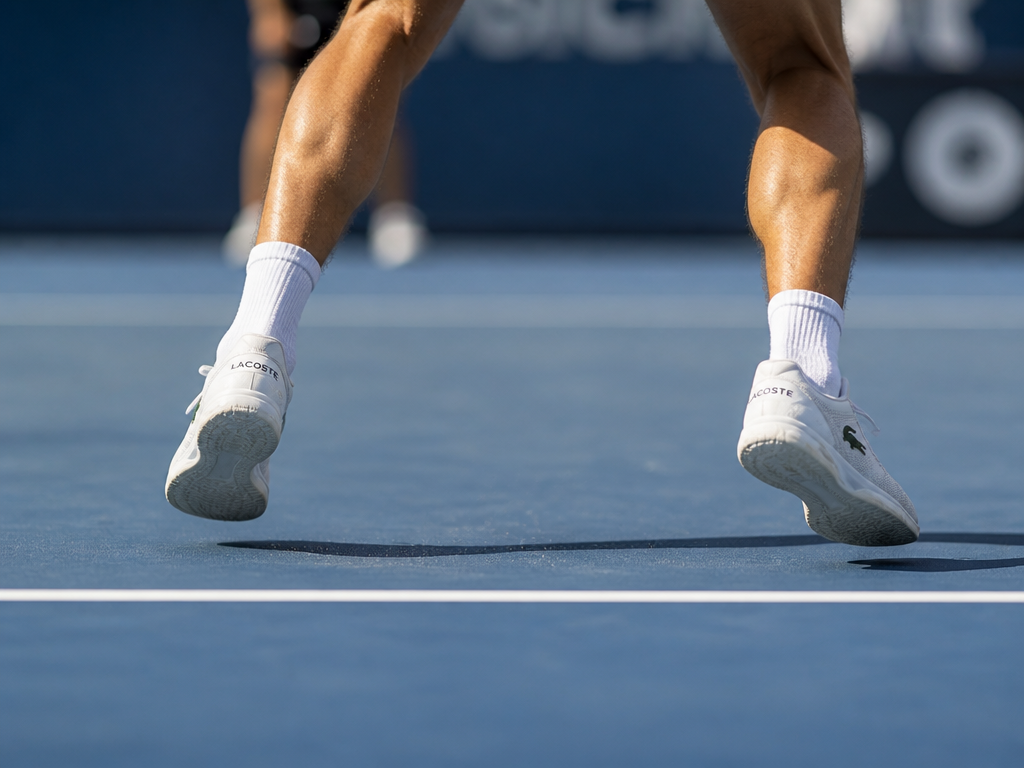
The number everyone repeats is "less than half a second." It is close enough to true to be useful and wrong enough to be misleading. Run the arithmetic: a 100 mph serve leaves the strings at about 45 meters per second and travels roughly 23 meters of path to a returner standing on the baseline. Ignoring air, that is 0.51 seconds. Air does not ignore the ball — drag strips a meaningful fraction of that speed before it arrives, so the honest figure for a club-level bomb is closer to 0.65 to 0.75 seconds.1 That is the whole budget. Most tennis serve return technique instruction spends it on the swing. The research we read spends it earlier — on what the legs are doing while the ball is still in the server's toss.
What most people do
Watch a club match from behind the fence and the pattern is consistent. The returner stands still, bounces once or twice on their own internal rhythm, and then hops — usually well after the serve has been struck, sometimes as the ball crosses the net. The hop is treated as a ritual that precedes the point rather than a mechanical event with a deadline.
Three failure modes recur. The hop is too high, which converts a quick unweighting into genuine airtime and leaves the player suspended while the ball is already committed to a side. The landing is flat and heavy, with the heels down and the knees locked, which is a stopping position rather than a loading position. And the timing is self-generated — cued off the returner's own nerves instead of the server's motion, so it drifts late under pressure, which is exactly when it matters.
The rest of the lesson then goes to the backswing. Shorten it, block it, use continental. That advice is sound. It is also downstream of a decision that has already been lost.
What the evidence suggests
The most-cited direct test is Uzu, Shinya and Oda (2009) in the Journal of Sports Sciences, which had trained players perform a choice reaction step-and-go movement with and without a preceding split step. The finding worth carrying around: the split step did not make players decide faster. Reaction latency was essentially unchanged. What improved was the time to actually get the body moving once the decision was made. The sample was small, as most tennis biomechanics work is.
That distinction matters because it names the mechanism. The split step is not a perception aid. It is a force-production aid. Landing from a small unweighting stretches the calf and quadriceps under load an instant before they are asked to shorten — the stretch-shortening cycle, which is one of the better-replicated findings in muscle physiology generally. A muscle that is already loaded produces force sooner than one starting from slack.
The absolute effect per repetition is small. We are talking hundredths of a second, not tenths. Anyone claiming a split step buys you half a step of extra reach is extrapolating past what was measured; the translation from lab milliseconds to court coverage is an inference, not a result.
The other relevant line of work is anticipation. Farrow and Abernethy (2002), also in the Journal of Sports Sciences, trained junior players with video of servers in which ball flight was occluded, comparing implicit and explicit instruction. Anticipation improved. The samples were small, the transfer to live match returning was not established, and the effect has not been replicated at the scale the claim usually gets stated with.
The order it actually happens
Roughly 200 milliseconds before contact. The server's toss height, trunk rotation and shoulder alignment are already on display. Occlusion studies going back decades show skilled players extract directional information from this window; less skilled players wait for the ball.
At the moment the server's legs drive. The returner pushes off — a few centimeters, not a jump. This is unweighting, not hopping.
At or fractionally after racquet-ball contact. The returner lands, feet about shoulder width, weight on the balls of the feet, ankles and knees absorbing. This landing is the loaded position, and it is the timing target.

Within about 100 milliseconds of landing. The first step goes out, and it is a small one — the crossover or pivot, not a lunge.
Only then does the racquet go back. The backswing is the last thing to happen, not the first.
| Claim | Status |
|---|---|
| A split step shortens time to initiate movement | Well-established (direct testing plus a clear physiological mechanism) |
| Landing should coincide with or just follow the server's contact | Plausible but thin (consistent with kinematic observation and coaching consensus; little direct experimental manipulation) |
| Anticipation from server body cues can be trained | Plausible but thin (small samples, transfer to match play unproven) |
| Prescribed hop heights and exact stance widths | Folk wisdom |
When should you split-step on a serve return?
Begin unweighting just before the server strikes the ball, and land as the ball leaves the strings. The takeoff is not the cue you are managing — the landing is. If you time the push-off and let the landing fall where it may, you will be airborne at the one moment you need ground contact. If you time the landing, the push-off sorts itself out. Against a faster server, the whole sequence moves earlier, not smaller.
What I actually do
Reviewer note — first person, one contributor's practice, not evidence. I stopped watching the racquet head years ago and started watching the toss and the front hip. My split is cued off the server's leg drive, which is the last large, slow, visible thing that happens before a fast, small, invisible thing. When I get tight, my split drifts late, so I have a partner stand behind the server and call "late" or "on" without telling me what they saw of the return itself.
The drill I keep returning to is a shadow block: twenty serves, no swing, the only job is landing on time and taking one step. I do not count returns made. I count landings that were on time. When that number is consistently high, the returns follow on their own; when it drops, no amount of grip advice fixes it. That is my experience, and I would not defend it as more than that.
An honest rule of thumb
Time the landing, not the hop. Set the landing to the instant the ball leaves the server's strings, keep the split small enough that it is silent, and let the first step be short. If your split step is audible from the other baseline, it is a jump, and a jump is a delay.
What this piece did not answer
We could not find a study establishing an optimal landing window in milliseconds across different serve speeds — the "land at contact" guidance is consensus and kinematic observation, not a measured optimum. We also found nothing credible on whether a staggered or asymmetric split beats a symmetric one on the return specifically, and nothing separating the split step's contribution from general readiness and attention.
The places to look next: the Uzu, Shinya and Oda paper itself rather than summaries of it; Farrow and Abernethy on perceptual training; and the ITF's Coaching & Sport Science Review, which publishes the applied biomechanics work that rarely reaches general sports journals. Then film yourself returning at 120 or 240 frames per second and find the frame where the server contacts the ball and the frame where your feet land. The gap between those two numbers is the most useful measurement available to a club player, and it costs nothing.
The return does not start when the ball arrives; it starts when the server's legs leave the ground.
-
The 0.51-second figure is straightforward arithmetic, not a published measurement. The drag-adjusted range reflects the general finding that a served ball loses a substantial share of its speed in flight; treat both numbers as order-of-magnitude, not precision. ↩