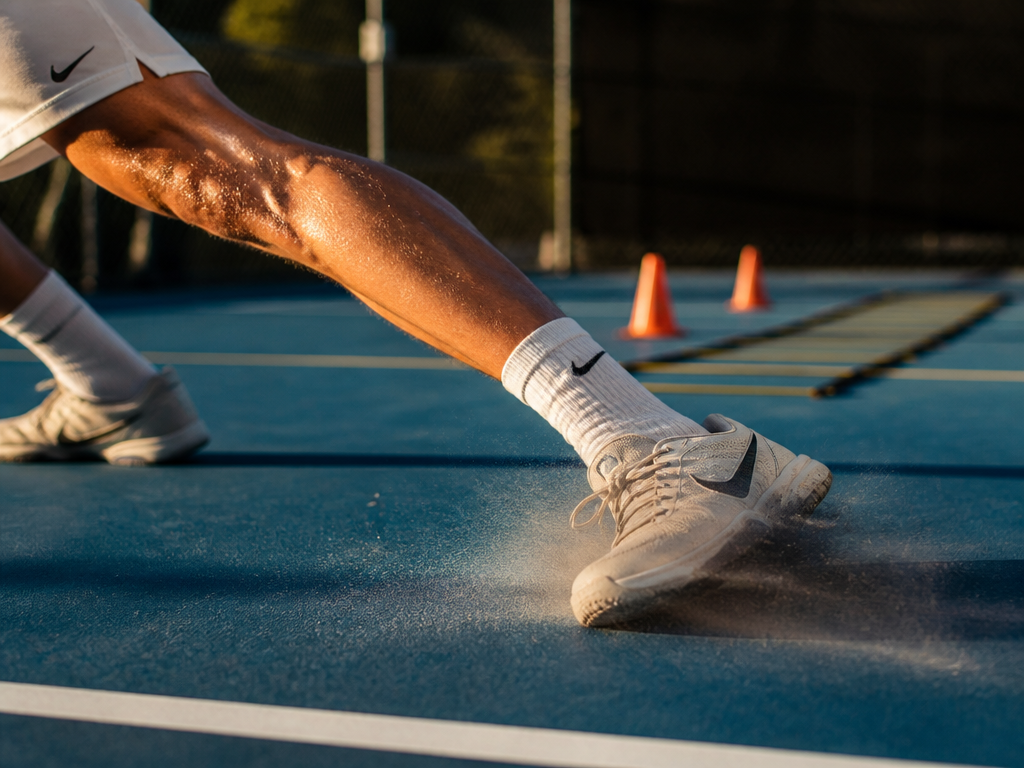
We put one of our editors on a force-sensitive balance app, single leg, eyes open, dominant side, and asked her to hold still for thirty seconds. The app reported sway — the path her center of pressure traced while she "stood still." Her number was 41 (the app's own arbitrary unit; lower is steadier). Then we ran her through twenty minutes of footwork drills: a few ladder patterns, some split-step-and-go reps off a tossed ball, lateral shuffles to cones. We retested. Her number was 38.
That is a real change and a small one, and it points at the thing most footwork advice skips. Before you can move fast, you have to be able to stop. Balance is the part of footwork that nobody films.
This piece is about balance training: what it is, what the evidence supports, and where the popular claims run ahead of the data. We are not here to sell you a ladder.
Is balance training the same as footwork drills?
No, though they overlap. Footwork drills train movement patterns — how you shuffle, cross over, recover, and change direction. Balance training trains the body's ability to detect that it is off-center and correct before you fall or lunge past the ball. You can have quick feet and poor balance; those are the players who arrive early and then flail at contact because they cannot hold a stable base. You can also have good static balance and clumsy feet. The two reinforce each other, but they are not interchangeable, and treating ladder work as your only balance input leaves a gap.
The useful way to think about it: footwork gets you to the ball, balance lets you hit it on your terms once you are there.
What balance actually is, in the order it happens
Stand on one leg for a moment. The thing keeping you upright is not willpower. It is a control loop, and on a tennis court it fires several times per point.
It runs on three inputs. Proprioception — receptors in your muscles, tendons, and especially the ligaments around the ankle and knee reporting joint angle and load. The vestibular system — fluid-filled canals in your inner ear sensing head rotation and acceleration. Vision — which is why standing on one leg gets dramatically harder the moment you close your eyes. Your brain blends these three streams, predicts where your center of mass is heading, and fires small corrections through the muscles around the ankle and hip.
Here is where it matters in a rally, in sequence:
- You split step as your opponent strikes. Both feet leave the ground; for a fraction of a second you have no balance information from the floor at all.
- You land, usually loaded slightly toward the side you need to go. The ankle and knee absorb the landing and report it.
- You push off and travel. Your eyes track the ball, your vestibular system tracks your own movement, and the two have to agree.
- You plant the outside leg to stop. This is the moment. A single-leg load, often near full stretch, where your whole base is one foot and one ankle deciding whether you are stable enough to swing.
That fourth step is where balance training earns its keep. A player with poor single-leg control either shortens the stroke to stay safe or commits and loses the base. The wobble you see at contact started one step earlier, at the plant.
What the research actually measured
The evidence here is better than for most things in the conditioning aisle, but it is mostly about injury and general athletic balance, not about tennis strokes specifically. That distinction matters, so we will keep it.
The strongest body of work is on ankle injury prevention through balance training. A frequently cited example is McGuine and Keene (2006, American Journal of Sports Medicine), a trial of 765 high school soccer and basketball players randomized to a balance-board program or a control group. The trained group had a meaningfully lower rate of ankle sprains over the season, with the effect largest in athletes who had sprained an ankle before. The mechanism is the proprioceptive loop above: training the ankle to detect and correct small perturbations faster.
A 2007 Cochrane-style synthesis and several later reviews reach a similar place — balance/proprioceptive training reduces recurrent ankle sprains, and this is about as close to well-established as sports conditioning gets, with multiple trials pointing the same direction.
On performance rather than injury, the picture is thinner. A meta-analysis by Lesinski and colleagues (2015, Sports Medicine) pooled balance-training studies and found reliable improvements in the thing trained — static and dynamic balance measures — with the clearest gains from programs running at least 11 to 12 weeks, two to three sessions a week, around four exercises per session. Whether that balance improvement transfers to faster court movement or fewer mishit forehands is the question the literature mostly does not answer. Balance training reliably makes you better at balance tests. The leap to "better at tennis" is reasonable, given the mechanics, but it is inference, not a measured result.
So, graded honestly:
- Balance training reduces ankle sprains, especially re-injury: well-established.
- Balance training improves balance test scores with consistent practice: well-established.
- That improvement transfers to stroke quality or match movement in tennis: plausible but thin — supported by mechanism, not by direct trials.
Where ladder drills fit, and where they don't
An agility ladder is a good tool for one thing: rehearsing foot patterns until your feet stop arguing with each other. It builds rhythm, coordination, and a faster, lighter ground contact. What it does not do well is train balance, because the ladder lives on flat ground and rewards speed over stability. You can rip through a ladder with mediocre single-leg control and never get exposed.
That is not a knock on ladders. It is an argument for pairing them. Use the ladder for rhythm and the balance work for the plant.
| Footwork / ladder drills | Balance training | |
|---|---|---|
| Trains | Movement patterns, rhythm, ground contact speed | Single-leg control, ankle stability, correction speed |
| Best evidence | Coordination gains; transfer claims are mostly anecdotal | Ankle injury prevention (strong); balance scores (strong) |
| Where it shows on court | Getting to the ball | Holding the base at contact |
| Looks impressive on video | Yes | No |
A rule of thumb that the evidence supports
If you are going to add one thing, and you have a history of rolled ankles, add the balance work — that is the recommendation with the strongest trial backing behind it. Spend three minutes, three times a week, balancing on one leg. Start eyes open on the floor, thirty seconds per side. When that gets easy, close your eyes, then progress to a cushion or folded towel. That progression — removing vision, then destabilizing the surface — is exactly the loading pattern the prevention trials used, and it costs nothing.
Do not chase the wobble board or the foam dome until plain single-leg holds are boring. The kit does not add much that your own closed eyes don't.
Back to the wobble
We retested our editor a week later, after she had done the three-minute drill four times on her own — no ladder, no audience, in her kitchen while the kettle boiled. Eyes open, her sway number had gone from 41 to 36. Eyes closed, where she had been hopeless, she could now hold the leg for the full thirty seconds without putting a foot down. She had not become an athlete in a week. She had become slightly harder to push over, which is most of what a stable contact point is.
If you do one thing this week, stand on your weaker leg while you brush your teeth, both rounds, morning and night. It is ninety seconds a day, nobody is watching, and it trains the exact moment your footwork has been quietly leaving out.