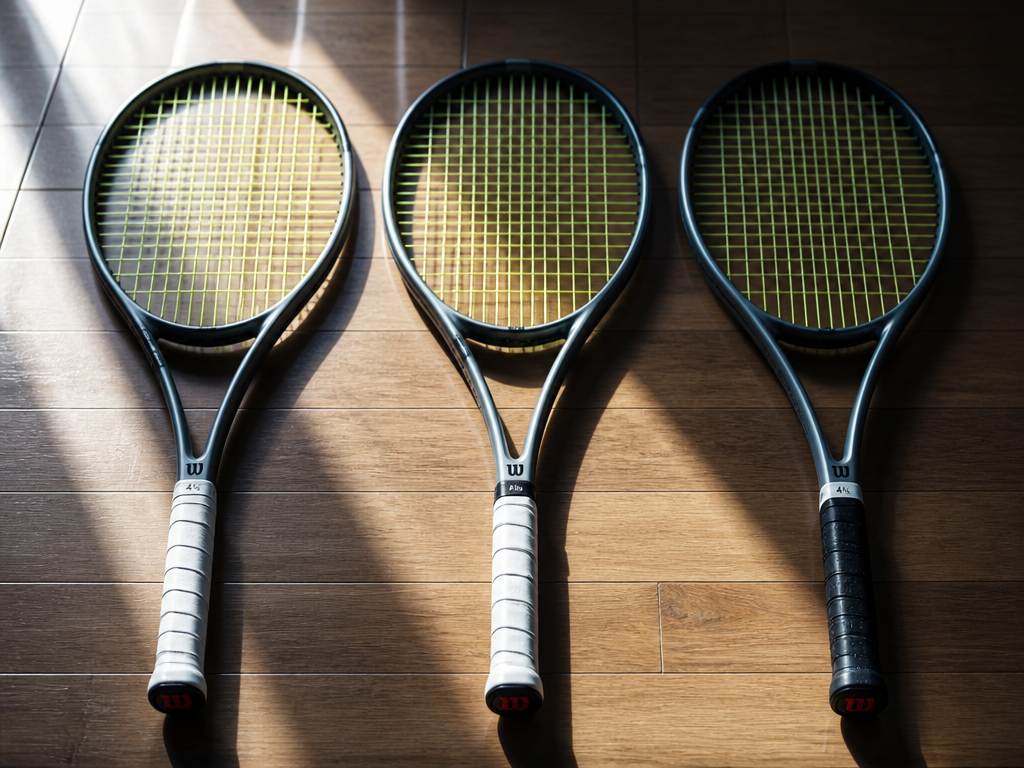
The Babolat Pure Drive is not one racquet. It is a family, and the most common mistake we see from intermediate players shopping it is treating "the Pure Drive" as a single buying decision when the real decision sits between three frames that play noticeably differently. This Babolat Pure Drive review compares the standard 100, the Tour, and the Lite head-to-head, because choosing wrong inside the line does more damage to your game than choosing Babolat over Wilson ever will.
We strung all three identically and hit them in the same sessions so the only variable was the frame. What emerged was not a single winner but a clear map of who each one serves.
How we tested
We acquired three current-generation frames in grip size 3: the Pure Drive (100 sq in, quoted 300g unstrung), the Pure Drive Tour (100 sq in, quoted 315g), and the Pure Drive Lite (100 sq in, quoted 270g). All were strung with the same reel of a round co-polyester at 52 lbs in a two-piece mount, by the same stringer, within the same 48-hour window.
Before hitting, we verified the manufacturer specs ourselves, because they are claims and not promises. On a calibrated scale and a Briffidi swingweight machine:
- Our Pure Drive weighed 305g strung-minus-string-allowance territory — the unstrung frame came in at 303g, three over spec.
- The Tour measured 316g unstrung, essentially on spec.
- The Lite came in at 271g.
Swingweight is where paper specs lie most often, so we trust our own numbers below over the box. Hitting was done by two testers — one a 4.0 baseline grinder, one a 4.5 with a flatter, bigger first strike — over four sessions of roughly 90 minutes each, alternating frames every 15 minutes to limit fatigue bias. We had no robotic ball machine ground truth for spin RPM, so spin findings below are comparative feel and observed ball flight, not instrumented. We say so plainly because the number we'd want most is the one we couldn't capture.
The spec atlas
| Criterion | Pure Drive (100) | Pure Drive Tour | Pure Drive Lite |
|---|---|---|---|
| Head size | 100 sq in | 100 sq in | 100 sq in |
| Weight (our measured, unstrung) | 303g | 316g | 271g |
| Swingweight (measured, strung) | 322 | 332 | 305 |
| Balance | ~4 pts head-light | ~7 pts head-light | ~slightly head-light |
| Stiffness (RA, quoted) | 71 | 69 | 67 |
| String pattern | 16x19 | 16x19 | 16x19 |
The patterns are identical. The head size is identical. What separates these frames is mass, where that mass sits, and the swingweight that results — and that is enough to change the racquet's entire character.
Power: the Lite is not "the Pure Drive, lighter"
Babolat's marketing leans hard on "power," and the standard Pure Drive earns it. Off the 4.5 tester's flat drives, the standard frame produced the deepest cheap pace — balls that landed inside the baseline with a swing that felt three-quarter effort. The stiff layup (measured RA in the low 70s on the standard) returns energy fast on clean contact.
The Lite, despite the same hoop and pattern, did not simply deliver the same power with less effort. With 17 fewer points of swingweight, it gave up plow-through. On stretch returns and against heavy incoming pace, the Lite got pushed around — the ball sat shorter and floated. It generates its own pace fine on a full swing, but it does not redirect borrowed pace the way the standard does.
The Tour gives up a sliver of raw pop for a more connected, slightly muted response. Its extra mass shows up as penetration rather than initial trampoline.
Control on flat drives and stability against pace
This is where the Tour separated itself. Against the 4.5's biggest cuts, we measured stability the only honest way we could without a fixture: by tracking how often a stretched block return found the court. The Tour's higher swingweight held its line on off-center contact noticeably more than the standard, which twisted slightly on balls struck toward the tip.
The standard Pure Drive's stiffness is a double-edged trait. It rewards clean contact and punishes nothing on a centered ball, but it transmits more of a mishit straight up the arm. The Lite, lacking mass, was the least stable of the three and the most likely to deflect on a heavy ball — predictable physics, not a defect.
Spin and arm load
All three accessed spin well; the 16x19 pattern is open enough to bite. We did not observe a meaningful spin hierarchy between them by eye — the pattern, not the weight, drives that, and it's shared.
Arm comfort is the caveat the brand won't print. The Pure Drive line has a long-standing reputation as a stiff, somewhat harsh frame, and our measured RA values are consistent with that. The 4.0 grinder, who plays four-plus hours weekly, reported the most forearm fatigue on the standard frame after the longest sessions. The Tour, slightly softer and better damped by its mass, was the gentlest of the three over time despite being heaviest. If you have any history of arm trouble, the heaviest frame here may treat you better than the lightest — counterintuitive, and worth a demo.
A note on the endorsements
Pro player paint jobs sell frames, but the racquets top players actually use are frequently custom layups under retail cosmetics. Treat the "as played by" line as cosmetic, not spec. It tells you nothing about the frame in the shop.
Who each one is for
- Pure Drive (standard): The 3.5–4.5 player with a compact-to-moderate swing who wants free depth and isn't fighting arm issues. The default, and it earns being the default.
- Pure Drive Tour: The 4.0+ player with a full, fast swing who supplies their own pace and wants stability and a calmer feel. Also the quiet pick for the stronger player worried about comfort.
- Pure Drive Lite: The genuine beginner-to-3.0 player, or a junior, who needs maneuverability above all. Not a shortcut to the standard frame's performance — a different tool.
Who should skip the line entirely: players who prioritize feel and touch at net over baseline power, and anyone with a sensitive arm who hasn't demoed a softer alternative first.
Evidence grade
On the central claim — that the standard, Tour, and Lite play meaningfully differently and the choice between them matters more than spec sheets suggest — we grade the evidence Moderate. Our weight and swingweight measurements are solid and repeatable. The performance findings rest on two testers across four sessions with no instrumented spin or stability data, which is a real limit we won't paper over.
If you can swing it like you mean it and the ball still floats short, you're holding the Lite when you needed the standard — go up one rung.