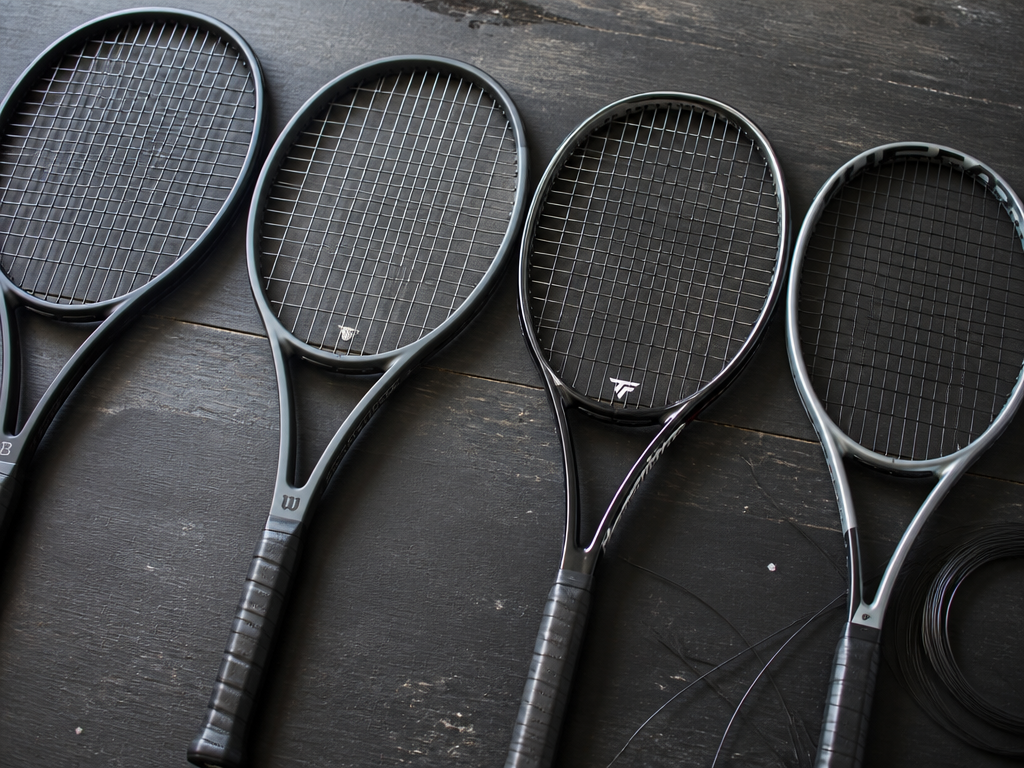
Dunlop racquet families and models are sold as a decoder ring. CX for control, SX for spin, FX for force, LX for comfort — pick your letter, pick your game. It is the tidiest taxonomy on any tennis wall, and it rests on a genuine engineering premise rather than pure marketing invention. It is also, once you line the published specifications up side by side, a coarser instrument than the four-letter system implies.
The verdict: the letters describe design intent honestly, but within Dunlop's own range, string pattern and swingweight separate two frames more reliably than the family badge does. A CX with an open pattern has more in common with an SX than with its own 18x20 sibling.
How we evaluated
We have not hit with these frames and we did not measure any of them. What follows is a synthesis, and it is worth saying plainly what went into it.
We compared Dunlop's published unstrung specifications across the four current families on the manufacturer's own product pages (dunlopsports.com); we read the technology claims against what the underlying materials are documented to do elsewhere; and we weighed both against the consensus in independent tester reviews — Tennis Warehouse's multi-playtester panels, Tennis Head, and the specialist review channels — plus the recurring themes in owner feedback at retail.
Three limits shape everything below. First, published unstrung weight and head size are reliable; swingweight is not, because manufacturing tolerance means two frames from the same batch can differ by several points, and third-party strung measurements are taken with different strings and tensions. Second, Dunlop refreshes these lines on a roughly three-year cycle, and specs move between generations — check the figures against the model year in front of you. Third, playtester panels are small, self-selected, and unblinded; they are useful for identifying where reviewers agree, and much weaker as evidence for any single reviewer's adjective.
The engineer's brand, and where that belief actually starts
The reputation that gives the letter system its credibility predates the letters by roughly thirty-five years. In 1980 Dunlop introduced the Max 200G, a frame injection-moulded from graphite-reinforced nylon rather than laid up by hand from prepreg sheets. It was a genuine manufacturing departure: the process produced frames with unusually consistent flex characteristics at a time when hand-laid graphite varied noticeably unit to unit. John McEnroe won with it. Steffi Graf won a great deal with it. For a generation of players, the association between Dunlop and materials engineering was formed there and never seriously revisited.
That is the source. It is worth noticing how thin it is relative to the belief it supports.
The Dunlop that made the Max 200G is not, in any corporate sense, the Dunlop making the CX 200 today. The sporting-goods business passed through a long sequence of owners across the 1980s and 1990s, was acquired by Sports Direct in the mid-2000s, and the racquet business ultimately came under Sumitomo Rubber Industries, the Japanese manufacturer behind the Srixon brand. The current four-letter architecture arrived in stages around 2019–2021, and its immediate technical ancestor is not the Max 200G lineage at all — it is the Srixon Revo CX, which was sold under the Srixon badge in some markets before the Dunlop name was reapplied to it.
So when a review invokes Dunlop's engineering heritage, the honest version is narrower than the phrase suggests: the current frames are competently designed by a manufacturer with real materials expertise, and they inherit a brand name whose engineering aura was earned by a different organisation using a process nobody uses anymore. Both halves of that sentence matter.
The taxonomy Dunlop inherited
The second belief worth tracing is that the three-lane split — control, spin, power — describes something intrinsic about racquet design. It mostly describes a retail convention, and Dunlop arrived at it late.
Babolat did the most to codify it, arranging its performance range into Pure Strike, Pure Aero and Pure Drive and marketing the three as distinct destinations for distinct players. Head has run a comparable structure for longer with Prestige, Radical, Extreme and Speed. Wilson organises around Pro Staff, Blade, Clash and Ultra. By the time Dunlop's CX/SX/FX/LX letters appeared, the shelf logic was already fixed, and a brand entering without a legible three-lane story would simply have been harder to sell.
This is not an accusation of cynicism. Segmenting by intended swing type is a reasonable way to organise a catalogue, and Dunlop's version is unusually clear about it. But the taxonomy is downstream of merchandising, not upstream of physics, and it should be read as a starting filter rather than a diagnosis.
What the published specs actually say
| Frame | Head size | Unstrung weight | Pattern | Family claim |
|---|---|---|---|---|
| CX 200 Tour 18x20 | 95 in² | ~320 g | 18x20 | Control, precision |
| CX 200 | 98 in² | ~305 g | 16x19 | Control, all-court |
| SX 300 | 100 in² | ~300 g | 16x19 | Spin |
| FX 500 | 100 in² | ~300 g | 16x19 | Power |

Figures as published by Dunlop for the current generation; confirm against the model year you are buying.
Two things fall out of that grid immediately.
The first is that the largest single jump in the table is inside the control family. The CX 200 Tour 18x20 and the CX 200 differ by three square inches, roughly fifteen grams, and a materially denser string pattern. In practice that is a bigger difference in launch angle and spin ceiling than the gap between the CX 200 and the SX 300 — two frames the taxonomy places in different lanes entirely. Reviewers converge on this. The consistent theme across playtest panels is that the 18x20 CX rewards a player who is already generating their own pace and wants a lower, flatter response, while the 16x19 CX behaves like a moderately firm all-court frame that many testers describe in terms indistinguishable from how they describe the SX.
The second is that the SX 300 and FX 500 share head size, unstrung weight and pattern. Whatever separates them — beam profile, layup, the grommet geometry Dunlop markets as Spin Boost — is real, but it is doing all the work of the distinction, and it is not visible in the numbers a buyer sees first.
Where reviewers genuinely split is stiffness. The SX 300 draws recurring comment for a firm, direct response, and the divide runs along arm sensitivity: testers without elbow history tend to report a lively, spin-friendly frame, while those with a history of arm trouble flag it. That is not a contradiction to be resolved. It is the single most useful piece of information in the review corpus, and it is the sort of thing a family letter cannot encode.
Sonic Core, and the limits of a mechanism claim
Dunlop's headline technology across the range is Sonic Core: a section of Infinergy — BASF's expanded thermoplastic polyurethane, the same material class used in running-shoe midsoles — embedded in the frame. Dunlop's claim is improved energy return and reduced vibration.
The material is real and its damping behaviour in footwear is well documented. What is not available, as far as we can find, is independent measurement of what a small volume of ETPU embedded in a graphite hoop does to impact shock at the hand. That figure is manufacturer-stated. Reviewers frequently describe Dunlop frames as feeling softer or more muted than their stiffness ratings would predict, which is consistent with the claim, but unblinded testers who know which technology they are evaluating are weak evidence for a specific mechanism.
Treat Sonic Core as a plausible design choice with an untested magnitude, not as a specification.
The variable the letters hide
There is a larger problem with organising a purchase around a spin family. In the string-lab work published by Crawford Lindsey and Rod Cross through Tennis Warehouse University, string bed properties — material, gauge, tension, and the inter-string friction that lets main strings snap back — accounted for more measured variation in spin than differences between frames did. Polyester monofilament versus synthetic gut is a larger lever than CX versus SX.
Which means an SX 300 strung tight with a textured multifilament may well produce less spin than a CX 200 strung low with a slick polyester. The family badge is describing a frame's contribution to a system in which it is not the dominant term.
Who each family is for, and who it isn't
CX is for the player whose misses are long, not into the net — someone with repeatable mechanics who wants the frame to do less. Within it, choose by pattern first and weight second: 18x20 if you swing fast and flat, 16x19 if you want access to spin without leaving the control lane. It is the wrong buy for anyone still developing racquet-head speed, and testers are consistent about that.
SX suits the heavy-topspin baseliner with a fast, brushing swing path who is not arm-sensitive. Given the split in the reviews, a player with any elbow history should demo before buying and should not treat the family label as a substitute for that.
FX is for the compact, blocking, doubles-forward player who wants free depth. It is the wrong frame for anyone whose problem is already controlling depth on the return.
LX is the comfort line — softer layup, generally lighter and more head-light — and it is the only family whose label is unambiguous. If arm comfort is the constraint, start there rather than trying to solve it with string choice in a stiffer frame.
Evidence grade for the central claim — that pattern and swingweight separate these frames more than family membership does: Moderate. The spec comparison is Strong; the reviewer consensus supporting it is Moderate, drawn from small unblinded panels; the string-versus-frame spin finding is Moderate and comes from a source with commercial ties to a retailer, which we note rather than dismiss.
The myth: Dunlop's four families are an engineering philosophy that tells you which racquet is yours.
The accurate version: Dunlop's four families are a well-organised shelf, and the racquet that is yours is decided by string pattern, swingweight and stiffness — three numbers the letter on the throat does not report.