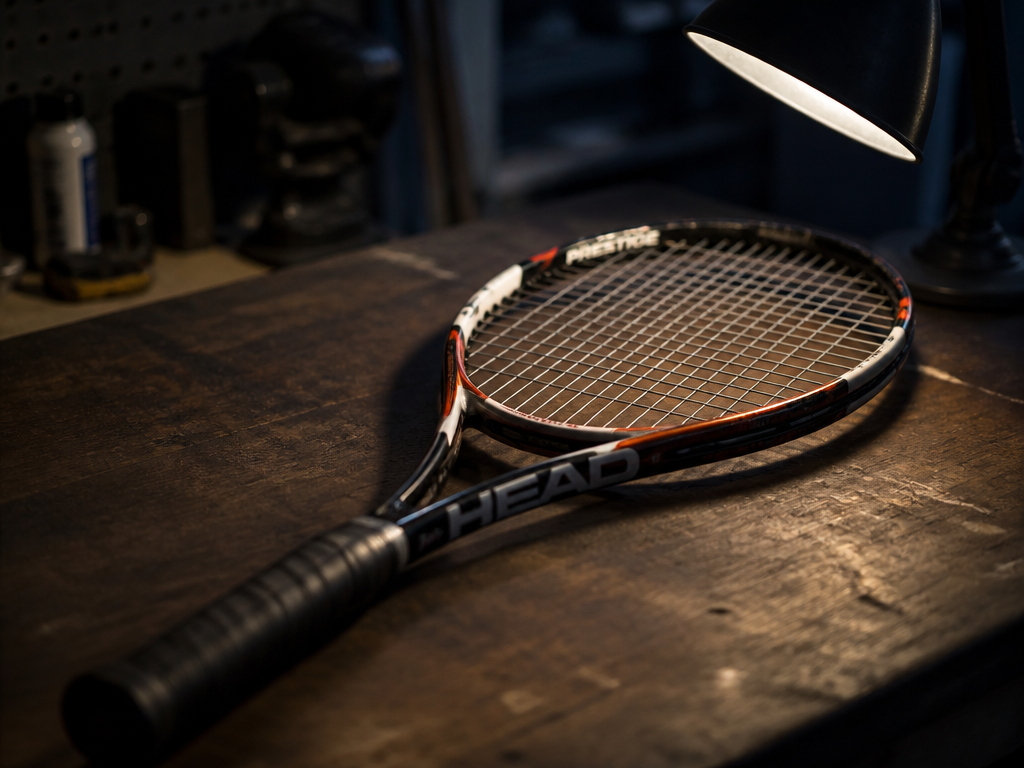
Player equipment identification sounds like a solved problem. Watch the match, read the logo, write it down. It is not solved, and it is least solved exactly where enthusiasts want it most: with a rising ATP prospect whose bag nobody has ever photographed up close, whose contract may cover the shirt and not the stick, and whose frame may wear a retail paint job over a mold that never reached retail.
The case that keeps landing in our inbox is Cruz Hewitt, the Australian junior who happens to be Lleyton Hewitt's son. He is a useful test subject precisely because he sits at the awkward stage where the evidence is thinnest: too visible to be invisible, not established enough to have a decade of pro-stock forensics behind him. If a method for identifying a player's equipment works here, it works anywhere. If it falls apart here, it was never as reliable as it looked when applied to a top-ten player with fifteen years of high-resolution photographs.
So this is not a piece about what is in Cruz Hewitt's bag. It is a comparison of the three methods people use to answer that kind of question — reading the paint, following the endorsement, and inferring from the spec sheet — judged on the same criteria, with a verdict left to emerge at the end rather than announced at the top. We did not handle any of these racquets. We read.
How we evaluated
We weighed four classes of source, and we weighed them unequally.
Manufacturer product pages are the highest-confidence source for retail specifications and the lowest-confidence source for what a professional actually plays. Yonex, like every brand, publishes head size, unstrung weight, unstrung balance, string pattern and length for each retail frame. Those numbers are reliable within a stated manufacturing tolerance and worthless as a description of a tour bag, because tour frames are customised after they leave the mold.
Endorsement announcements and signed-player listings are primary sources for a relationship. They tell you a brand and a date. They rarely tell you a model, and they almost never tell you a spec.
Tournament and agency photography is the only source that shows the physical object. It is also the source most vulnerable to misreading, for reasons we get to below.
Community archives and playtest write-ups — the pro-stock threads on Talk Tennis, the model-by-model reviews at Tennis Warehouse and Tennisnerd, the owner comments underneath both — are where the accumulated knowledge about molds, codes and paint jobs actually lives. They are unrefereed. They are also, on the narrow question of which mold is hiding under which cosmetic, the best documentation the hobby has, because the people writing them have had the frames in hand.
Our rule throughout: a figure gets printed only if we can name where it came from, and a manufacturer-stated number is labelled as manufacturer-stated. Where the community consensus and the brand's own copy disagree, we say so rather than picking the more interesting version.
Method one: reading the paint
This is what most people mean by equipment ID. You find a photograph, you match the cosmetic against a retail catalogue, you name the racquet.
It is fast, it costs nothing, and for the great majority of players below the top of the professional game it is correct. Juniors, college players and most challenger-level pros play retail frames, sometimes with lead tape, because that is what their arrangement provides and because retail frames are good.
The failure mode is specific and well documented: the paint job and the mold are separate things. A tour frame can be sprayed in the current season's cosmetic while the layup underneath is years or generations older. The community's shorthand for this — a "PJ" over a legacy mold — exists because it happens constantly. Wilson's PT57A, Head's TGK-coded frames and Babolat's H22 are the canonical examples, all of them known through hands-on inspection and pro-stock trading rather than through any manufacturer statement. None of the three brands publishes a mold register. Yonex is no more transparent than the others.
There is a second, smaller failure mode that catches enthusiasts more often than the first: photography flattens detail. Grommet strip shape, throat geometry and the exact taper that would distinguish one generation from the next are frequently unreadable at broadcast resolution, and the logo — the one element designed to be legible at distance — is the least informative part of the frame.
What reading the paint reliably delivers is a brand and a cosmetic family. What it cannot deliver, on its own, is a mold. Anyone who tells you they identified a professional's exact frame from a television still, without corroboration, has told you what they wanted to see.
Method two: following the endorsement
The second method treats the commercial relationship as the evidence. Brands publish signed-player pages; federations and agencies issue announcements; a young player's first equipment deal is usually reported somewhere.
The strength here is provenance. An endorsement announcement is a named source making a checkable claim about itself, which is a different quality of evidence from a fan matching pixels. If a brand lists a player, the player is playing that brand.
The weakness is scope, and it is a bigger weakness than most write-ups admit. Equipment contracts are bundles. A deal may cover racquets, strings, bags, shoes and apparel, or any subset of those. Racquet and apparel deals are routinely with different companies. String is very often outside the frame contract entirely, which is why you see players in one brand's frames with another brand's string in them — and string, along with tension, is arguably the variable that most changes how a racquet plays.

The endorsement trail also has a resolution problem. Brands announce players; they do not announce specifications. A listing that says a prospect plays Yonex narrows the field to a catalogue with several distinct families in it — EZONE, VCORE, Percept — which behave differently enough that knowing only the brand tells you very little about the player's preferences.
So: high confidence, low resolution. This method is the one least likely to be wrong and least likely to be useful on its own.
Method three: inferring from the spec sheet
The third method is the most technically ambitious and the most frequently abused. You take the retail specification, apply what is known about how tour frames are customised, and produce an estimate of the player's actual setup.
The raw material is solid. Yonex's own product pages list, for example, the EZONE 98 at 98 in² with a 16×19 pattern and 305 g unstrung, and the Percept 97 at 97 in² with 16×19 and 310 g unstrung, with heavier variants in each family. Those are manufacturer-stated figures, published within a tolerance, and they are the correct starting point.
The customisation math is also real. Adding mass at the hoop raises swingweight substantially more than the same mass at the handle; counterbalancing in the butt cap restores static balance while leaving much of that swingweight gain intact; a leather grip adds both weight and headlight balance. Stringing adds roughly 15–17 g depending on gauge and pattern. All of this is standard, uncontroversial and taught in every customisation guide worth reading.
Where it collapses is the input. To output a professional's setup you need to know their finished static weight, balance and swingweight, and for a prospect none of those three numbers is public. What circulates instead are estimates — someone's guess at a swingweight in the low 330s kg·cm², repeated until it acquires the texture of fact. We have seen the same speculative number attached to three different players in the same season. A figure with no named source is worse than no figure, and this method generates them faster than any other.
Spec-sheet inference is genuinely valuable in one direction: it tells you what is plausible. It cannot tell you what is true, and pieces that present its outputs as measurements are the reason equipment coverage has a credibility problem.
The three methods on the same criteria
| Criterion | Reading the paint | Following the endorsement | Spec-sheet inference |
|---|---|---|---|
| What it actually answers | Brand and cosmetic family | Brand and relationship date | What setup is plausible |
| Effort to apply | Minutes | Minutes | Hours, plus assumptions |
| Typical failure | Retail cosmetic over a non-retail mold | Contract covers apparel, not frames or string | Guessed inputs presented as measurements |
| Confidence ceiling alone | Moderate | Strong, but narrow | Weak |
| Usefulness for an unestablished prospect | Moderate — few archival photos | Strong — announcements exist early | Weak — no public finished specs |
Read across the rows and a pattern shows up that is not obvious when the methods are discussed one at a time. The two methods people trust most — paint and specs — have the worst confidence ceilings. The method people find boring, because it yields one word and a date, is the only one that clears a strong grade on its own.
The other pattern: the prospect case inverts the usual advantage. For an established top-twenty player, paint-job reading is strengthened by a decade of photographs and a community that has physically handled traded frames from that player's bag. For a nineteen-year-old, that archive does not exist yet, and the endorsement trail is the only stream that is actually denser early in a career, because signing a young player is news and playing a frame for four years is not.
The test case: a Hewitt with a Yonex
Run Cruz Hewitt through all three and you get a clean demonstration of each method's ceiling.
Endorsement trail. Yonex is the brand associated with him, and the association is not a fan inference — it sits on the brand's side of the relationship, and it is consistent with a family history in which Lleyton Hewitt played Yonex frames across a career that included the 2001 US Open, Wimbledon in 2002 and the year-end No. 1 ranking in 2001 and 2002. Confidence that the brand is right: high. Information gained: one word.
Paint reading. Photographs from junior and Australian summer events show Yonex cosmetics, which is exactly what the endorsement predicts and therefore adds nothing independent. Whether the frame under the paint is the current retail layup or something from an older mold is not answerable from any image we have seen. In fairness, for a player at this stage the base rate favours retail: pro-stock molds are typically a later-career accommodation, not a junior's starting point. That is a probabilistic argument, not evidence.
Spec-sheet inference. Here we stop. We have not seen a sourced figure for his static weight, balance, swingweight, string or tension, and we are not going to construct one. The customisation math would happily produce a confident-sounding number, and that number would be fiction.

We will also decline to print a ranking figure. Junior and early-professional rankings move fast enough that any number we published today would be stale before most readers reached this paragraph; the ATP and ITF profile pages carry the current ones, and they are one click away.
Editor's note: I have spent more evenings than I want to admit zooming into grommet strips on wire-service photographs, and the honest lesson is that the zoom almost never settles it. What settles it is somebody holding the frame.
What a legacy bag does and does not predict
The family angle is the reason this particular equipment question gets asked so often, so it deserves a straight answer rather than a romantic one.
A parent's brand relationship does predict the child's brand, and the mechanism is unmysterious: access, familiarity from the age of six, and a company with an obvious interest in continuity. That is a reasonable inference and it is usually right.
A parent's specification predicts nothing. Frame construction has moved through several generations of materials and geometry since the early 2000s; a young player's physical build, grip structure and preferred contact point are their own; and the tour has shifted toward lighter, more open-patterned frames than the mid-2000s norm. Inheriting a brand is not inheriting a stick, and the writing that treats the two as the same thing is doing narrative, not identification.
There is a third thing worth separating out, because it is where the legacy framing earns its keep: what a player does with the equipment. Playing style is observable from match footage in a way that specifications are not, and the comparison between generations belongs there — in court position, return depth, and how a point is constructed — rather than in the racquet.
Who this is for, and who it isn't
This is for you if you want to buy a frame in the same family as a player you follow, and you want to know how much of the resemblance is real. The answer, from the grid above: the brand and the retail family are usually knowable, the mold sometimes is, and the finished spec almost never is for a player this early in a career. That is enough to shop with, as long as you shop for the retail frame on its own merits.
This is for you if you write about gear and want a defensible standard for what to publish. The standard we have landed on: name a brand when a brand names itself; name a model when photographic and community evidence agree; name a spec only when someone who handled the racquet says so, and attribute it to them.
This is not for you if you want the exact string and tension. That information exists — the stringing team has it — and it is not public for a player at this level. Anyone offering it without a source is guessing.
This is also not for you if you are trying to replicate a professional's setup as a route to their results. The customisation literature is clear that tour specs are built around swing patterns and physical conditioning most club players do not have, and a heavy, high-swingweight frame is a good way to develop an arm problem rather than a forehand.
The verdict
On the five criteria above, following the endorsement wins outright on reliability and loses outright on resolution, and no single method clears both bars. The combination that actually works is narrow and unglamorous: use the endorsement to fix the brand, use the paint to fix the retail family, and stop before the spec sheet — reporting a plausibility range, labelled as such, rather than a number.
That is the screenshot line: for a rising prospect, the honest ceiling of player equipment identification is brand and model family, not specification. Every write-up that goes past that ceiling is extrapolating, whether or not it says so.
Evidence grade for the central claim — that brand-level identification is reliable while spec-level identification is not, for players at this career stage: Strong for the brand half, since it rests on primary announcements; Moderate for the mold half, since it rests on community documentation that is credible but unrefereed; Weak for anything below that, which is the entire point.
What we didn't answer, and where to look next
We did not establish which Yonex family Cruz Hewitt actually plays, and we deliberately did not estimate a weight, balance, swingweight, string or tension for him. We also did not determine whether his frames are retail layups or anything else, and we could not find a sourced account either way.
Four places are more likely than this article to close those gaps. Manufacturer product pages for current retail specifications — go to the brand's own domain and read the numbers there rather than a retailer's summary of them. Tournament stringing rooms, whose staff occasionally give interviews around the majors and are the only people with the string and tension data. Pro-stock and racquet-customisation communities, where frames that leave players' bags eventually get weighed and photographed by people who own them. And high-resolution agency photography from the moment a player's schedule steps up, which is when the archive that makes paint-reading work finally starts to accumulate.
If you have handled one of these frames, or you have a clear photograph of a butt cap or a grommet strip that settles a mold question, we would rather print your evidence than our inference. Send it with a date and a location, and we will say where it came from.