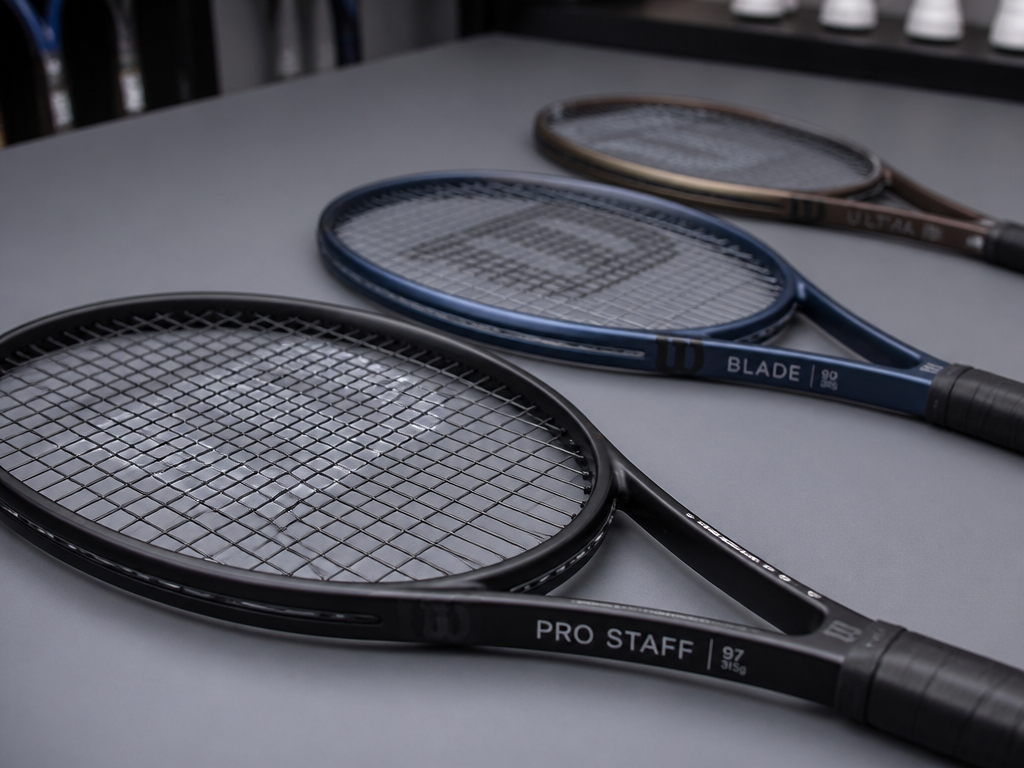
If you are standing in a shop deciding whether to spend more on the "advanced" racquet because you intend to get good, the honest answer is that the advanced frame will probably make you play worse for the next two years. Not because the racquet is bad. Because it was built to amplify a swing you do not yet have. That single misunderstanding drives most of the regret we hear about in tennis racquet selection, and it is the easiest one to avoid once you understand what the category labels are actually describing.
Here is the verdict in one sentence: for most recreational players, the correct racquet is one tier easier than the level you think you are, because the specs that define "advanced" remove help you still need.
The rest of this piece earns the right to have said that. We are going to walk through the four numbers that separate the tiers, explain what each one physically does to a struck ball, and only then tell you who each category genuinely serves. No brand list. No "you'll love it." Just the mechanics and where they leave you.
How we're framing this comparison
The words "beginner," "intermediate," and "advanced" are marketing categories, not engineering ones. They are a shorthand a brand uses to sort its line. They are useful, but they hide the thing that actually matters, which is the spec sheet underneath.
So instead of arguing about labels, we sorted racquets by the four measured attributes that consistently track with those labels across most brands:
- Strung weight — measured in grams. We treat anything under ~285g as beginner-leaning, ~285–310g as intermediate, and 310g-plus as advanced.
- Head size — measured in square inches. Roughly 105+ at the easy end, 98–104 in the middle, 95–98 at the demanding end.
- Stiffness (RA) — a frame's resistance to bending, on the standardized RA scale. Higher is stiffer.
- Balance — where the mass sits, expressed in points head-light (HL) or head-heavy (HH) from the center.
We are not running a hitting trial here; this is an explainer, and we will say plainly where the reasoning is mechanism-based rather than measured. The physics of weight, head size, and beam stiffness are well established and predictable. The part that varies player to player — how a given frame feels — we flag as exactly that.
One honest limit up front: RA numbers published by brands are measured on an unstrung frame, and stringing changes the effective stiffness. Treat published RA as a comparison tool between frames, not an absolute.
The four numbers that actually define a tier
Before tiers, the mechanisms. Every category difference comes down to some combination of these four.
Weight: the trade between forgiveness and control
Mass is the most underrated spec because it does two opposing jobs at once.
A heavier racquet has more plow-through — when it meets the ball, it loses less of its own speed, so more energy transfers into the shot and the frame twists less on off-center hits. That stability is why advanced frames are heavy. But there is a catch the marketing never mentions: that stability is only an asset if you can swing the mass fast enough to get it to the contact point on time. A 320g frame in the hands of someone whose preparation is still half a beat slow does not produce a heavy, stable ball. It produces a late, framed one.
A lighter racquet is easier to maneuver, gets to the ball sooner, and forgives slow preparation. The cost is that it twists more on mishits and offers less inherent power on flat, slow swings. That cost is real, but for a developing player it is a smaller cost than chronic lateness.
Head size: where the easy power lives
A larger head does two things. It enlarges the sweet spot, so off-center contact is punished less, and it generates more rebound power because the strings have more room to deflect and snap back. A bigger string bed simply does more of the work for you.
A smaller head tightens that sweet spot and reduces that free rebound. In exchange it gives a more connected, predictable response — the player who can find the center consistently gets more precise feedback and less of the slightly mushy, ball-flies-long behavior that big heads can produce on hard hits. The smaller head is not "better." It is less forgiving in exchange for more information.
Stiffness: the part most people get backwards
This is the spec most likely to be sold to you wrong, so it gets the most space.
A stiffer frame flexes less on contact, which means it returns more energy to the ball rather than absorbing it into the bend of the beam. Higher RA generally means more power. Marketing loves this, because "more power" sells.

What the marketing tends to skip is where that power goes when you miss. A stiff frame also transmits more of the impact shock back up into the arm, particularly on off-center hits, and it is less self-correcting on those mishits. The research on arm load is consistent enough that it belongs here: studies of frame stiffness and impact loading (for example, work summarized across racquet-vibration research over the past two decades) point to stiffer frames transmitting higher shock to the forearm, which is one reason elbow complaints cluster among players using stiff, light, powerful frames with the wrong string.
So the counterintuitive bit: a more flexible frame is often the more comfortable and, for some players, the more controllable one, because it does not over-launch the ball and it asks less of your joints. Advanced players frequently choose lower RA on purpose. The "powerful stiff frame" is, ironically, more of a beginner-and-improver convenience than a hallmark of expertise.
Balance: the lever you don't notice until it's wrong
Balance describes where the weight lives. A head-light frame keeps mass back toward the handle, which makes the racquet feel quicker and more maneuverable even at a given total weight. A head-heavy frame puts mass out toward the tip, which adds power and stability on contact but slows the swing and asks more of the wrist and shoulder.
Most lighter beginner frames are built slightly head-heavy to put power back into a slow, short swing. Most heavier advanced frames are built head-light to keep a heavy racquet maneuverable in fast hands. This is the elegant part of frame design: balance is used to compensate for weight, in opposite directions at opposite ends of the range. It is also why total weight alone never tells the whole story.
The three tiers, explained by what the numbers do
Now we can put the mechanisms together. Notice that each tier is internally consistent — the four specs are chosen to work as a set for a particular swing.
Beginner / improver frames
Typical profile: light (260–285g strung), large head (105–115 sq in), stiffer beam, slightly head-heavy or even balance.
Read that as a set. The light weight forgives slow, late preparation. The big head forgives off-center contact. The stiffer beam and forward balance inject power into a swing that is still short and not yet generating its own racquet-head speed. Every spec is doing the same job: producing a decent ball from an incomplete stroke.
The trade is precision. This frame will fling a fast incoming ball long if you take a full cut at it, and it gives vaguer feedback about where on the string bed you made contact. For someone whose rallies rarely exceed a few balls and whose main goal is to make clean contact and keep the ball in, those are trades worth making every time.
Intermediate frames
Typical profile: medium weight (285–310g strung), mid-plus head (98–104 sq in), moderate stiffness, clearly head-light.
This is the tier most recreational players will live in for years, and the one most often skipped over in a panic to "not buy the beginner one." The intermediate frame assumes you can now generate some of your own pace and prepare on time more often than not. So it pulls back the free help: the head shrinks toward a truer sweet spot, the weight climbs to add stability you can now wield, and the balance goes head-light to keep that added weight quick.
The reason this tier matters is developmental. A frame that does slightly less for you forces — and rewards — better contact. You feel the difference between center and off-center, and that feedback is how technique sharpens. The beginner frame hides your errors; the intermediate frame shows them to you gently enough that you can fix them.
Advanced / player frames
Typical profile: heavy (310–340g+ strung), small head (95–98 sq in), often lower stiffness, strongly head-light.
Reread that and notice it inverts the beginner logic at every point. Heavy and head-light: maximum stability and plow-through for a player who already swings fast enough to carry the mass. Small head: a tight sweet spot for a player who finds the center reliably and wants precise, connected feedback. Lower stiffness: a frame that does not over-launch a ball already being hit hard, and that stays comfortable across thousands of full-pace strokes.
The advanced frame is not "the best racquet with the most features." It is a racquet that removes almost all the automatic help and hands control back to the player. In the wrong hands it does exactly that — removes the help — and leaves a player fighting late, off-center, underpowered contact with no safety net. That is the precise mechanism behind our opening claim.
The comparison, side by side
| Spec | Beginner / Improver | Intermediate | Advanced / Player |
|---|---|---|---|
| Strung weight | 260–285g (forgives slow prep) | 285–310g (stability you can wield) | 310–340g+ (max plow-through) |
| Head size | 105–115 sq in (big sweet spot) | 98–104 sq in (truer center) | 95–98 sq in (tight, precise) |
| Stiffness (RA) | Higher (free power) | Moderate | Often lower (control + comfort) |
| Balance | Even to head-heavy | Head-light | Strongly head-light |
| What it does for you | Maximum automatic help | Rewards improving contact | Removes help, returns control |

The pattern worth seeing is that the specs are not independent dials you mix and match. Each tier is a coherent answer to one question: how much of the stroke is the racquet expected to supply, and how much is the player?
The gap between the label and the spec sheet
Here is where skepticism earns its keep. Two racquets both marketed "intermediate" can sit a full tier apart on the numbers. One brand's intermediate line might run 295g and 100 sq in; another's might run 285g and 104 sq in with a stiffer beam — closer to what the first brand calls a beginner frame.
The fix is simple and free: ignore the label and read the four specs. Every reputable spec sheet lists strung (or unstrung) weight, head size, balance, and usually RA. Once you can read those four numbers, the marketing word becomes decoration. You are no longer buying "advanced"; you are buying 305g, 98 sq in, head-light, moderate stiffness — and you know exactly what that combination will do to your ball.
We will be honest about the one number we cannot resolve from a chart: feel. Two frames with near-identical specs can play differently because of how the mass is distributed along the beam, the string pattern, and the flex profile. Specs get you to the right shortlist of three or four frames. The final pick comes from hitting them, ideally with the same string at the same tension. No spreadsheet replaces that.
Who each tier is actually for
Beginner / improver frames are for you if: you are still learning to make consistent clean contact, your rallies are short, you are not yet generating your own pace, or you want the lightest, most forgiving thing while you build a swing. There is no shame here and no rush to leave. Many recreational players are best served by an "improver" frame indefinitely, and the people most likely to overpay are the ones who skip this tier out of pride.
Intermediate frames are for you if: you can rally, you prepare on time most of the time, you generate some of your own pace, and you have started to feel the limits of a forgiving frame — balls flying long when you swing freely, or a sense that the racquet is doing too much. This is the longest-lived tier for the recreational player and the one we would default to recommending when someone is genuinely between two.
Advanced / player frames are for you if: you swing fast and on time consistently, you find the center reliably, you want feedback and control over automatic power, and you are playing enough that comfort over long sessions matters. If you have to ask whether you are ready, you are probably better served one tier down — not as an insult, but because the advanced frame's entire design is to withhold help, and help is what most players are still using.
The category nobody warns about is the player who buys advanced "to grow into it." A frame you grow into is a frame that punishes you daily until you do. You can develop perfectly good technique on an intermediate frame and step up later, by which point you will know from feel exactly which heavy, low-stiffness, head-light frame you want — and you will be choosing it for the right reasons.
Back to the opening claim
We said an advanced racquet will probably make you play worse for two years, and that the right frame is usually one tier easier than the level you think you are. That is not a put-down and it is not gatekeeping. It falls directly out of the mechanics: the advanced frame is heavy where you need quick, small-headed where you need forgiveness, and tuned to return control to a swing that is still being built. Every spec that earns it the "advanced" badge is a spec that subtracts help.
So the reframe is this. The frame that makes you better fastest is the one that does slightly less than you can already manage — enough help to keep the ball in, enough honesty to show you your mistakes. Buy the four numbers, not the word on the throat. The advanced racquet is not a goal to reach for. It is a tool you will recognize when you no longer need the help it refuses to give.
Evidence grade for the central claim — that the right frame is typically one tier easier than the player assumes: Moderate. The spec mechanics (weight, head size, balance, stiffness and their effect on the struck ball) are well established and predictable. The stiffness-to-arm-load link is supported by racquet-vibration research. What we cannot grade higher without a controlled hitting trial across many players is the developmental claim that an easier frame improves technique faster — that rests on mechanism and coaching convention rather than a measured study, and we have marked it as such.