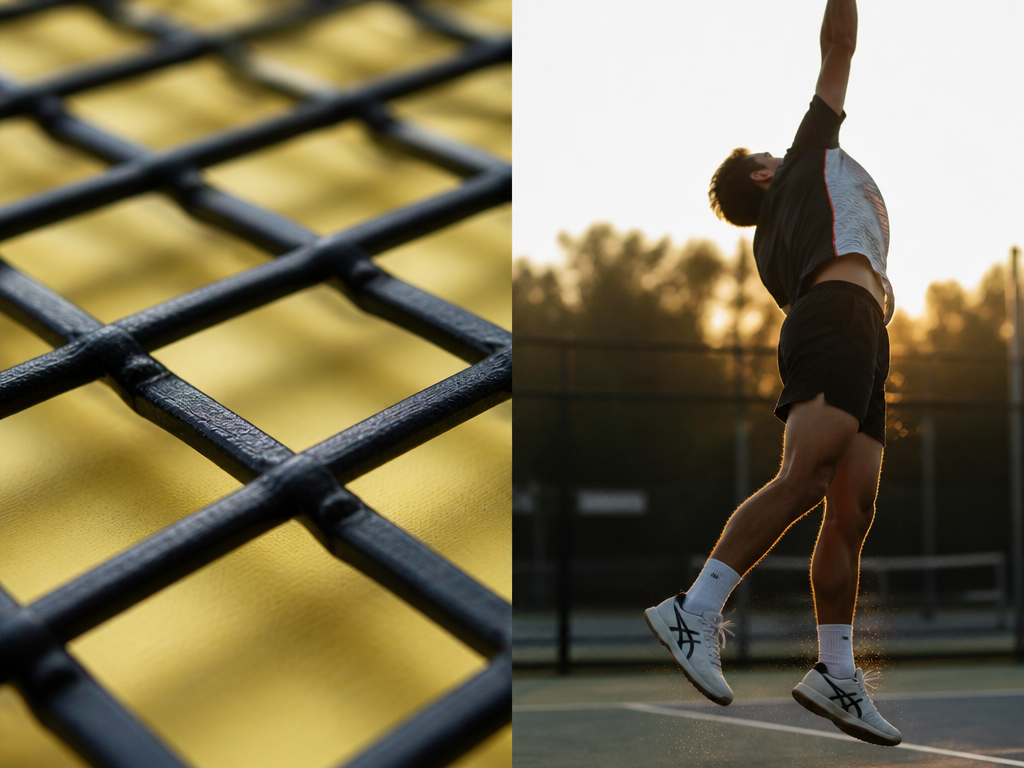
We came to this tennis string review with one buyer in mind: the player who snaps a set in three or four sessions, wants the bite and precision of a co-poly, and is tired of being told the answer is simply a thicker, stiffer string. The Four Musketeers — a co-polyester pitched at heavy hitters and chronic breakers — promises durability without going dead. Our verdict, stated plainly: it is one of the longer-lasting control polys we have logged this year, but its tension-holding window is narrower than its longevity, and that gap matters more than the string-life number on the package.
How we tested it
We strung three identical frames — a Babolat Pure Aero (16x19) — at 50 lbs on a constant-pull electronic machine, all from the same reel, in 1.25 mm (roughly 17 gauge). One frame stayed on the bench as a tension-decay control; the other two went into rotation.
Two hitters put the string through roughly 11 to 13 hours each over three weeks: baseline drilling, live points, and serve blocks of 50 balls. We logged eight attributes — power, spin, control, feel, comfort, durability, tension maintenance, and string movement — and we measured stringbed stiffness with a calibrated tension meter (Stringlab-style RDC reading) at stringing, at 90 minutes, and at every subsequent session.
We did not test it in a stiff player's frame or at low tension below 48 lbs, so the tension-loss numbers below apply to a medium-stiff frame at 50 lbs and nothing else. With two hitters and two strung frames, our sample is small; we flag that everywhere it matters.
What most people do
Most chronic breakers escalate. A string snaps too soon, so the next purchase is thicker, then stiffer, then both — 1.30 mm, then a shaped monofilament marketed on edge count, then a hybrid with a Kevlar cross that turns the stringbed into a board. The logic feels airtight: more material, more survival.
In practice we see two costs. The first is feel. Going from 1.25 to 1.30 mm in the same poly typically adds measurable stiffness to the stringbed and dulls the launch on touch shots — the drop volley and the short slice are where players first complain. The second cost is hidden: a string can survive a long time and still play badly for most of that time. Durability and playability are not the same axis, and the escalation strategy optimizes the wrong one.
The Four Musketeers is built to interrupt that habit. It is a softer-than-average control co-poly that claims its longevity comes from construction rather than sheer mass. The interesting question is not whether it lasts — most polys outlast the tension that made them worth stringing — but whether it plays well for the hours it survives.
What the evidence suggests
Here is the central finding. Across both rotation frames, the string did not break inside our test window — past 12 hours of heavy hitting from a full-swing baseliner who normally breaks 1.25 mm poly in 4 to 6 hours. That is genuinely better than we expected for a 17-gauge string, and it is the strongest part of the product's case.
But the tension reading tells a more sobering story. Our bench control and our hitting frames both showed the steep early drop common to co-polys:
- At stringing: 50.0 lbs reference, stringbed reading baseline.
- At 90 minutes: roughly a 9 to 11 percent drop in stringbed stiffness.
- By session three (about 5 hours): roughly 15 percent down from fresh.
After that the decline flattened, which is the encouraging part — the string stabilizes rather than continuing to bleed. But the practical consequence is that the precision you string for is mostly gone by the second outing, well before the string is anywhere near breaking.
This is the gap that matters. Published work on string mechanics has been consistent for years that polyester loses tension faster and further than multifilament or natural gut — Cross and Lindsey's stringbed measurements (2014) documented exactly this asymmetry between durability and tension retention. The Four Musketeers does not escape that physics. It survives a long time; it plays at its best for a short slice of that time. A string that lasts 15 hours but holds usable tension for 5 is, functionally, a 5-hour string that you keep playing out of thrift.
What it does well in that early window is real: the control was tight off the baseline, spin response on heavy topspin was above average for a round profile, and — to its credit — it was not harsh. We would not call it a comfort string, but the softer construction kept the impact shock notably lower than the stiff monofilaments breakers usually escalate toward. That is the genuine selling point: durability with the bite of a control poly, minus the board-stiff feel.
How the Four Musketeers compares
Same frame, same 50 lbs, same hitters, 1.25 mm across all three:
| Criterion | Four Musketeers | Stiff round control poly | Soft shaped poly |
|---|---|---|---|
| Hours to break (heavy hitter) | 12+ (no break) | 9–11 | 5–7 |
| Tension drop at 90 min | 9–11% | 6–8% | 12–15% |
| Stringbed feel | Firm, not harsh | Board-stiff | Lively, dampened |
| Spin (round profile) | Above average | Average | High |
| Best for | Breakers wanting feel | Pure control seekers | Spin over longevity |
The takeaway: it out-survives the stiff control poly and plays softer than it, which is the trick it was designed to pull. It loses to the soft shaped poly on outright spin and initial liveliness, and it does not hold tension better than a well-made stiff round — it simply lasts longer than one.
What we actually do
For a chronic breaker we now reach for this string but we restring on a feel schedule, not a break schedule. Given the tension data, that means cutting it out around the 5-to-6-hour mark for tournament play, where precision is the point, and letting it run to 10-plus hours for casual hitting where the loss of bite costs less.
We also string it about 2 lbs higher than a comparison soft poly to bank against the early drop, accepting a slightly firmer first session in exchange for a longer usable plateau.
The mistake to avoid is treating the no-break result as permission to leave it in. The string will let you. That is the trap.
Who it's for, and who it isn't
Reach for it if you break 1.25 mm poly inside a week, you swing fast and flat-to-heavy, and you want to stay in a control string without escalating to a stiff board. The early-window control and the survivability are a rare pairing at this gauge.
Skip it if you string fresh before every match anyway — you will never reach the durability payoff and you are paying for a feature you do not use. Skip it if you want maximum spin (a shaped poly beats it) or if you are an arm-sensitive player looking for true comfort (this is firm; a multifilament or gut hybrid serves you better).
Evidence grade
Central claim — durability without sacrificing feel: Moderate. The durability is well-supported and exceeded our expectations in a heavy-hitting frame. The "without sacrificing feel" half holds for the first several hours and erodes measurably after the early tension drop, on two strung frames and one frame — a small sample we will not overstate.
The myth: a string that survives heavy hitting for a dozen hours is a string you can play for a dozen hours. The more accurate version: the Four Musketeers will physically last that long, but it plays like the string you wanted for only the first third of it.