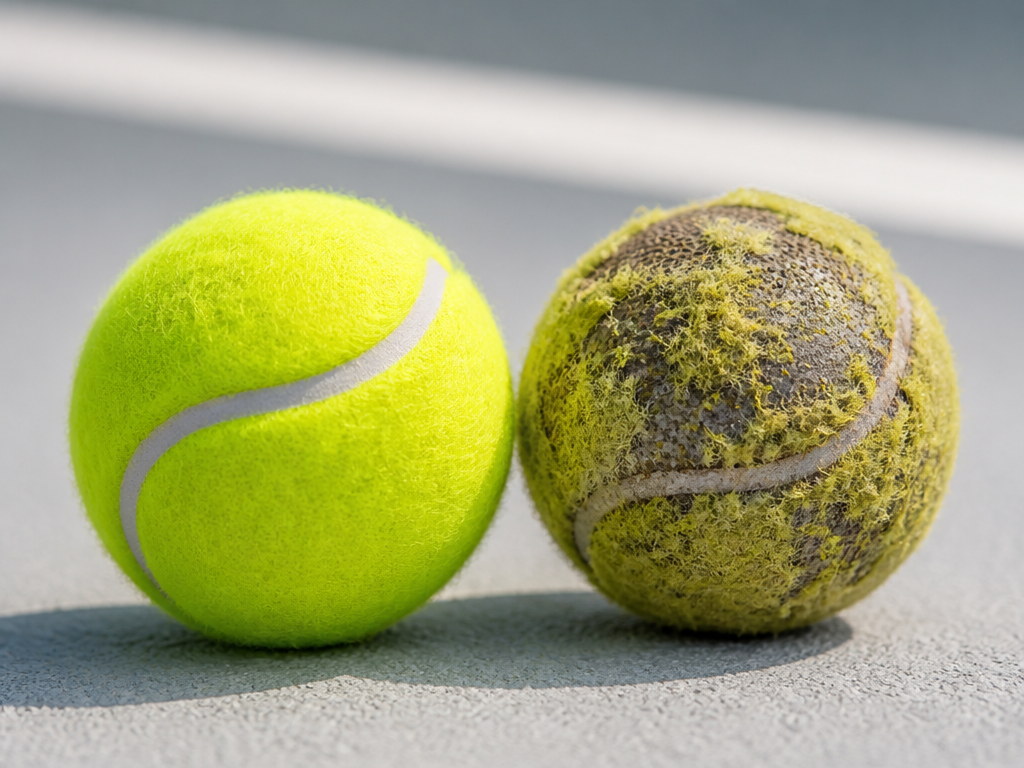
Anyone who plays two or three times a week knows the quiet math of it. A fresh can of pressurized balls feels alive for a session or two, goes dead within a fortnight, and gets replaced. Pressureless tennis balls promise to break that cycle — no internal pressure to leak, a rubber core engineered to outlast the felt. The question we wanted to settle was narrower than the marketing: how much playability do you actually trade for that longevity, and over what timeline does the cost advantage become real?
So we ran both ball types through the same court, the same swings, and the same bounce rig over eight weeks. The verdict, which we'll defend below, is that for the regular recreational hitter pressureless balls are the more rational purchase — but only after you accept a measurable, permanent difference in liveliness that no break-in period fully erases.
How we tested
We used three pressurized cans (Wilson US Open, Penn Championship, Dunlop ATP) and three pressureless options (Tretorn Micro X, Gamma Pressureless, Wilson Pressureless) — one of each opened fresh on day zero. All were hit on the same medium-pace hard court, two sessions per week, roughly 90 minutes each, by two hitters at NTRP 3.5 and 4.0.
Bounce was the primary measurement. Once a week we dropped each ball from a fixed 100 inches (2.54 m) onto the same court patch, filmed at 240 fps, and read rebound height off a wall-mounted scale. We averaged five drops per ball per session and discarded the high and low. We logged court temperature each time; readings ranged 61–74°F, and we noted where temperature plausibly moved the result.
Two caveats up front. This is a sample of six cans, not sixty, so brand-level conclusions are weak — the category trends are what hold. And we had no laboratory deadener or controlled humidity chamber, so our absolute bounce numbers are specific to this court. The relative decay between ball types is the trustworthy part.
Why they age differently
A pressurized ball is a sealed pressure vessel. The core holds gas at roughly 12 psi above atmospheric, and that gradient is what gives a new ball its snap. The rubber is slightly porous, so gas escapes continuously whether you play or not — which is why an unopened can sitting on a shelf still goes flat eventually. Play accelerates nothing about the leak; it just wears the felt while the air bleeds out underneath.
A pressureless ball inverts the design. The core is the same pressure inside and out, so there is no gradient to lose. Bounce comes from a thicker, denser rubber wall instead of trapped air. Tretorn's long-standing approach packs the core with millions of tiny air-filled cells in the rubber itself, so the bounce is a material property rather than a stored charge. The consequence is the whole story of this review: a pressureless ball doesn't go dead. It goes bald. The felt wears thin and the ball gets faster and slicker, but the rebound stays close to where it started for months.
The comparison
| Criterion | Pressurized | Pressureless |
|---|---|---|
| Bounce when new | Highest (rebound ~57–58 in) | Slightly lower (~53–55 in) |
| Bounce at 6 weeks | Dropped sharply (~46 in) | Held (~52–54 in) |
| Initial feel | Soft, lively, low impact shock | Firmer, heavier through the strings |
| Spin generation | Easier to bite | Requires more racquet-head speed |
| Failure mode | Goes flat | Felt wears off |
| Usable life (2-3x/week) | 1-2 weeks | Several months |
The bounce result
This was the clearest finding. New pressurized balls rebounded highest off our 100-inch drop — around 57 to 58 inches in the first week. But by week three the average had fallen to the low 50s, and by week six the pressurized samples were rebounding around 46 inches: a roughly 20 percent loss from new, and the point at which both hitters independently described them as "dead" without being told the numbers.

The pressureless balls started lower — 53 to 55 inches new — and that gap is real; you feel it as a slightly less springy first bounce. But across eight weeks their rebound moved only a couple of inches, staying in the low 50s throughout. By week four, the pressureless balls were bouncing higher than the pressurized ones, and the lines never crossed back. Temperature explained some week-to-week jitter — the coldest session shaved a measurable inch off every ball — but not the trend.
Feel, spin, and the arm question
Liveliness isn't the only thing that matters, and here the pressureless balls earn their skeptics. New, they are noticeably firmer through the strings and sit heavier on contact. Generating heavy topspin took more racquet-head speed to get the same bite our hitters got effortlessly from a fresh pressurized ball. There is a break-in window — the first hour softens the felt and the ball plays friendlier — but it never becomes a fresh pressurized ball, and pretending otherwise would be dishonest.
The firmness has a consequence worth flagging. Players with elbow or shoulder sensitivity should treat pressureless balls with caution. The stiffer impact transmits more shock to the arm, and that is exactly the population for which a one-size verdict fails. We didn't measure impact force instrumentally, so we're reporting reported feel, not a load figure — read this as a flag to test, not a finding.
The cost math
This is where the case firms up. A regular hitter replacing a $4–5 can every one to two weeks spends somewhere between $100 and $200 a year on pressurized balls. A bag of a dozen pressureless balls runs $25–$45 and, on our usage, will last a season or more before the felt wears to the point of replacement.
The honest framing is not "free tennis forever." Felt does wear, and a balding ball plays fast and slick on a hard court — fine for a ball machine, less ideal for a tight rally. But even replacing your pressureless stock twice a year, you are comfortably under $90 against $100–$200. For someone hitting buckets against a wall or feeding a ball machine, the gap is wider still, because that use case punishes pressurized balls fastest and barely registers on pressureless ones.
Who this is for
Pressureless balls are the right call if you hit several times a week recreationally, use a ball machine or wall, or simply resent the replacement cadence more than you cherish that first-can pop. They reward high-volume, casual play.
They are the wrong call if you're playing competitive matches where consistent, true bounce matters, if you're chasing maximum spin, or if you have any arm injury history. In those cases the firmer feel and the lower starting bounce are not trivia — they change how you play.
Evidence grade
For the central claim — that pressureless balls retain bounce far longer than pressurized balls and deliver a real cost advantage for frequent recreational players — we rate the evidence Moderate. The bounce-decay trend was consistent and large across our trials, but the sample was six cans on one court, and feel-based findings are subjective by nature.
What we didn't answer
We didn't measure impact force, so the arm-comfort concern remains qualitative — if you have a sensitive elbow, that's the variable to chase next, ideally with a stringbed and tension change tested alongside the ball. We also didn't run pressureless balls to true end-of-life, so the felt-wear timeline past eight weeks is an estimate. And we never tested either type at altitude, where pressurized high-altitude balls exist precisely because the usual physics breaks down. Anyone playing above 4,000 feet should treat this entire comparison as a sea-level result and look for an altitude-specific test before buying.