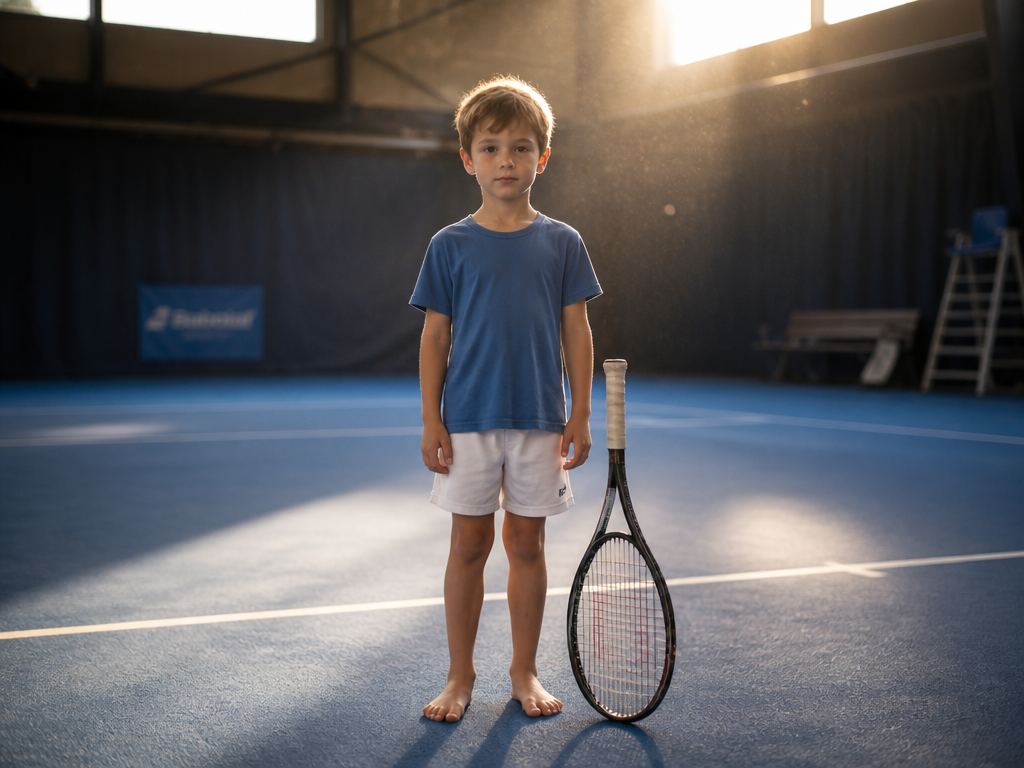
A 27-inch adult racquet weighs about 300 grams strung. A 23-inch junior frame weighs about 200. Manufacturers lead with that hundred-gram gap, and it is close to the least useful number printed on the box. Anyone standing in front of a wall of junior tennis equipment for the first time is being sold on static weight, while the specification that actually decides whether a seven-year-old can swing the thing — how hard the frame resists being rotated — appears nowhere on the packaging, the hangtag, or most brand websites.
The question that brings most parents to that wall isn't an engineering one. It is arithmetic with a fear attached. The 23-inch frame fits now. The 25-inch will fit by next spring. Buying the 25 saves a purchase, and the only thing standing in the way is a warning from a coach about bad habits — delivered the way dentists talk about sugar, with the implication that a racquet two inches too long will bake something into a child's forehand that takes years to sand off.
So: can you buy one size up. The honest answer has a shape. Yes at the top of the range, no at the bottom, and the reason has less to do with developmental psychology than with a formula from first-year physics.
What size racquet a child actually needs
Fit by height, not age. Age is the worst proxy available, because two nine-year-olds can differ by 25 centimeters, and the racquet does not know how old anyone is. Every fitting chart in the industry is really a height chart with ages printed beside it for the convenience of people shopping online.
| Racquet length | Height | Rough age | Typical strung weight | ITF ball stage |
|---|---|---|---|---|
| 19 in / 48 cm | under 100 cm | 3–5 | 150–175 g | Red (foam) |
| 21 in / 53 cm | 100–112 cm | 4–6 | 165–190 g | Red |
| 23 in / 58 cm | 112–125 cm | 6–8 | 190–215 g | Red / Orange |
| 25 in / 63 cm | 125–137 cm | 8–10 | 205–240 g | Orange |
| 26 in / 66 cm | 137–150 cm | 9–11 | 240–265 g | Green |
| 27 in / 69 cm | above 150 cm | 11+ | 255–285 g | Yellow |
The physical check is faster than the chart and more reliable. Have the child stand upright, arms hanging at their sides, and hold the racquet alongside them with the tip of the frame on the ground. The butt cap should reach roughly to the heel of the hand — fingers curling around it comfortably, wrist not cocked. If the handle rides up past the wrist, the frame is long. If the child's fingertips are still reaching down past the butt cap, it's short.
One detail the charts obscure: the jump from 23 to 25 inches is the largest single step in the sequence, and it is the one most often made too early. Most of the range moves in two-inch increments of a small racquet. That particular step happens right when a child is also usually moving from the red ball to the orange ball and from a 36-foot court to a 60-foot one. Three variables change at once. If something goes sideways in that window, the racquet gets blamed and the court usually deserves it.
Why length matters more than weight
A racquet swung from the handle is a rotating body, and the resistance you feel is not its mass. It is its moment of inertia — mass distributed over distance, and distance enters the calculation squared. In racquet-lab terms this is swingweight, quoted in kg·cm².
Run the numbers on the 23-to-25-inch step. Length increases by about 8.7 percent, so the length-squared term rises by a factor of roughly 1.18. Typical strung weight goes up perhaps 10 to 15 percent over the same step. Multiply them and the frame becomes something like 30 percent harder to rotate for a weight increase the box describes as small.1 A parent lifting both racquets in a shop feels the 10 percent. The child feels the 30.
That gap is why static weight is a misleading spec for kids' gear specifically. Adults have enough surplus strength that a 20-point swingweight difference is a preference. A 22-kilogram child swinging a frame a third heavier in rotation has no surplus to spend.
What the compensation looks like, in order
The failure is not dramatic. It is a chain, and it runs in the same order almost every time.
First, the swing arrives late. The child cannot accelerate the frame in the time the ball gives them, so contact drifts backward — behind the front hip instead of ahead of it. Second, the racquet head drops. Holding a long frame's tip up against gravity requires wrist and forearm strength the child doesn't have, so the head sags below the hands and the racquet face opens toward the sky. Third, the arm takes over. With the head trailing and the face open, the shoulder-and-torso rotation that should drive the stroke can't be timed to it, so the child pushes with the elbow and forearm instead — the stroke most coaches call arming the ball, or a waiter's-tray forehand.

Fourth, and this is the part worth caring about, the grip migrates. A child who cannot support the frame will slide the hand toward a flatter, more western position, or wrap a second hand onto the forehand side, because both make the racquet feel lighter. That accommodation is rational. It is also the one that takes real coaching time to undo later, because by then it isn't a compensation — it's the child's forehand.
None of those four steps requires a bad attitude, a bad coach, or a bad kid. They follow from torque.
What the research actually measured
The evidence base for scaled equipment in youth tennis is real, and it is smaller than the confidence with which it gets quoted.
The most-cited experiment is Farrow and Reid (2010, Journal of Sports Sciences), which put beginner children through a block of lessons using either scaled equipment or full-size adult gear and compared skill outcomes. The sample was small — a couple of dozen children — and the results favored scaling on some measures without being uniform across all of them. It is a supportive study, not a decisive one.
Timmerman and colleagues (2015, Journal of Sports Sciences) took a different approach and looked at what children actually do on court under different equipment and court combinations. Working with ten-year-olds, they varied ball compression and court size and coded the shots played. Under scaled conditions, contact points sat lower relative to the body, and children played more balls from inside the baseline rather than retreating behind it. That finding matters more than a skill score, because it describes the shots a child gets to practice. Equipment that forces a child to contact the ball above shoulder height, backing up, is equipment that has quietly chosen which stroke they will learn.
The best synthesis is Buszard, Reid, Masters and Farrow (2016, Sports Medicine), a systematic review of scaling equipment and play area in children's sport. It concluded that scaling generally supports skill acquisition, while noting that the literature is modest in size, heterogeneous in design, and dominated by short-term studies. Nobody has followed a cohort of six-year-olds for eight years to see which frame produced better fifteen-year-olds, and nobody is likely to.
There is also a methodological problem that runs through nearly all of it. These studies scale racquet, ball, and court together, because that is how the sport is taught. Isolating the racquet's independent contribution is hard, and the studies that try are the smallest ones. The claim "scaled equipment helps children learn" is reasonably well supported. The narrower claim "a racquet two inches too long specifically damages technique" is a mechanism argument with thin direct evidence behind it — plausible, coherent with what coaches observe, not demonstrated in a controlled trial.
The ball is doing more work than the racquet
Here is the part of the system with the strongest evidence and the lowest price tag, and it isn't the frame.
The International Tennis Federation's Tennis 10s framework, which grew out of the Play and Stay campaign and now sits in the appendices of the Rules of Tennis, specifies three graded balls. The red ball has roughly 25 percent of a standard ball's compression, the orange about 50 percent, the green about 75 percent. Court size scales with them: red is played on a court about 11 by 5.5 meters with a lowered net, orange on roughly 18 by 6.5 meters, green on the full 23.77-meter court. Racquet length limits are written into the same regulations — up to 23 inches for red, 23 to 25 for orange, 25 to 26 for green. The ITF publishes the specifications directly.
A red ball bounces low and travels slowly. On a 36-foot court, a small child can reach it, contact it near waist height, and swing through. Give the same child a standard yellow ball on a full court and the bounce clears their shoulder, the ball arrives before the swing does, and the only stroke available is a defensive push. The frame is not what broke; the ball was never playable.
A sleeve of stage-appropriate balls costs a fraction of a racquet. If a household is going to be precise about one thing in a child's setup, the ball stage is where precision buys the most, and it is the piece casual buyers skip most often.
The specs that get oversold

Grip size. The standard pro-shop measurement — index finger slotted into the gap between fingertips and palm, an approach popularized through Robert Nirschl's clinical work on tennis elbow — is a sensible starting point, and it has less experimental support than its precision implies. Hatch and colleagues (2006, American Journal of Sports Medicine) measured forearm muscle firing patterns across different grip sizes using EMG and did not find the clear differences the conventional advice predicts. The sample was small and adult, so it does not transfer directly to children. What it does suggest is that grip size is a comfort variable with a wide tolerance rather than a precision fitting. In practice, junior frames under 25 inches ship in a single grip size and that is usually fine. A grip that is clearly too large is worth fixing, because it prevents a child from changing grips between strokes at all. Half a size is not worth a decision.
String tension. A pre-strung 21- or 23-inch aluminum frame arrives with inexpensive synthetic gut at low tension, and that is the correct specification, not a corner cut. Low tension gives a softer, more forgiving response at the low swing speeds a small child generates. Restringing a sub-25-inch junior racquet is almost never worth the labor cost, which will often exceed the frame's value. Around 25 and 26 inches, when a child starts breaking strings, restringing becomes a real maintenance item.
Aluminum versus graphite. Aluminum alloy frames are ductile: dropped, scraped along a court, or stepped on, they bend and keep playing. Graphite composite is stiffer per unit mass and holds its shape under load, which matters once a player generates enough head speed for frame flex to affect where the ball goes. It also cracks rather than bends. For roughly the 19-to-23-inch range, aluminum is the right engineering answer and the cheaper one. Somewhere around 25 to 26 inches the switch to composite starts to earn its price, because the child is finally hitting hard enough for stability to be a variable.
Swingweight. Almost no manufacturer publishes it for junior frames. Independent measurement work — the pendulum and inertia methods documented by Rod Cross and Crawford Lindsey through Tennis Warehouse University — shows how much frames of identical stated weight can differ in how hard they are to swing. Until brands publish the number, the shop-floor substitute is to have the child hold the racquet out at arm's length, parallel to the ground, and then swing it slowly through a forehand path. If the tip dives or the shoulder hikes up, the frame is too much regardless of what the sticker says.
So can you buy one size up
It depends on which step you're skipping, and the two ends of the range are not comparable.
At the bottom — a 19-inch child handed a 23-inch frame — the answer is no, and not marginally. Absolute strength is the binding constraint at that age, the proportional jump in rotational resistance is enormous, and the compensation chain described above will run all the way through to the grip. A four-year-old given a 23-inch racquet does not learn a slightly worse forehand. They learn a two-handed shove, or they stop.
At the top — a child on the cusp of 26 inches handed a light 27-inch adult frame — the answer is often yes, with conditions. By then the child usually has enough strength margin to absorb an inch, the ball has gone yellow, and a genuinely light adult racquet in the 255-to-270-gram range with a head-light balance can be less demanding to swing than a heavy 26-inch junior frame. Weight distribution, not length, is what to check.
The middle steps sit between those cases and scale accordingly. Skipping 23 to 25 is worse than skipping 25 to 26 for the same reason a proportional jump means more to a smaller body. And the economics are not as favorable as they look: children grow through these sizes in twelve to twenty-four months, so buying up buys a season of struggle to save perhaps a season of use. Used junior frames trade actively and hold value poorly, which is a problem when selling and a gift when buying.
Rules of thumb
- Fit by standing height and the ground test, and treat printed age ranges as marketing convenience.
- Buy the correct ball stage before upgrading the frame; it changes more about what a child can practice, for less money.
- Choose aluminum below 25 inches, and pay for graphite composite only once strings start breaking.
- Have the child swing the frame slowly through a forehand path before buying. A dipping tip outranks any spec sheet.
- If a size must be skipped, skip late in the sequence, never early.
Verdict
Well-established: scaling ball compression and court size to a child's size changes the shots they can play, and the ITF stage system is built on it. Plausible but thin: the specific claim that a racquet one size too long produces lasting technique faults. The mechanism is sound and the direct evidence is a handful of small, short studies. Folk wisdom: precise grip sizing for children, and the idea that any junior racquet can be future-proofed.
Buy for the arm swinging it today. Nothing about this purchase was ever going to last three years.
-
This treats the racquet as a uniformly scaled rigid body rotating about the handle. Real frames redistribute mass through the hoop and handle, so the actual figure varies by model — which is precisely why the missing swingweight spec matters. ↩