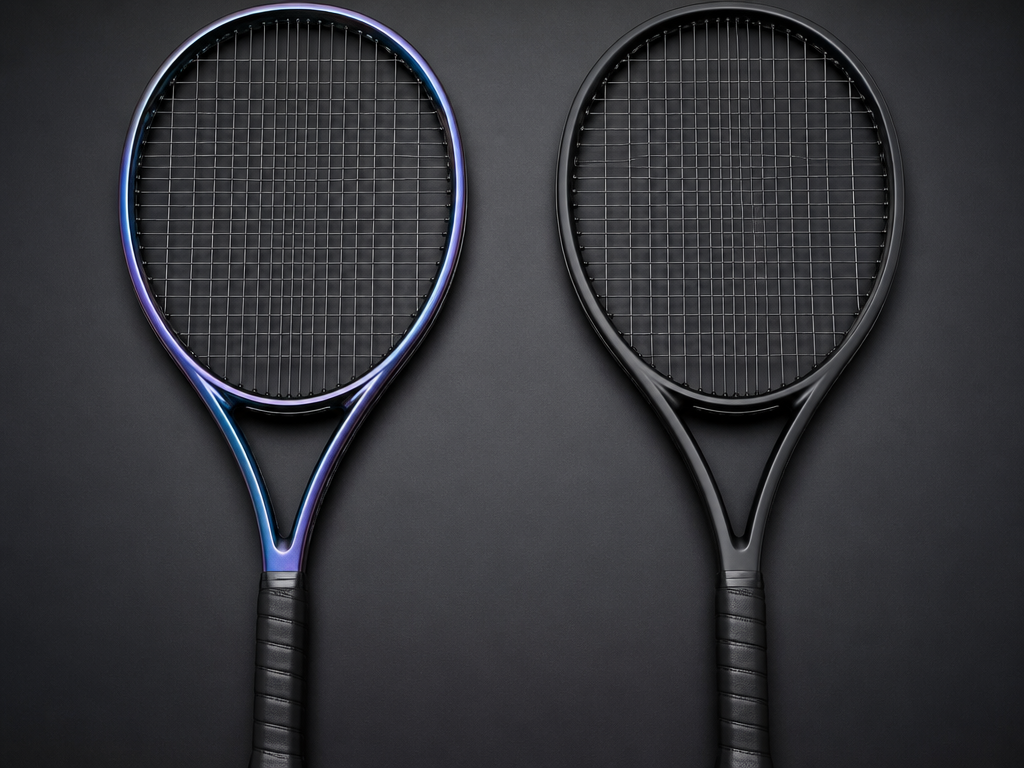
A limited edition drops, the forums light up, and inside a day somebody asks the only question that actually matters: is this a different frame, or a different paint job? When a Babolat Pure Drive racquet shows up in a new finish — prismatic, matte, blacked-out, whatever this season's adjective is — the answer is almost always the second one. That isn't a scandal and it isn't a scam. It's just how composite manufacturing works, and knowing the sequence tells you exactly when to care and when to enjoy the colorway for what it is.
The verdict: a cosmetic-only limited edition is a decision about how you want your bag to look, not about how the ball leaves your strings — and the published spec table is where you confirm that in under a minute.
How we evaluated
We did not hit with anything. This is a synthesis, and the sources are the ones available to anyone willing to read carefully.
We weighed four kinds of evidence, in descending order of how much they settle a question:
- Manufacturer spec sheets. Babolat publishes head size, unstrung weight, balance, length, beam construction and string pattern for each model and generation. For a colorway release, this is the primary document — it states intent, and it's the thing that either changes or doesn't.
- Retailer-published strung specs. Large specialist retailers such as Tennis Warehouse list strung weight, strung balance, swingweight and a stiffness reading. These are shop measurements of sample frames, not manufacturer specifications, and that distinction matters more than it usually gets credit for.
- Independent reviewer write-ups. Useful for whether a generation changed feel. Nearly useless for colorways, because almost nobody runs a blind comparison between two paint jobs of the same mold — and we haven't seen one published.
- Owner reports. Forum threads (Talk Tennis, r/tennis) and retailer reviews are the only place unit-to-unit oddities get flagged. They are self-selected, unblinded, and impossible to weight properly. We treat them as a source of hypotheses, not conclusions.
Where those sources disagree, we say so. Where a figure exists only because a company printed it, we say that too.
First: the mold was frozen long before anyone picked a color
A graphite frame is laid up by hand or machine into a hard mold, cured, and pulled. The things that determine how it plays are decided at that stage: the mold's hoop geometry and beam cross-section, the layup schedule — how many plies of what fiber at what angle — the resin system, the grommet channel positions, and the length. Retooling any of that means new tooling, new curing programs, and a new round of validation.
The paint decision sits downstream of all of it. That's the whole mechanism in one sentence, and it's why a special-edition Pure Drive can be announced with a straight face as unchanged: nothing that was capable of changing was reopened.
Babolat's own naming convention respects the distinction. Generations get dated and re-specced, with the marquee technology renamed when the construction genuinely moves. Colorways get a name and a story. On the standard model, Babolat has long published 300 g unstrung, a 100 sq in head, a 16×19 pattern, 27 inches, and an unstrung balance in the region of 320 mm; retailer measurements of recent generations have put strung stiffness in the low 70s RA. Verify against the current sheet before you quote any of that at someone, because generation numbers move and the figures move with them — but the point stands: a colorway release should reproduce those lines exactly.
Next: the finish goes on — the one place a real difference can enter
Here is where we'll defend the manufacturer less than the forums expect.
Paint and clearcoat have mass, and mass on a racquet is not fungible. Static weight is a scalar; swingweight is a moment of inertia, so mass contributes in proportion to the square of its distance from the pivot. A gram at 12 o'clock does far more to how a frame swings than a gram under the grip. A heavily layered metallic or multi-coat prismatic finish is not obviously the same mass as a thin matte one, and it lands mostly on the hoop.
So: is there a measurable difference between two colorways of the same generation? We don't know, and neither does anyone else publishing on the subject. We have found no apples-to-apples, multi-unit measurement isolating paint mass between finishes of a single mold. Treat the paragraph above as mechanism, not measurement — a reason the effect is not physically impossible, not evidence that it's real or large enough to feel. Anyone telling you the special edition is "three points of swingweight heavier" without a sample size and a scale is telling you a story.
Two smaller things do change at this stage and are worth checking on a limited run: the grommet set and butt cap are often color-matched parts, so confirm replacements are still stocked in a color you can live with, and gloss-versus-matte changes how the throat feels under the off hand. Neither alters the string bed.

Then: the announcement, where the vocabulary inflates
The release copy will reach for a city, a light phenomenon, or a mood. Fine — that's the job. Read past it to the spec block, which is the tell:
- Published specs identical, technology names identical, beam profile identical → cosmetic. Buy it because you like it.
- Any movement in unstrung weight, balance, beam widths, pattern, or length → not a colorway. That's a new frame with a limited badge on it, and it needs the generation review, not the drop post.
The announcement usually arrives with an ecosystem — matching bag, dampener, grip, a string reel in the same palette. The bag and the dampener are honest products; a color-matched bag is a color-matched bag. Just notice that the collection's coherence is doing rhetorical work on the frame, implying a release bigger than a paint change.
Then: retail, where the window is the product
Limited editions land at parity with the standard model or slightly above, and the scarcity is the feature being sold. Run sizes are almost never published. That absence is itself information: without a number, "limited" is a marketing adjective with no denominator, and you cannot distinguish a genuinely small batch from a seasonal colorway that simply won't be reordered.
Last: resale, where cosmetics finally have money attached
This is the stage where paint stops being decorative and starts being priced. The used market does pay for desirable colorways, and that's the strongest practical argument for buying the special edition over the standard one at the same price — you're taking the option on collector demand for free.
But we can't hand you an index. The only data is sold listings, which are noisy, geographically fragmented, and survivorship-biased toward frames that sold at all. What the collector community consistently reports valuing: unstrung and unmounted, original plastic and bag, common grip sizes (Babolat 2 and 3), no stencil, no lead. Whether the premium is 10% or 60% depends on the release, and nobody publishing has the dataset to generalize.
Cosmetic edition vs. the alternatives
| Release type | What actually changes | Published specs | Real upgrade case |
|---|---|---|---|
| Cosmetic limited edition | Paint, grommet/butt-cap color, bag art | Unchanged | None on performance; option value on resale |
| Standard colorway refresh | Paint, mid-generation | Unchanged | None; usually the cheapest way into the mold |
| New generation | Mold, layup, damping tech, sometimes specs | Changed, sometimes subtly | Genuine — demo before deciding |
| Pro-stock / player layup | Mold and layup, often unavailable at retail | Rarely published | Only if you already know your numbers |
Who this is for, and who it isn't
Buy it if: you were replacing a frame anyway and the price matches the standard model; you keep a collection and value scarcity; you want a matched pair and the limited run is what's in stock in your grip size.
Skip it if: you're hoping a colorway addresses something about how your current frame plays. It won't, and the mechanism above explains why it can't. Skip it also if you'll be buying replacement grommets for years and hate the idea of mismatched parts — and skip it if the limited edition carries a premium and you're not in it for resale, because the premium buys finish, not performance.
If your current frame plays the way you want, a colorway isn't an upgrade — it's an accessory with a string bed attached.
Evidence grade
Split, because the sub-claims aren't equally supported.
- Published specs are unchanged across colorways of a generation: Strong. Directly verifiable against manufacturer and retailer spec listings in minutes.
- Therefore two colorways are identical in hand: Moderate. It follows from the manufacturing sequence, but no published multi-unit measurement isolates finish mass, and the physics leaves room for a small effect.
- Limited editions carry a resale premium: Weak. Directionally supported by sold listings and collector behavior; no clean dataset, high variance by release.
The question still open
Here's what none of this resolves, and what we'd most like to see measured. Manufacturers publish a single nominal spec and a tolerance band; matching and customization services exist precisely because frames off the same line differ. Nobody publishes the actual distribution — the spread of strung weight, balance, and swingweight across a real production run of one model in one colorway.
Which means the interesting comparison has never been made. Is the frame you're holding more different from the identical frame beside it on the shelf than this generation is from the last one? If the within-run spread is wider than the between-generation change — and there is no public data ruling that out — then the whole upgrade conversation has been arguing about the smaller number the entire time. Somebody with a scale, a swingweight machine, and thirty frames of one colorway could settle it in an afternoon. As far as we can tell, they haven't.