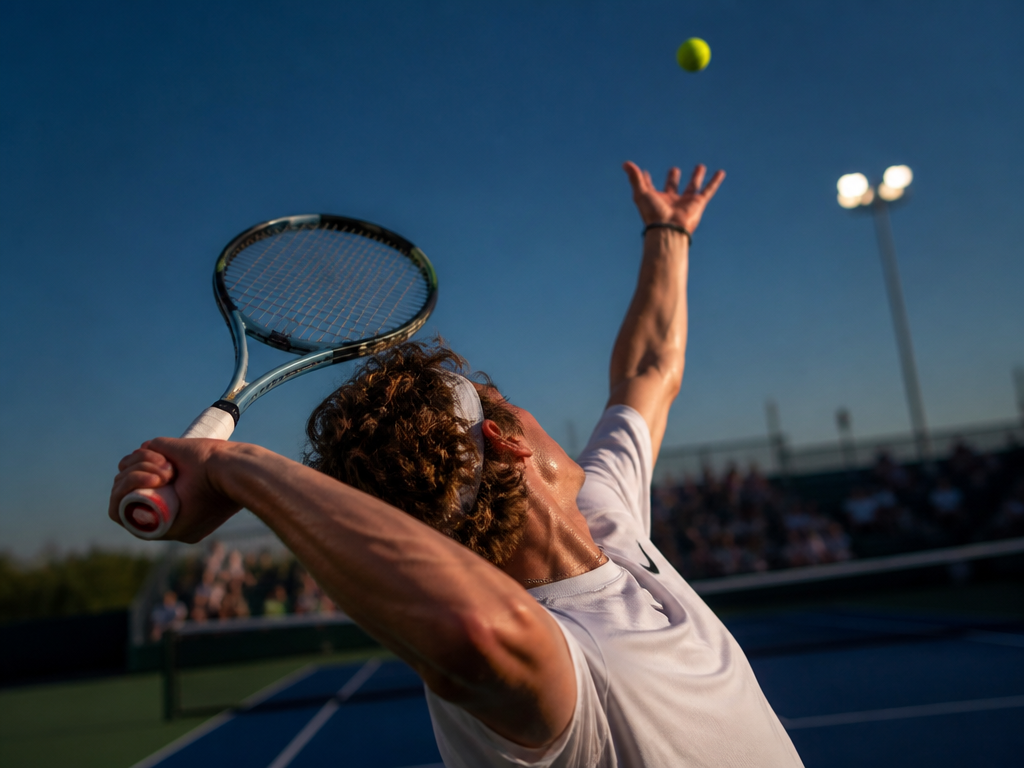
One number should anchor any honest conversation about serve mechanics, and it isn't a radar reading. It's 54 percent — the share of racquet-head speed at impact attributed to internal rotation of the upper arm in Elliott, Marshall and Noffal's 1995 segment-rotation analysis, published in the Journal of Applied Biomechanics. Wrist flexion is usually reported at roughly a further 31 percent. Legs, trunk and shoulder-over-shoulder rotation divide what's left.
Our verdict, up front: the stability-versus-speed trade-off that keeps 3.0–5.0 players stuck is mostly a category error. The two aren't opposite ends of a single dial. They live in different parts of the motion — the base and the toss want more stability, the final link of the arm wants less. Plateaued servers almost always have it reversed: a drifting toss and a rigid arm.
How we evaluated
We didn't measure anything. We read the biomechanics literature on serve mechanics — principally the University of Western Australia group, whose segment-rotation work underpins most modern coaching-science writing — alongside the ITF's coaching and sport-science publications and the recurring pattern in what club coaches and players report about what actually moved their numbers. Where a figure is peer-reviewed we name the study. Where it's coaching consensus we label it as consensus. Where the two disagree, we say so.
Two caveats we applied to every source. First, nearly all serve biomechanics is done on small samples of high-performance players — often fewer than a dozen — because those are the players who can produce a repeatable maximal serve for a camera. Second, a contribution percentage is accounting, not a training plan. Knowing where the speed appears does not tell you what to do to produce it.
What the 54 percent actually measured
Elliott and colleagues filmed skilled servers and used three-dimensional analysis to partition racquet-head velocity, at the instant of impact, among the contributing joint rotations. Internal rotation of the upper arm came out largest by a wide margin. That's the finding, and it has been reproduced in shape, if not in exact value, across later work.
Here's the part that gets lost in translation to the practice court. At serve speed, that internal rotation is not primarily something the player does. The standard reading in the coaching-science literature is that the arm is thrown into external rotation by trunk and shoulder rotation, the internal rotators are stretched under load, and the recoil happens far faster than voluntary effort could drive it. The 54 percent measures the last domino falling. It is not an instruction to push it.
Which is precisely why swinging harder fails, and fails in a specific, diagnosable way. Deliberate muscular effort in the forearm and hand arrives too early and too slowly. It cuts external rotation short, so there is less stretch to recoil from. You spend effort reducing the input to the mechanism responsible for most of your racquet speed.
What the number doesn't measure
Four things — and they happen to be the four a recreational player actually cares about.
It doesn't measure consistency. Racquet-head speed at impact says nothing about first-serve percentage. A serve you land 38 percent of the time is, in match terms, a slower serve than one you land 65 percent of the time.
It doesn't measure the cost of loose. A relaxed arm accelerates better and steers worse. That is the real trade-off, and it is local to the arm — not a property of the whole motion.

It doesn't measure your distribution. Those percentages come from players with an established, sequenced service motion. A 3.5 whose trunk barely rotates may have a genuinely different split, with more of the speed coming from arm effort simply because nothing upstream is supplying any.
It doesn't measure load. Later kinetic work from the same research lineage documents substantial shoulder and elbow loads during the serve, with the internal-rotation phase among the most exposed. Speed bought through arm effort is speed bought with joint load.
Pricing the trade-off
| What you change | Realistic speed effect | Consistency cost | Evidence quality |
|---|---|---|---|
| Grip pressure and arm effort | Meaningful — restores the stretch-and-recoil the 54 percent describes | High at first; steering degrades before it improves | Strong mechanism, moderate direct evidence |
| Toss placement discipline | Indirect — it's what makes everything else affordable | Negative cost; consistency improves | Coaching consensus, thin peer-reviewed support |
| Stance change (platform vs pinpoint) | Small | Low | Elliott and Wood, 1983 — foot-up produced greater vertical drive, ball speeds broadly comparable |
| Trunk rotation and shoulder-over-shoulder | Meaningful | Moderate | Strong |
The stance row is the useful one for anybody who has been sold a technique overhaul. Elliott and Wood's 1983 comparison of foot-up and foot-back service techniques is usually summarised as showing greater vertical force production from the foot-up action without a corresponding jump in ball speed. If you are changing stance to find miles per hour, the evidence says you are changing the wrong variable — pick the stance that keeps you balanced and stop relitigating it.
Where stability actually pays
Toss, and essentially only toss. This is the honest asymmetry in serving mechanics: a toss that varies forces the arm to correct late, late correction requires grip tension, and grip tension is exactly what suppresses the phase carrying most of your racquet speed. Stabilise the toss and a loose arm becomes affordable. Try to loosen the arm on an unreliable toss and you will double-fault your way back into tension inside a set.
That's the sequence, and it doesn't run in reverse.
Who this is for — and who it isn't
For: 3.0–5.0 players whose serve is repeatable but slow, who have tried swinging harder and got sore rather than faster. If your second serve lands consistently and sits up, you have stability to spend, and this trade is available to you.
Not for: anyone whose double faults are already the problem. Below roughly 50 percent on first serves, loosening the arm makes things worse before better, and better may take a season. Also not for players with existing shoulder symptoms — the internal-rotation phase is the loaded one, and deliberately adding range under load is a conversation for a physiotherapist, not an article.
Evidence grade for the central claim — that the speed lives in the arm's last link while stability belongs to the base and toss: Moderate. The biomechanical decomposition is well established in elite samples and mechanically coherent. Its transfer to recreational players is inference rather than measurement, and we found no study testing this trade-off directly at club level.
Tonight, hit ten serves and watch only the toss: if it lands in the same spot every time and your hand still feels tight, loosen the hand — if the toss is wandering, fix that first and leave your grip alone.