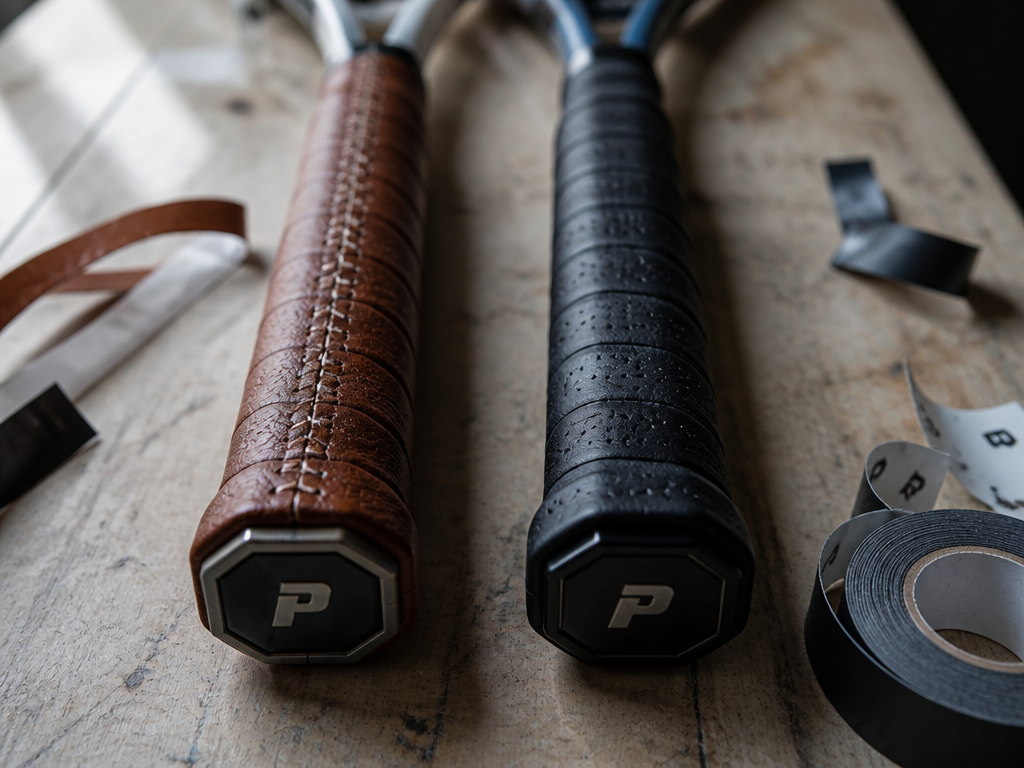
The question that brings most players to leather base grips is not really a question about leather. It is a question about eight to twelve grams — roughly what a leather grip adds over the synthetic one it replaces — and whether that mass buys anything a Level 3+ player can feel on a Tuesday night, or whether it is the racquet equivalent of a heavier watch strap. Here is our verdict in one sentence: the weight is real and its effects are predictable, but almost none of them land where players expect them to — leather moves static weight, balance and recoil resistance while leaving swingweight essentially untouched, and the change owners most consistently report noticing is bevel definition, not power or stability.
That verdict is deliberately narrow. "Worth it" depends on what you are trying to change, and most of the disappointment we see in owner feedback comes from players who bought a grip expecting a different specification to move than the one that actually moved.
How we evaluated
We did not weigh grips on a scale, swing a frame, or run a vibration rig. This piece is a synthesis, and the honest way to open it is to say which evidence we leaned on and how much weight we gave each kind.
Manufacturer and retailer specifications. Wilson, Babolat, Tourna and Gamma all publish or list grip masses and thicknesses for their leather and synthetic lines through their own sites and through major retailers. We treat these as approximate. Grip mass varies with the length of the strip, whether the tacky finish is included, and whether the listed figure includes the finishing tape. The widely repeated "leather adds 8-12 g" figure is consistent across listings, but we could not find an independently verified, brand-by-brand measurement set, and that matters: the difference between a light synthetic and a heavy leather is a bigger gap than the difference between a heavy synthetic and a light leather.
Racquet physics. For anything involving mass, balance and moments of inertia, we relied on the established mechanics as laid out in Brody, Cross and Lindsey's The Physics and Technology of Tennis (2002) and in Rod Cross's racquet-physics material published through Tennis Warehouse University. Where we give a number below, we show the arithmetic and state the assumptions — it is a calculation, not a measurement.
Vibration and arm-health literature. Hennig, Rosenbaum and Milani (1992) measured how racquet vibration transfers to the forearm using accelerometers, and found the transfer depends heavily on grip firmness and handle coupling rather than on the frame alone. Stroede, Noble and Walker (1999) tested string dampeners and found they did not meaningfully reduce frame vibration. Neither study was about grip materials, and we are not going to pretend otherwise — we cite them for what they establish about the handle-to-hand interface generally.
Independent reviewers and owner feedback. Reviewer write-ups and owner reviews are where the subjective claims live. We treat them as directional consensus, not data. They also carry a confound we will come back to: almost nobody hits with bare leather, so most "leather feels harsher" reports are actually reports about leather-plus-overgrip.
Where those sources disagree, we say so rather than picking the tidier story.
What most people do
The standard path runs like this. A player at Level 3 or above starts paying attention to specs, reads that most touring professionals use leather under their overgrips, notices that their own frame feels a little unstable against heavy pace, and concludes that the leather grip is a cheap first step toward a more "player-grade" setup. They order one, wrap it, add an overgrip, and go hit.
The reasoning underneath that path is usually some version of: more mass equals more stability equals more plow-through. It is not a stupid heuristic. It is just aggregated at the wrong altitude. "More mass" is not a specification. A racquet has at least four mass-related numbers that behave independently — static weight, balance, swingweight, and twistweight — plus recoil weight, which is the one that quietly does a lot of the work people attribute to the others. Ten grams added at the butt cap and ten grams added at three-and-nine o'clock in the hoop are the same purchase of lead and completely different racquets afterward.
The second thing most people do is change two variables at once. Leather goes on, a fresh overgrip goes on top, and often the strings are new that week too. Then the frame feels better, or worse, and the grip gets the credit or the blame. This is the single biggest reason owner reviews on leather are so contradictory. A player who swaps from a compressed, three-month-old synthetic to fresh leather plus a fresh overgrip has changed the total handle diameter, the tackiness, the compliance, and the mass distribution simultaneously.
The third pattern is the reverse-engineering one, and it is the most defensible of the three: a player who already wants to add weight in the hoop uses leather as a counterweight so the frame does not end up head-heavy. That player is not really buying feel. They are buying a place to put mass that keeps the balance where they want it. We think this is the strongest genuine use case, and we will come back to it.
What almost nobody does — and what the rest of this piece argues for — is decide, in advance and in writing, which number they are trying to move.
What the evidence suggests
The arithmetic of ten grams
Start with a representative modern player's frame: 315 g strung, balance 32 cm from the butt cap, 27 inches (68.6 cm) long. That balance works out to about 7 points head-light, since the midpoint sits at 34.3 cm and one balance point equals one-eighth of an inch, or 3.18 mm.

Now add 10 g of leather. A grip strip covers roughly the bottom 20 cm of the handle, so its mass centroid sits somewhere near 11 cm from the butt cap. The new balance is:
(315 × 32 + 10 × 11) ÷ 325 = 31.35 cm
That is a shift of 6.5 mm toward the handle, or about two balance points more head-light — our 7-point frame becomes roughly a 9-point frame. Static weight rises about 3%, to 325 g. Both of those are real, both are easy to feel when you pick the racquet up, and neither is what most people bought the grip for.
Swingweight is the number that does not move
Swingweight is measured as the moment of inertia about an axis roughly 10 cm from the butt cap. Mass added at that axis contributes nothing, because the contribution scales with the square of the distance from it. Our 10 g of leather centered at 11 cm sits 1 cm from the axis, contributing 10 × 1² = 10 g·cm², which is 0.01 kg·cm² — arithmetically indistinguishable from zero. Even under a deliberately pessimistic assumption, with all 10 g concentrated at the top of the grip 20 cm up, the contribution tops out around 1 kg·cm².
That is less than one swingweight unit, which is inside the repeatability of most swingweight machines. A leather base grip does not measurably change your swingweight. If your complaint is that the frame gets pushed around by a heavy ball, or that it feels light through contact on a stretched backhand, leather is not the intervention. Lead at 12 o'clock is. Lead at three-and-nine is, and it also moves twistweight, which leather leaves entirely alone because the mass sits directly on the long axis.
What it does change: recoil
Recoil weight — the moment of inertia about the balance point — is where handle mass earns its keep. Using the same numbers, the added 10 g sits about 20.4 cm from the new balance point, contributing roughly 10 × 20.4² ≈ 4,140 g·cm², or about 4.1 kg·cm². Add the small parallel-axis correction from the frame's own mass shifting relative to the new balance point and you land near 4.3 kg·cm². Against a typical modern frame's recoil weight in the neighborhood of 155-170 kg·cm², that is a rise of roughly 2-3%.
This is the honest answer to "does it add stability." Yes, in the specific sense that the racquet resists being knocked backward and rotated about its own center of mass slightly more at impact. It is a real, calculable, low-single-digit improvement. It is not the same thing as the stability you feel on an off-center hit, which is governed by twistweight. And 2-3% is close to the threshold where perception and expectation become hard to separate.
On power: the physics says handle mass does contribute to the effective mass the ball encounters at impact, but that contribution falls off sharply with distance from the impact point, and the butt end of the handle is about as far from the sweet spot as anything on the racquet gets. Treat any claim that leather adds meaningful pace with suspicion.
Feedback, damping, and the arm question
This is where the evidence gets thinner and the disagreement gets louder.
The mechanism is straightforward: leather is a firmer, less compressible interface than a foam or elastomer synthetic. Less compression between handle and palm means more of the handle's motion arrives at your hand. Hennig, Rosenbaum and Milani's 1992 forearm-transfer work supports the general principle that the coupling at the handle governs how much vibration reaches the arm — grip firmness was a significant variable in their measurements. It does not follow that leather is bad for your arm, and no source we found tested grip material against elbow outcomes directly.
What the reviewer and owner consensus does say, fairly consistently, is that leather transmits more information. Players describe knowing where on the stringbed the ball hit without looking. That is the same physical property described in a flattering way. Whether increased feedback is a feature or an injury risk is a question about your arm, not about the grip, and anyone who answers it for you without asking about your elbow history is selling something.
The second reported change is more concrete and less contested: bevel definition. Synthetic grips, especially thicker cushioned ones, round off the octagon. Leather keeps the edges crisp. Players who rely on feeling the bevel to confirm a grip change mid-point — a continental-to-eastern switch at the net, a full western reset — report this as the most noticeable single difference. It is also the one most independent of brand and mass, which makes it the most trustworthy claim in the whole category.
Where sources disagree
Three genuine conflicts are worth naming.
Harshness. A meaningful minority of owners report leather as less buzzy, not more, describing the frame as feeling deadened rather than livelier. Both reports can be true — a firmer coupling transmits more of the low-frequency shock while a heavier handle slightly reduces post-impact recoil. The net sensation appears to be player-dependent, and we would not predict it for you.
The overgrip confound. Almost every leather user runs an overgrip on top, which restores much of the cushioning the leather removed. A leather-plus-overgrip stack and a synthetic-plus-overgrip stack are far more similar than bare leather and bare synthetic. Most comparative feedback you will read online is quietly about the former while being written as though it were about the latter.
Grip size. Leather is commonly described as thinner than a cushioned synthetic, so the swap can leave the handle a touch smaller and rounder in the hand. Reports of needing to go up a size, or add a heat-shrink sleeve, are common but not universal, and the magnitude depends entirely on which synthetic you removed. Do not order a new frame around this.

Leather vs synthetic, on the criteria that matter
| Criterion | Leather base grip | Cushioned synthetic |
|---|---|---|
| Mass (listed, approximate) | Commonly mid-to-high 20s of grams | Commonly mid-to-high teens |
| Effect on swingweight | Under 1 unit — effectively none | Under 1 unit — effectively none |
| Effect on balance | ~2 points more head-light per 10 g added | Baseline |
| Bevel definition | Crisp; edges stay readable | Softened, more so as it compresses |
| Shock and vibration to the hand | More transmitted; firmer coupling | More absorbed |
| Lifespan and cost | Longer service life, higher unit price | Shorter, cheaper, compresses with use |
Mass and thickness figures here are drawn from manufacturer and retailer listings, which vary by brand — check the specific product page for the grip you are considering rather than trusting a category average. The swingweight and balance rows are arithmetic from the worked example above.
What we actually do
When we look at a frame on paper and someone asks where ten grams should go, the order we work in is not "grip first." It is this.
First, name the number. Write down which specification is failing you. "Gets pushed around on returns" is a swingweight and twistweight problem. "Feels whippy but I lose the frame on off-center hits" is twistweight. "Feels heavy and slow late in a match" is swingweight in the wrong direction. "I can't tell where I hit it" is a feedback problem. Only the last one, and the balance-correction case, points at the handle. If your named number is swingweight, a leather grip is the wrong purchase and no amount of it will help.
Second, treat leather as a counterweight, not an upgrade. The strongest case for a leather replacement grip is as the handle half of a two-ended modification. If you want 6-8 g at 12 o'clock or at three-and-nine to fix stability, that mass will drive your balance head-heavy and your swingweight up fast. Ten grams at the butt end restores the balance you liked while adding almost nothing back to swingweight — because of the same distance-squared relationship that makes handle mass useless for swingweight in the first place. This is the one application where the physics unambiguously favors leather, and it is exactly why the pro-stock frames people cite as evidence have leather on them: those frames have been weighted at the hoop first.
Third, change one thing. New leather, old overgrip, same strings, same tension. If you swap the overgrip in the same session you have thrown away your ability to attribute anything, and you will end up contributing to the same muddled body of owner feedback we had to read through to write this.
Fourth, keep the old grip. Leather is a reversible modification and it costs about the price of two overgrips to find out. That is genuinely favorable odds compared with most equipment experiments, and it is the honest reason we do not argue people out of trying it. The failure mode is not expensive, it is just usually uninformative.
Fifth, weigh your own frame before and after if you can. A kitchen scale accurate to a gram settles the mass question for your specific grip and your specific racquet in thirty seconds, which is more than any published category average will do for you. We are working from listings; you can work from your own handle.
Who this is for — and who it isn't
This is for you if you already add lead to the hoop and need a counterweight; if you rely on feeling bevels to confirm grip changes at speed; if your frame is under about 310 g strung and you want static mass without touching swingweight; or if you play with a firm handle grip and want more information about where the ball hit.
This is not for you if your complaint is stability against pace or on off-center contact — that is swingweight and twistweight, and leather moves neither. It is not for you if you have an active elbow, wrist or shoulder issue: the mechanism points toward more transmitted shock, the evidence is a mechanism rather than a trial, and there is no reason to run that experiment on an injured arm. It is not for you if you sweat heavily and dislike overgrips, since bare leather's wet-weather behavior is a recurring owner complaint. And it is not for you if you are hoping for power, which the physics does not support at that distance from the impact point.
The verdict
Leather is not a performance upgrade — it is a place to put mass where it changes balance and recoil without touching swingweight, plus a firmer, more communicative interface between the handle and your hand. Buy it for those two properties and it delivers reliably. Buy it for stability or power and you will be paying eight to twelve grams for a placebo with good reviews.
Evidence grade — Strong for the mechanical claims: the balance shift, the negligible swingweight change, and the low-single-digit recoil increase follow directly from established racquet physics and simple arithmetic, and nothing in the sources contradicts them. Weak-to-Moderate for the feel and comfort claims: the mechanism is sound, reviewer and owner consensus leans consistently one direction on feedback and bevel definition, but no controlled comparison of grip materials was available to us and the overgrip confound contaminates most published impressions.
So, the rule of thumb for tonight: if you cannot name which specification you are trying to move — balance, recoil, or bevel feel — leave the grip alone and put the ten grams somewhere you can actually measure.