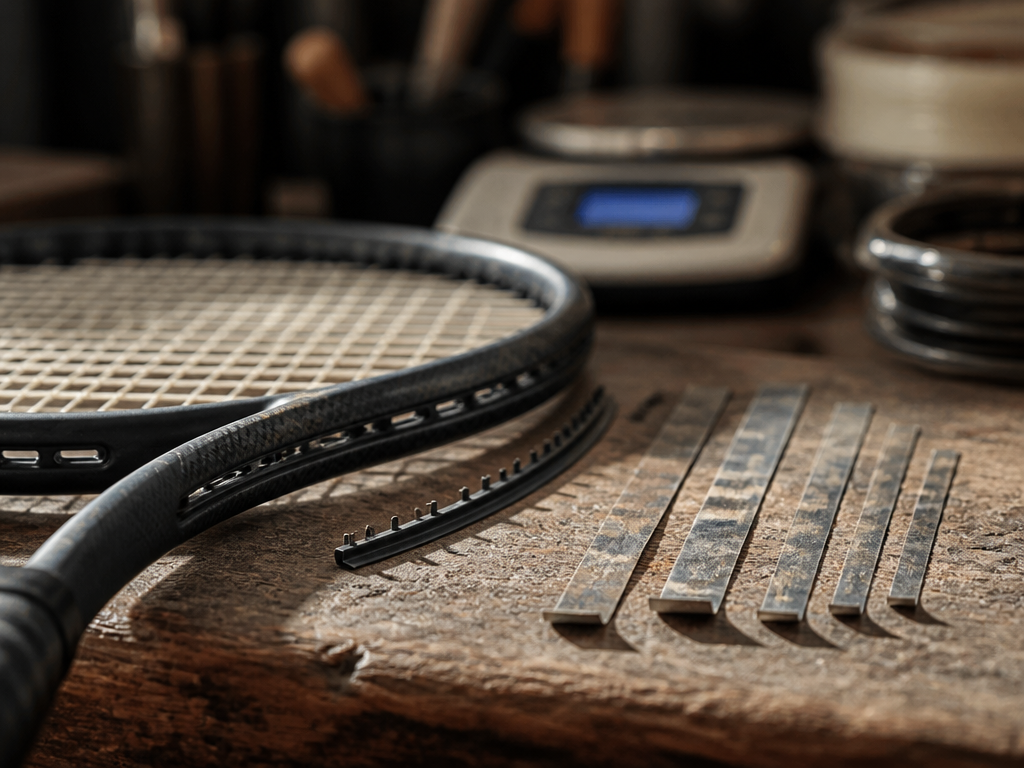
Ask a room of self-tuners what makes a modification reversible and the answer comes back fast: weighted grommets are, lead tape isn't. It is the tidiest claim in racquet customization, and it has the shape of every durable gear myth — right about the annoyance, wrong about the mechanism.
Our verdict: Solinco's weighted grommet kit for the Whiteout series is the better tool for a repeatable weight package and the worse tool for reversibility. Tape comes off in ninety seconds with a fingernail. A grommet strip comes off at a restring, and only if you still own the stock one.
The myth, stated fairly
The version a smart reader has actually heard goes like this: tape peels, so it is a maintenance item; grommets are part of the frame, so the modification is integrated — and you can always put the original strip back. Both halves sound reasonable, and both are describing something real. The error is that they collapse two different properties into one word.
Repeatability is whether you can land the identical mass in the identical place again, restring after restring, without a ruler and a marker. Reversibility is whether you can return the frame to stock cheaply and on demand. Weighted grommets win the first decisively — a molded insert cannot drift two centimetres toward 1 o'clock the way a strip of tape does. They lose the second, because undoing them costs a restring and requires a part that lives in a drawer somewhere.
How we evaluated
We compared published specifications for the Whiteout line, read Solinco's own product materials and the retailer listings that carry the kit, and gathered what independent testers and owners have written about weighted grommet systems and about tape customization generally. We then ran the standard swingweight arithmetic ourselves and show it below, so the mechanism claims can be checked rather than taken on trust.
We did not weigh a kit, string a frame, or hit a ball for this piece. Where the only source for a figure is the manufacturer, we say so. And a limit worth stating up front: owner feedback specific to this kit is thin — much thinner than for lead tape, which has decades of it — which caps how hard we are willing to push any conclusion below.
What the evidence supports
The manufacturer's numbers. Solinco describes the kit as a drop-in replacement for the stock grommet strip, with configurations built around roughly 3 g at 12 o'clock and about half a gram per side at 3 and 9, usable alone or combined. Those are manufacturer-stated figures. We have seen no independent weigh-in of the strips on a jeweller's scale, and until someone publishes one, they should be read as a specification rather than a measurement.
The net-delta question the listings tend to skip. A weighted strip does not add mass to a bare frame; it replaces plastic that was already there. What the racquet gains is the difference between the two parts, not the raw figure on the insert. Manufacturers usually quote the net addition, but listings rarely say which convention they are using — and the distinction moves the swingweight math meaningfully. It is a fair question to ask a retailer before ordering.
What the tape complaints actually are. Across tester write-ups and owner threads, the criticisms of lead tape are consistent and specific: edges lift after a few sessions, adhesive residue accumulates under the bumper, tape migrates as the guard wears, and placement is hard to reproduce exactly once a stringer has peeled it off. Notice what that list does not contain. Nobody complains that tape is permanent. The consensus objection is that it does not stay put — a maintenance problem, and precisely the problem a molded insert solves.
The mechanism: the hole matters more than the gram
Swingweight is conventionally measured about an axis 10 cm from the butt of the racquet, and mass added at a distance r from that axis raises it by approximately m·r². That single relationship explains most of what customization does.
The 12 o'clock grommet holes sit a couple of centimetres below the actual tip, so on a standard 27-inch frame r is around 55 cm. One gram there buys roughly 3 points of swingweight. Three grams buys about 9 — not a subtle tweak, but close to the gap between two adjacent stock models in most manufacturers' catalogues. That is the single most consequential thing the kit does, and it is worth knowing before you fit one and go looking for a feel you did not intend to change.

Now the 3 and 9 option, where the arithmetic is less flattering. Those holes sit around 45 cm from the butt, so r is roughly 36 cm: one gram spread across both sides adds about 1.3 points of swingweight. Twistweight, though, is measured about the frame's long axis, where r is half the head width — five or six centimetres. The same gram contributes on the order of 0.03 kg·cm² against a stock twistweight in the low teens. That is a fraction of a percent. Our honest reading is that a half-gram per side is a small swingweight and static-weight addition often discussed as though it were a stability upgrade. Testers who report feeling it may be feeling the swingweight; the geometry does not support much else. Head width varies by model, so treat these as order-of-magnitude figures from our own calculation, not measurements.
The deeper constraint is placement. A grommet kit puts mass where the holes are. Tape goes wherever you want it — 10 and 2, under the buttcap, an inch above the throat — which is exactly why tape remains the instrument for finding a spec, and a fixed insert is the instrument for holding one.
The four methods, side by side
| Method | Where mass can go | Restring required? | Time to undo | Main failure mode |
|---|---|---|---|---|
| Weighted grommet strip | Only the holes the strip occupies | Yes | One stringing appointment | Stock strip lost; stated gram figure may not be the net delta |
| Lead tape on the hoop | Anywhere on the frame | No | Under two minutes | Peeling, residue, placement drift after service |
| Tungsten putty / weight under the buttcap | Butt end only | No | Minutes | Raises static weight and head-lightness, barely touches swingweight |
| Silicone injected in the handle | Handle interior | No | Effectively never | Genuinely one-way — the actual irreversible modification |
Who this is for, and who it isn't
Fit it if you already know your target spec, restring on a regular schedule, and keep losing placement fidelity in the process — particularly if your frames go to a shop that strips tape without photographing it first. A Whiteout owner who has settled on a 12 o'clock addition and wants it to survive service without re-measuring is exactly the intended buyer.
Skip it if you are still hunting for the spec. Tape is the search tool: cheap, granular to a quarter-gram, and undoable in the ninety seconds between two matches. Skip it also if the change you want is static weight or balance — that lives in the handle, where no grommet can reach. And if you restring twice a year, a modification you can only alter twice a year is not tuning; it is a purchase decision.
The honest takeaway
A weighted grommet kit converts a running maintenance chore into a fixed part number. That is a real benefit and it is worth paying for if repeatability is what has been frustrating you. It is not a reversibility benefit — it trades a modification you can undo anywhere for one you can only undo at a workbench.
And the property both methods actually depend on is the one nobody sells: knowing what stock was. A frame is only restorable if the original spec is written down somewhere and the original part still exists. Lose the note or lose the strip and both methods are permanent, whatever the marketing says.
Evidence grade for the central claim — that weighted grommets are more repeatable but less reversible than lead tape: Moderate. The swingweight mechanism is Strong and independently checkable. The mass figures are manufacturer-stated and unverified. The stability claims at 3 and 9 we grade Weak.
Reviewer's note
I keep the stock grommet strip for my own frame in a labelled bag in the drawer with the awl, and the bag has an index card in it: string pattern, the swingweight the shop measured the week I bought it, and the date. It has never once been the interesting part of owning the racquet. It is also the only reason I can say what "back to stock" means for that particular frame, which is more than I can say for the two before it.