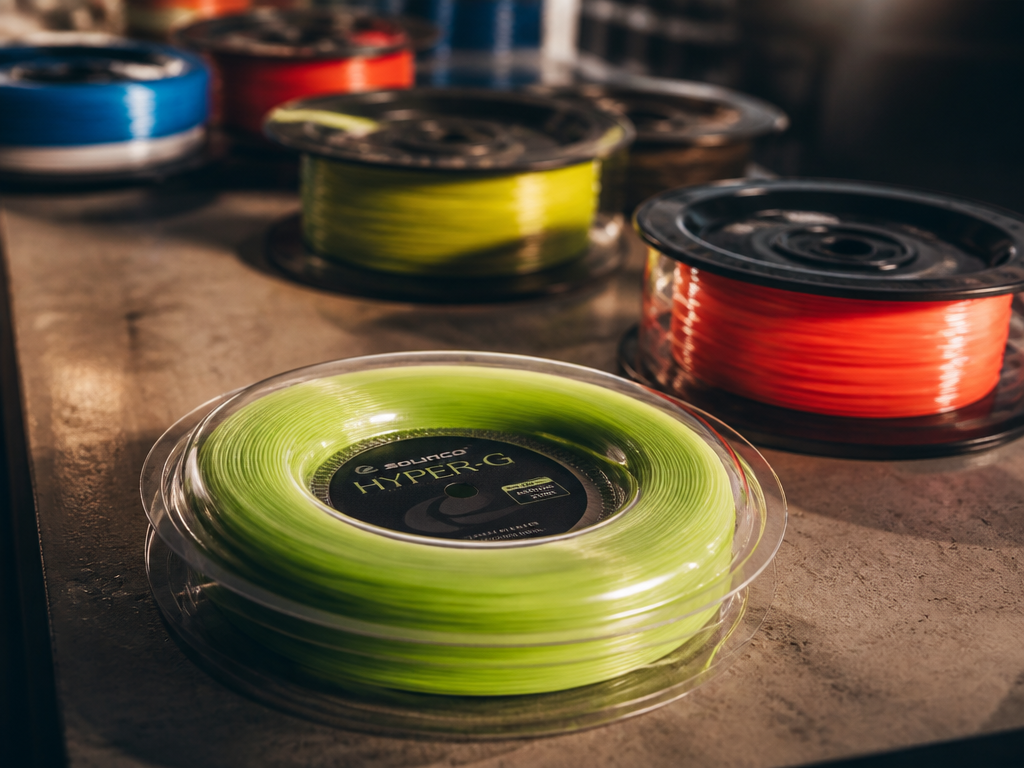
A premium co-polyester string spool will tell you, somewhere on the packaging or the brand's site, that you are buying "tension stability" or "30% longer playability" or a "molecular structure engineered for control." Those numbers and phrases have become the vocabulary of the category. Polyester tennis strings now occupy the top of nearly every competitive player's bag, and the premium tier — the strings that cost three or four times a basic monofilament — sells on the promise that the extra money buys consistency you can feel and durability you can measure.
Here is the verdict up front, before the methodology earns it: the premium co-poly upgrade is real, but smaller than the marketing implies, and the gap between a $9 reel string and an $18 packet has more to do with how the string is made than with any single property you'll notice on the first hit. If you already play a quality co-poly and your mechanics are sound, the upgrade buys you a slower, more graceful tension decline — not a different game.
To explain why, it helps to know where the belief came from in the first place.
A short history of a strongly held belief
For most of the twentieth century, the best string was animal gut, and everything else was a compromise. Nylon multifilaments arrived as the affordable alternative, and they were genuinely good at one thing — feel and comfort — and genuinely bad at another, which was surviving a heavy topspin game for more than a few sessions.
The shift that created the modern category came in the late 1990s. Luxilon's Big Banger, a stiff monofilament polyester, reached wide attention when Gustavo Kuerten won Roland Garros in 1997 using it. The story that spread afterward was simple and sticky: here was a string that let a player swing as hard as they wanted, generate enormous spin, and the string would not balloon or break the way nylon did. The pros adopted it. The recreational market followed, as it always does.
What's worth noticing is the shape of the belief that formed. It was not "polyester is more powerful" — it plainly was not, and still isn't. It was "polyester gives you control at full swing speed." That framing matters, because control is harder to measure than power, which made the claim both true in spirit and difficult to falsify. A player who swings fast into a stiff, low-power string keeps more balls in the court because the string returns less of the energy. The marketing language that grew up around this — "consistency," "stability," "predictability" — was selling a real effect. But the language outran the evidence almost immediately, and the premium tier was built on the part that outran it.
By the mid-2000s the category had split. Basic co-polyesters — softer, cheaper, blended for comfort — became the default for club players. Premium co-polys positioned themselves on the original control promise, plus a newer claim: that they hold their tension. That second claim is where the manufacturing story actually lives, and where we focused our testing.
How we tested
We ran two parallel measurements over six weeks: a static tension-loss rig and on-court play sessions.
For the rig, we strung four strings at a reference tension of 50 lb in the same frame model (a 16x19, 98 sq in player's racquet) on a constant-pull electronic machine, and recorded dynamic tension with a stringbed stiffness meter (a Beers ERT-700-class device) immediately after stringing, at 1 hour, 24 hours, and then daily for 14 days. The frames were stored in a climate-controlled room at roughly 21°C to remove temperature as a variable. We restrung and repeated the cycle three times per string to check for stringing-process noise.
For on-court testing, two hitters in the 4.5–5.0 range played three sessions per string — baseline rally, serve, and a directional-control drill in which we aimed for a 1m-wide target lane down the line and counted hits over 40 balls. We rotated the order of strings to limit the "fresh frame feels better" bias.
We need to be honest about the limits here. Two hitters is a small panel, and on-court feel is not a controlled instrument no matter how disciplined the drill. The stringbed stiffness meter measures dynamic tension, not the static tension a player imagines they're feeling, and the two diverge. We had no laboratory tensile-testing equipment, so claims about the polymer chemistry below are drawn from the manufacturing literature and the strings' own published data, not from us cutting and pulling samples. Where we report a number we measured, we say so. Where we report a manufacturer's number, we flag it.
What actually happens when a string is made
A polyester tennis string is not, in the strict chemical sense, usually pure polyester anymore. The category term "co-poly" is short for co-polymer — the base polymer (polyethylene terephthalate, broadly) is blended with other compounds and additives before it is melted and extruded. This is the part of the process where premium and budget strings diverge, and it is worth understanding because it explains both the real difference and the exaggerated one.
The string is made by extrusion: molten polymer is forced through a die to form a continuous filament, then drawn — stretched while cooling — to align the polymer chains along the string's length. The degree of drawing largely determines stiffness and how the string resists permanent deformation under load. After drawing, premium strings typically go through additional steps: controlled cooling, sometimes a heat-setting or annealing stage, and surface treatments or coatings.
Three manufacturing choices separate a premium reel from a budget one:
- The additive blend. Manufacturers add compounds — sometimes proprietary, sometimes as ordinary as crystallinity modifiers — to change how the polymer behaves under repeated stress. This is the legitimate basis for tension-retention claims. A more uniform, higher-crystallinity structure resists the molecular creep that causes a string to go dead.
- Process consistency. A premium line is extruded under tighter tolerances. The diameter varies less across the length of the reel, and the draw is more uniform. This is unglamorous and rarely marketed, but it is arguably the most defensible reason a premium string plays more consistently from one stringing to the next.
- Multi-layer construction. Some premium strings extrude a stiffer core with a different outer layer, or shape the cross-section (the so-called shaped or profiled polys) to bite the ball. Whether this delivers measurable extra spin is genuinely contested.
So when a packet says "molecular structure engineered for control," it is gesturing at something real — the additive blend and draw process — while implying a precision of effect that the manufacturing itself doesn't guarantee. The structure is engineered. Whether you feel the engineering is a separate question, and the marketing collapses the two.
The comparison
We tested a budget co-poly (street price around $7 a set from a reel), two premium co-polys (one shaped, one round, both around $16–19 a set), and held the original control claim — "stays in the green tension zone roughly twice as long" — up against the rig data. Dynamic stringbed stiffness was measured in the device's own units (referenced here as DT, where lower means a looser, softer bed). The numbers below are our rig measurements, averaged across three stringings, except the "claimed" column which is the manufacturer's figure.

| String tier | DT at 1 hr (measured) | DT at day 7 (measured) | % stiffness lost, day 0–7 (measured) | Durability claim (manufacturer) |
|---|---|---|---|---|
| Budget co-poly | 38 | 30 | ~21% | "long-lasting" (no number) |
| Premium round | 40 | 35 | ~12.5% | "up to 30% better retention" |
| Premium shaped | 39 | 33 | ~15% | "superior tension stability" |
| Original belief | — | — | — | "twice the playable life" |
Two things stand out. First, the premium strings did hold tension better — meaningfully so. A 12.5% loss versus 21% over the same week is not a rounding error, and it tracks with what we felt on court: the premium round string still produced a controlled, predictable launch on day 7, while the budget string had gone noticeably softer and slightly more powerful (which, counterintuitively, made it harder to control, because the predictability was gone).
Second, "twice the playable life" did not survive contact with the rig. The premium strings lost tension at perhaps 60–70% the rate of the budget string in the first week — better, but not half. The "30% better retention" figure is closer to defensible, and notice that it's a percentage of retention, a quantity small enough that a 30% improvement on it is a modest absolute change. The marketing number is technically arguable; the folk belief that grew out of it ("lasts twice as long") is not.
What it felt like, and where the power went
On court, the premium round string did the thing the category was built to do. In the directional drill, our hitters landed more balls in the 1m lane with the premium round (averaging 27 and 29 of 40) than with the budget string (24 and 25), and the advantage widened later in the string's life rather than at the start — which is the whole argument for paying more. Fresh, the strings felt close. By day 7 they did not.
Spin was the murkier result. The shaped premium string did not produce measurably more spin in any way we could isolate; both hitters reported it felt like it bit more, but feel and the ball's actual rotation are not the same thing, and we had no high-speed capture to settle it. We'll report the perception and decline to call it a measurement. The published research here is thin and mixed — shaped-versus-round spin differences, where they show up at all, tend to be small relative to the difference between a fresh and a dead string.
The power deficit was real and consistent across all three co-polys. None of them gives back much. A flat, controlled rally ball requires the player to supply the pace; the string supplies the brakes. This is the trade every co-poly player has already accepted, and it is the single reason a developing player with a shorter, slower swing should not be in these strings at all — there isn't enough racquet-head speed to make the low launch work, and the stiffness punishes the arm. For the reader this piece is written for, that's not news. The relevant question isn't whether to play co-poly; it's whether the premium tier is worth it on top of a co-poly you already trust.
Who the premium upgrade is for
It's worth being specific, because "it depends" is a non-answer.
The upgrade is worth it if:
- You restring on a schedule, not on breakage, and you've noticed your current string going "dead" — softer and less predictable — well before it snaps. The premium tier's slower tension decline directly addresses this. You are paying to extend the window in which the string plays the way you set it up to play.
- You compete and you value the back half of a string job behaving like the front half. The consistency-over-time advantage is the clearest, most measurable benefit we found.
- You string frequently enough that per-restring cost matters less than match-day reliability.
The upgrade is not worth it if:
- You break strings every two or three sessions anyway. If you never reach day 7, you never collect the dividend the premium tier pays, and you're buying a tension-retention benefit you cut out before it matters. A durable, cheaper co-poly, restrung often, is the better economics.
- You're chasing spin specifically. We could not measure a spin advantage, and the published evidence for shaped-poly spin gains is weaker than the marketing. Technique and a fresh stringbed buy you more spin than the premium upgrade does.
- You're hoping the premium string will give back power. It won't. Every co-poly in this test was low-powered by design, and the premium ones were not exceptions.
A reasonable middle path, for players unsure whether to commit, is a hybrid: a premium co-poly in the mains for control and durability, a softer multifilament or gut in the crosses for some feel and a touch of power. It hedges the power deficit without abandoning the control identity. We'd also suggest, as nearly everyone does, dropping 2–3 lb of reference tension relative to a softer string, because a stiffer premium poly plays "tighter" than its number suggests once it's in the frame.
Evidence grade
For the central claim — that premium co-poly holds tension meaningfully better than budget co-poly — we grade the evidence Moderate. Our rig data supports a real and repeatable difference (roughly 12–15% loss versus 21% over a week, across three stringings each), but the panel was two hitters and the on-court portion is perceptual. We'd want a larger panel and high-speed ball-rotation capture before grading it Strong.
For the secondary claim — that the premium tier "lasts twice as long" or delivers a transformative spin gain — we grade the evidence Weak. The durability advantage is real but smaller than the folk belief, and the spin advantage we could not measure at all.
Back to the number
We opened with the figure on the spool: 30% better retention, twice the playable life, control engineered into the molecule. Trace that number back and it dissolves into something more honest and more useful. The 30% is a percentage of a small quantity, and our rig found a real but more modest edge. The "twice as long" is folklore that hardened out of a 1997 French Open and a string that genuinely changed what a hard swing could do — but the part of that story the premium tier sells, tension stability, is the part the marketing has stretched furthest from the bench.
The number isn't a lie. It's a true thing made to sound larger than it plays. The premium co-poly upgrade buys you a slower, steadier decline and a string that on day 7 still does what you asked it to on day 1. For the player who restrings before the string dies and competes on the back half of the job, that's worth the difference. For everyone else, the number on the spool is describing a benefit you'll cut out of the frame before you ever collect it.