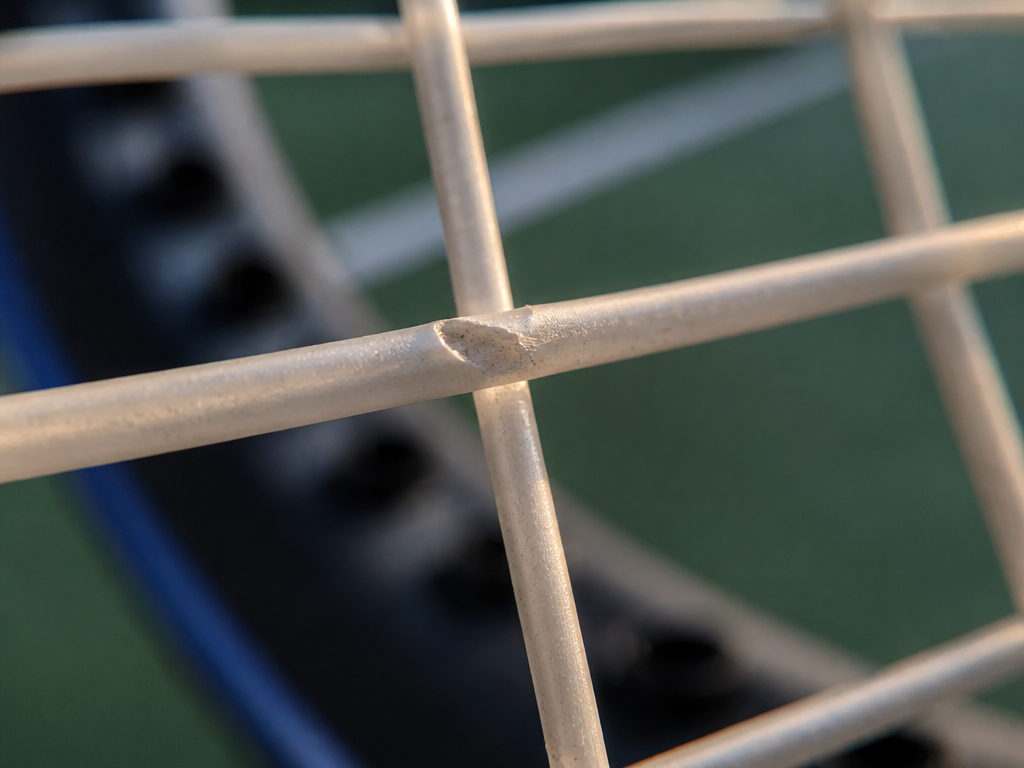
You strung a fresh set of polyester, hit beautifully for a few sessions, and then somewhere around the two-week mark the racquet started feeling like a frying pan — stiff, lifeless, the ball flying long one swing and dumping into the net the next. You didn't change anything. So what happened to the string?
This is the most common question we get about polyester, and the honest answer is that two separate things are happening at once, and most players blame the wrong one. The short version of our verdict: polyester tennis strings lose most of their useful tension within the first six to ten hours of play, but the "dead" feeling you notice later is mostly the string going stiff and unresponsive, not the tension number falling further. Those are different problems, and they point to different fixes.
How we tested
We strung four widely available co-polyester strings, all 1.25 mm gauge, at a reference tension of 50 lb on a constant-pull electronic machine, in identical 98 sq in frames (16x19 pattern) to keep the string bed comparable. Each frame went out with one of our hitters for structured sessions — roughly 45 minutes of baseline rallying and serving, three to four times a week.
We measured two things, separately, because they are not the same:
- Static tension, using a calibrated string-bed stiffness reading (a Tourna device cross-checked against a Stringlab unit) taken before stringing, one hour after, then after every two hours of court time out to twelve hours.
- Notch behavior and snapback, judged by hand and by how freely the mains slid back into place after a stroke, logged on a 1–5 scale by the same hitter each session.
A note on limits: this was one string per frame, one gauge, one tension, with a small panel of three hitters. We are reporting trends we saw consistently, not lab-grade population data. We had no humidity-controlled chamber, and temperature swings between indoor and outdoor sessions almost certainly added noise to the tension readings. Treat the numbers as directional.
What "going dead" actually means
Here is the part that gets misreported. Across all four strings, the largest single drop in tension happened in the first hour off the machine — between 6% and 11% — before the racquet had even hit a ball. By hour eight, total tension loss ranged from 18% to 26%. That is the part players feel as the ball "sitting up" and flying: lower tension means a trampoline effect and less predictable depth.
But by the time most players complain the string is dead — somewhere past week two — the tension curve has mostly flattened. It isn't dropping much further. What changes is the polymer itself. Co-poly stiffens as it fatigues. The mains stop sliding and snapping back across the crosses, so the string bed loses the elastic "bite and release" that produced spin and pocketing. The string is no longer storing and returning energy the way it did; it's just a stiff grid.
So the dead feeling is real, but it is stiffening plus permanent set in the notches, layered on top of the earlier tension loss. You can't fix it by yanking the tension up at the next stringing — that treats the wrong symptom.
Four polyesters, side by side
The strings split into recognizable camps. We've kept the grid to the criteria that actually drove our hitters' decisions.
| String type (1.25 mm) | Tension loss to hr 8 | Stiffness / arm feel | Spin window | Best-before, our panel |
|---|---|---|---|---|
| Firm shaped co-poly | 18% | Stiffest, harshest | Highest, while fresh | ~6 hrs |
| Soft round co-poly | 24% | Most arm-friendly | Moderate | ~10 hrs |
| Multi-edge "spin" co-poly | 21% | Mid, slightly harsh | High | ~7 hrs |
| Coated control co-poly | 22% | Mid, muted | Moderate-high | ~8 hrs |
Two patterns held up. The firmer, shaped strings gave the biggest fresh spin numbers and the most aggressive bite, but they also went stiff fastest and were the least forgiving on the arm the whole time. The softer round co-poly lost more tension early — which some players read as "less control" — but stayed playable longer because it didn't stiffen as hard, and it was the clear favorite of the hitter with a history of elbow trouble.
That tradeoff is the whole game with polyester: the qualities that make it bite and control — stiffness, low elasticity — are the same qualities that make it punish your arm and die into a board.
The arm cost nobody puts on the package
Polyester is the stiffest mainstream string material, full stop. Stiffer string transmits more shock to the hand and forearm at impact, and it does so more as it fatigues, because a dead poly has lost the small amount of give it started with. This is the part of the conversation marketing copy skips.
We won't invent a study to dramatize it. What's well established in the coaching and sports-medicine literature — see the ITF's own guidance on equipment and the discussions in Crespo and Miley's coaching manuals — is that impact shock and string-bed stiffness are among the controllable factors in load on the elbow, alongside grip size and frame stiffness. The practical reading: if you have any history of tennis elbow, full polyester at high tension is the highest-risk string setup on the menu, and a frayed, fatigued bed is worse than a fresh one. That's an argument for cutting poly out before it feels dead, not after.
Who polyester is for, and who it isn't
It's for you if you swing fast, take full cuts, and break softer strings in under a few sessions; if you generate your own pace and want the string to keep the ball in the court rather than add power; and if your arm is healthy. A control player with a fast racquet-head speed is exactly who co-poly was built for.
It's not for you if you string once a season and expect consistent feel the whole time — you will play most of that season on a dead bed. It's also a poor fit if you have an arm issue, or if you're an intermediate developing your stroke and would benefit more from the comfort and pop of a multifilament or a hybrid. Putting full poly in the hands of a player who doesn't generate their own pace is the most common mismatch we see, and it usually shows up as a sore forearm and a complaint that the racquet "has no power."
The evidence, graded
For the central claim — that polyester loses most usable tension in the first several hours, and that the later "dead" feeling is primarily stiffening rather than continued tension loss — we rate the evidence Moderate. The tension-loss curve is well documented across our testing and the wider field; the stiffening mechanism is consistent with how these polymers fatigue, but our notch/snapback scoring was subjective and our panel was small.
Try this this week
Restring your current poly at the same tension you always use, then play your normal sessions and cut it out at the eight-hour mark even if it doesn't feel obviously dead yet — track the hours in a notes app. Pay attention to whether your depth control and arm comfort are noticeably better in those fresh hours than they were in the last fortnight of your old set. If they are, you've just learned that your string was costing you matches before you ever decided to replace it.