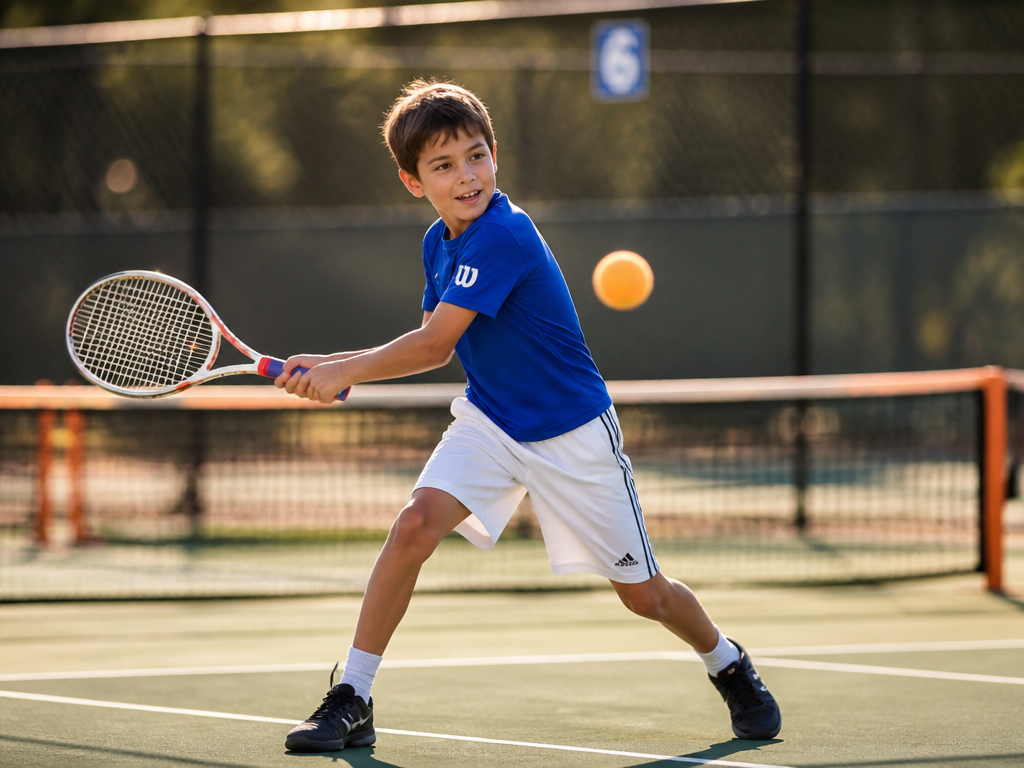
The "official" color of a standard tennis ball is not the one most people would name on the spot. The International Tennis Federation calls it yellow. Ask a room full of casual players and a healthy share will say green. Both groups are looking at the same ball. We started here because the confusion over the canary fuzz on a regulation ball is a smaller version of the confusion that sends tennis parents back to the rack three times: nobody told them that tennis ball colors carry actual meaning, and that the red, orange, and green balls hanging beside the standard ones are a graded system, not a marketing gimmick.
The verdict up front: for a child aged 4–12, the ball color you want is set by age and court size — red foam or red felt under 8, orange from roughly 8 to 10, green dot from 10 to 11 — and the familiar yellow ball is the last step, not the first.
The yellow-vs-green question, settled enough
The ITF's Rules of Tennis specify that the ball "shall be a uniform surface and be white or yellow in colour." Yellow entered the picture for visibility on color television; the 1972 standardization is why Wimbledon, steeped though it is in white-clothing custom, plays with yellow balls today. So the rulebook is unambiguous: yellow.
Why do so many people see green? Because perception is genuinely split. The fluorescent "optic yellow" pigment sits right on the yellow-green boundary, and lighting, screen calibration, and the words your brain learned as a child all nudge the answer. A widely shared 2018 social poll found respondents split nearly down the middle. There is no ground truth to win this argument with — only the label on the can and the rule it follows. We say yellow. We will not die on the hill.
What matters more for a parent is that the other colors are not opinion. They are regulated.
How we sorted the junior system
We are not pretending to have run a randomized trial on six-year-olds. What we did was cross-check three things and only report where they agree:
- The ITF specifications for Stage 3 (red), Stage 2 (orange), and Stage 1 (green) balls, which define rebound and compression for each.
- The USTA 10 and Under Tennis framework, which maps ball color to court length and racquet length by age.
- The printed specs from Penn, Wilson, and Dunlop junior lines, checked against those two references for consistency.
Where a manufacturer's age band disagreed with the USTA guidance, we deferred to the governing-body number and flagged the gap. Court dimensions below are the published USTA values, not estimates.
The junior color ladder
The whole system exists to fix one problem: a standard yellow ball bounces too high and travels too fast for a small player on a full court, so the child learns to wait at the back fence and swat. Slower, lower balls keep the ball in the strike zone long enough to actually swing at it.
| Color (ITF Stage) | Typical age | Speed vs. standard | Court length | Racquet length |
|---|---|---|---|---|
| Red (Stage 3) | 4–8 | ~75% slower | 36 ft | 19–23 in |
| Orange (Stage 2) | 8–10 | ~50% slower | 60 ft | 23–25 in |
| Green (Stage 1) | 10–11 | ~25% slower | 78 ft (full) | 25–26 in |
| Yellow (standard) | 11+ | Full speed | 78 ft (full) | 26–27 in |
A few specifics that the table flattens:
Red comes in two forms. Foam red balls are large, light, and very slow — the right call for the 4–6 crowd and indoor or hard-floor play. Felt red balls bounce a little truer and suit the older end of the red band on a proper court. Both are roughly a quarter of standard ball speed.
Orange is the stage parents skip most often, jumping a child straight from red to a yellow ball because the green dot "looks normal." It is the wrong move. The 60-foot court and the half-speed ball are where stroke mechanics get built; rushing past it tends to produce the back-fence swatter the system was designed to prevent.

Green dot balls are full-size and look nearly identical to standard yellow ones — the green marking is the only tell. They play on a full court at about 75% pressure. This is the bridge to adult equipment, not adult equipment itself.
Pressurized or pressureless for kids?
For juniors specifically, pressureless balls earn their keep. A pressurized ball goes dead within a week or two of regular hitting as gas escapes the core; a pressureless ball relies on the rubber wall itself, so it holds its bounce for months. Children do not need tournament-grade liveliness, and a basket of pressureless red or orange balls survives a season of being stepped on, left in the car, and lost in the hedge. The trade-off is a slightly heavier, harder feel as the felt wears, which matters to advanced adults and not at all to a seven-year-old.
Who this guide is for — and who it isn't
This is for you if you are buying for a 4–12 player and want to match the ball to the child rather than to the rack. Use age and court size as your guide, default to pressureless for durability, and resist the urge to graduate early.
This is not for you if you are an intermediate-or-better adult choosing match balls. Your decision is about pressurized ball brand, felt type, and altitude — high-altitude balls have a lower internal pressure to counter thin air, which is a separate conversation from the color ladder entirely.
The clear pick for most parents of under-8s: a bag of pressureless red felt balls, with a few foam reds for the youngest. It covers the widest age range, lasts longest, and costs least per session.
The bin of dead balls in your garage
Here is the genuinely useful part nobody prints on the can. A ball that has gone dead for tennis is still a dense, grippy, hollow rubber sphere — which makes it quietly excellent at other jobs.
- In the dryer. Two or three balls bounce around with the laundry, separating wet clothes and breaking up clumps so things dry faster and come out softer. Wrap a worn pair in a pillowcase if you would rather not chase loose fuzz.
- On chair and walker feet. Cut an X in one side and slide a ball onto the leg of a walker or a classroom chair. It glides instead of scraping, and the noise reduction in a room full of chairs is not subtle. This is a long-standing accessibility hack, not a novelty.
- As a muscle roller. Pressed under a foot or against a wall behind a shoulder blade, a dead ball does honest work on a tight spot. Two balls taped together make a passable spine roller.
- For the dog. The obvious one, with one caveat: a strong chewer can shred the felt, and the fibers are not meant to be swallowed. Supervise, and retire the ball when it starts to come apart.
None of this saves a ball for tennis. All of it keeps a perfectly good rubber object out of the bin a while longer, which is the most you can ask of something that has already given you its bounce.
Evidence grade
For the central claim — that ball color should be matched to a child's age and court size, and that the junior color system meaningfully slows the ball — we grade the evidence Strong. The color-to-stage mapping is defined in ITF specifications and the USTA 10 and Under framework, and the manufacturer specs we checked were consistent with both. The one honest soft spot is the exact age bands, which are guidelines that real children cross at their own pace; treat them as ranges, not gates.
The yellow-versus-green question we leave Unclear, by its nature. The rulebook says yellow. Your eyes get a vote, and they may overrule it.
Buy the color that fits the kid, not the one that looks grown-up. The bounce will tell you the rest.