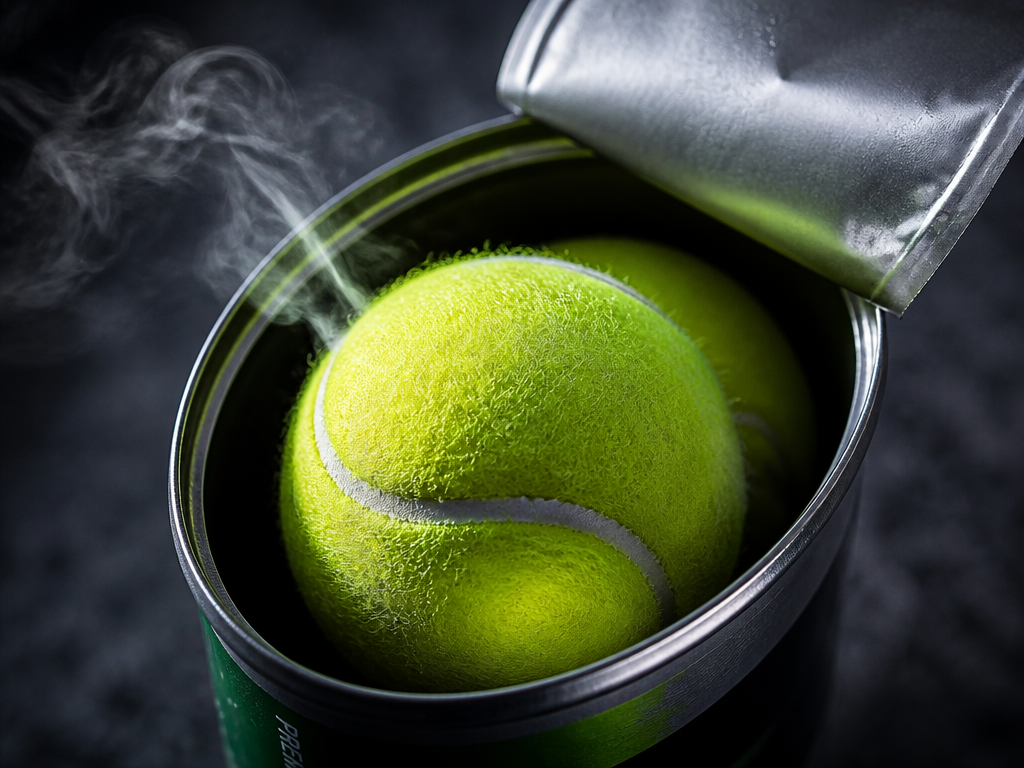
Open a fresh can and you hear it: a short hiss, then nothing. That hiss is roughly 12 to 14 psi of internal pressure equalizing with the room. The can is not packaging in the ordinary sense. It is a pressure vessel built to keep the air inside the balls from leaking out before you buy them.
Most tennis balls sold for adult play are pressurized — a sealed core holding gas at higher pressure than the surrounding air. That pressure is what makes a new ball lively. It is also what makes a can of tennis balls a perishable product, more like a carton of milk than a set of golf balls. Understanding that one fact explains the hiss, the bald-looking ball that still bounces, and the lively-looking ball that doesn't.
Why do tennis balls come in a pressurized can
Tennis balls come in a pressurized can because the ball itself is pressurized, and the can keeps it that way. The rubber core is filled with air (or a nitrogen-rich mix in some brands) at around 12 to 14 psi above atmospheric pressure. Rubber is not a perfect seal. Gas slowly diffuses out through the walls of the core whether the ball is being hit or sitting on a shelf. By pressurizing the can to a similar level, the manufacturer cancels out the pressure difference, so almost no gas escapes until the seal is broken. The hiss is the can losing its pressure advantage. From that moment, the clock starts.
What actually happens, in order
The decline of a tennis ball happens in a sequence, and the sequence is the part most people get backward.
First, internal pressure drops. This begins the instant the can opens and continues every day after, faster once the ball is struck repeatedly. Each impact briefly deforms the core and accelerates diffusion. This is the change you feel as the ball going "dead" — lower bounce, a duller sound, more effort needed for the same depth.
Second, the felt wears. The wool-and-nylon felt fluffs up with early use, then abrades down against the court. Fluffed felt adds air drag and slows the ball slightly; worn-smooth felt does the opposite. Felt condition affects how the ball travels through the air and grips the strings, but it is largely independent of bounce.
The practical consequence: a ball can look terrible and still play fine, or look fine and play dead. A ball that has sat in an opened bag for three weeks may have a respectable nap and almost no bounce left. The fuzz is the part you can see. The pressure is the part that matters most, and you cannot see it at all.
What the evidence suggests
The numbers here are not folk wisdom. They are written into the rules.
The International Tennis Federation specifies that a regulation ball, dropped from 254 cm (100 inches) onto concrete, must rebound between 135 cm and 147 cm. That bounce window — well-established and tested at ITF facilities — is the closest thing to an objective definition of a "good" ball. A ball that bounces below 135 cm from that drop has failed, regardless of how it looks. The ITF also sets mass (56.0 to 59.4 grams) and diameter (6.54 to 6.86 cm) for the standard Type 2 ball.
What the rules do not do is tell you how long a ball stays in that window after the can opens. That depends on use. The widely repeated guidance is that a pressurized ball plays its best for one to three hard sessions and noticeably fades within a couple of weeks of opening, even unused, as diffusion continues. We'd file the specifics here as plausible but loosely measured: the diffusion physics is sound and uncontested, but exact "shelf life after opening" figures come mostly from manufacturer guidance rather than published independent testing.
There is a second category worth knowing. Pressureless balls have a solid or thicker rubber core and rely on the rubber's own elasticity rather than internal gas. They start slightly stiffer and less lively than a fresh pressurized ball, and — this is the useful part — they do not go dead. There is no pressure to lose. Their decline comes almost entirely from felt wear over months. They are heavier-feeling on the string bed, which some players dislike, but for ball machines, hitting walls, and high-volume practice, the economics favor them clearly.
Different play levels are served by different balls, and the categories are regulated rather than marketing inventions:
| Ball type | Who it suits | Key trait |
|---|---|---|
| Pressurized (Type 2 standard) | Match play, club and competitive | Liveliest, but perishable once opened |
| Pressureless | Ball machines, walls, frequent practice | Slow to die, stiffer feel |
| Stage 3 / Red (foam or low-compression) | Ages ~5–8, smallest courts | ~75% slower, lower bounce |
| Stage 2 / Orange | Ages ~8–10 | ~50% slower than standard |
| Stage 1 / Green | Ages ~10+ transitioning | ~25% slower, near full size |
The youth stages are not "easier toys." They are engineered to bounce lower and travel slower so a developing player can actually rally at a contact point near waist height instead of chasing balls over their head. The slower ball is the point.
An honest rule of thumb
Retire a pressurized ball when it feels dead, not when it looks bald. Tap-bounce two balls on a hard floor side by side — a fresh one and the questionable one. If the old ball's rebound is visibly and audibly lower, its pressure is gone and no amount of intact felt will bring it back. For practice that doesn't need tournament liveliness, switch to pressureless and stop buying cans you only half-use.
What we actually do
A reviewer note, in the first person, because this is preference as much as physics.
For matches I open the can the same day I play, not the night before. The difference between a same-day can and a two-day-old opened can is small but real on serve depth, and it costs nothing to time it right. I don't store opened balls expecting them to keep — once the seal is broken, they are on the clock no matter how careful I am.
For the ball machine and wall sessions, I use pressureless exclusively. A bucket of them outlasts a dozen cans, and the slightly heavier feel stops mattering after the first basket. For my own kids learning the game, I use the stage balls without apology, because watching a seven-year-old rally ten balls in a row with a red foam ball is more instructive than watching them whiff a fast yellow one.
The pressurized can earns its keep for one job: a fresh, lively ball when the result matters. Outside that, it's an expense that quietly leaks away.
That hiss you hear opening the can is the sound of the manufacturer handing you the pressure they spent the supply chain protecting. It is not a guarantee of a great ball for a month. It is the starting gun on the only number that truly defines how a ball plays — and the moment to decide whether this is a can you actually need, or a bucket you should have bought instead.